
Best Fake Hardwood Floors 2025: Top 7 Stunning Picks Reviewed
The Evolution of Wood-Look Flooring
Best fake hardwood floors have revolutionized the flooring industry by offering remarkable alternatives to traditional hardwood at a fraction of the cost. If you’re looking for quick recommendations, here are the top options based on our extensive research:
- Luxury Vinyl Plank (LVP) – Best overall for waterproof durability and realistic appearance
- Laminate Flooring – Best value with improved water resistance and easy DIY installation
- Engineered Hardwood – Best premium option with real wood veneer and stability
- Wood-Look Tile – Best for high-moisture areas and extreme durability
- Bamboo – Best eco-friendly alternative with natural hardness
The quest for the perfect floor often leads homeowners to the timeless beauty of hardwood, but concerns about cost, maintenance, and durability in challenging environments can be significant barriers. Modern technology has created impressive alternatives that capture the warmth and character of genuine hardwood while addressing these limitations.
Today’s fake hardwood options offer remarkable advantages: waterproof protection for kitchens and bathrooms, improved scratch resistance for active households with pets and children, and simplified maintenance routines that fit busy lifestyles. Many options are also more environmentally sustainable and budget-friendly than harvesting hardwood trees.
I’m Francisco Romero, owner of Romero Hardwood Floors Inc., and with over 15 years of experience installing both traditional hardwood and the best fake hardwood floors, I’ve witnessed how these alternatives have transformed homes throughout Revere, MA and beyond.
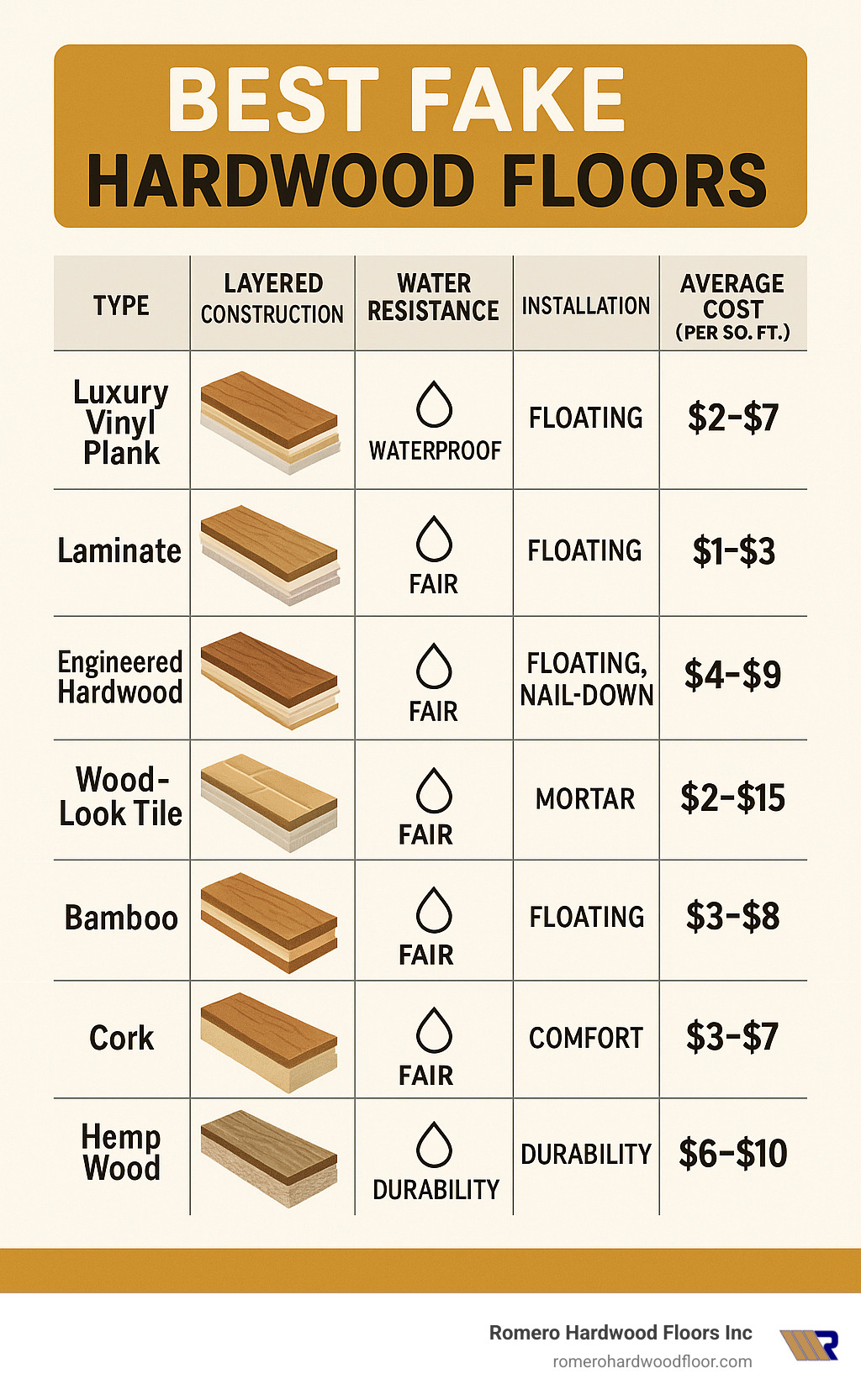
Terms related to best fake hardwood floors:
– Engineered vs solid hardwood
– best solid hardwood flooring
– best wood floor for kitchen
What Are Fake Hardwood Floors & How They Stack Up
Remember the first time you walked into a home with gleaming hardwood floors? There’s something magical about that warm, natural beauty underfoot. But what if I told you that stunning floor might not be real hardwood at all?
Fake hardwood floors (or wood-look flooring) are clever imposters designed to capture the timeless appeal of natural hardwood while solving many of its practical challenges. Unlike solid hardwood cut from a single piece of timber, these alternatives are engineering marvels composed of multiple layers that work together to create both beauty and performance.
The wood-look family has grown impressively over the years, with several distinct members:
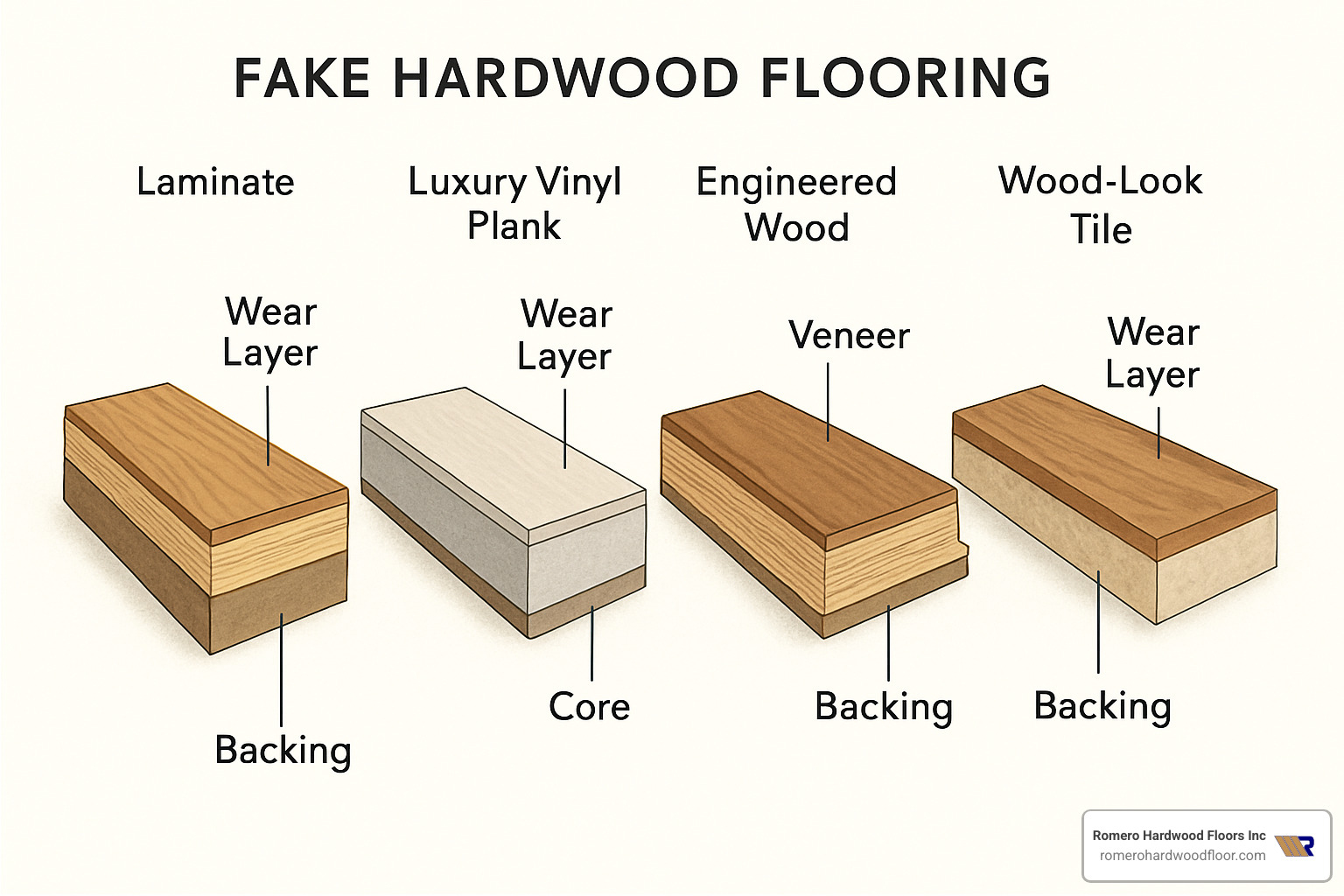
Laminate flooring pairs a high-density fiberboard core with a photographic layer showing detailed wood grain, all protected by a clear wear layer. Think of it as a hardwood photograph with serious durability credentials.
Luxury vinyl plank (LVP) takes a different approach with its vinyl core and remarkably realistic printed design layer. The star performer for moisture resistance, it’s become the go-to for bathrooms and basements.
Engineered hardwood offers the best of both worlds – a stable plywood or fiberboard core topped with a genuine slice of real hardwood. It’s the closest to the real thing because, well, the surface actually is real wood.
Wood-look tile brings ceramic or porcelain into the mix, with incredibly realistic wood grain printing. It’s practically indestructible and perfect for homes in hot, humid climates.
Alternative materials like bamboo, cork, and hemp aren’t technically “fake” wood, but they serve as sustainable hardwood alternatives with their own unique benefits.
But how do these options really compare to the real thing? Let’s break it down:
| Feature | Solid Hardwood | Laminate | Luxury Vinyl Plank | Engineered Wood | Wood-Look Tile |
|---|---|---|---|---|---|
| Water Resistance | Poor | Good (some waterproof) | Excellent (100% waterproof) | Moderate | Excellent |
| Scratch Resistance | Moderate | Very Good (AC3-AC5) | Good to Excellent | Moderate | Excellent |
| DIY Installation | Difficult | Easy | Easy | Moderate | Difficult |
| Lifespan | 50+ years | 15-25 years | 15-30 years | 20-40 years | 50+ years |
| Refinishing | Multiple times | Not possible | Not possible | 1-3 times | Not possible |
| Cost Range* | $5-$15/sq ft | $1-$5/sq ft | $2-$8/sq ft | $3-$10/sq ft | $3-$12/sq ft |
| Comfort Underfoot | Warm, solid | Firm | Slightly yielding | Similar to hardwood | Hard, cold |
*Note: These are average costs based on internet data and not actual costs for Romero Hardwood Floors Inc.
The sustainability story is particularly interesting for some newer alternatives. Hemp flooring, for example, can be harvested after just 120 days compared to the 40+ years needed for hardwood trees to mature. Even more impressive, hemp absorbs four times more carbon during growth and produces more flooring material per acre than traditional timber. According to scientific research on hemp sustainability, it’s becoming an increasingly attractive eco-friendly option for environmentally conscious homeowners.
Fake vs. Real: Quick Jargon Buster
Shopping for best fake hardwood floors can feel like diving into alphabet soup. Let me translate some of the terms you’ll encounter:
Solid hardwood is exactly what it sounds like – 100% natural wood throughout the entire plank, typically 3/4″ thick. It’s the original, the classic, the real deal.
Veneer refers to that thin slice of actual wood (usually 1/16″ to 1/8″ thick) that tops engineered hardwood. This is what gives engineered wood its authentic look and feel.
The wear layer is your floor’s bodyguard – that transparent protective coating on laminate and vinyl floors that determines how much abuse your floor can take before showing damage.
AC rating is laminate’s durability score card. Think of it like this: AC3 is good for a living room, AC4 can handle a busy kitchen, and AC5 can probably survive a kindergarten classroom. Higher numbers mean better scratch resistance.
SPC/WPC core refers to what’s inside your luxury vinyl planks. SPC (Stone Polymer Composite) is harder and more durable, while WPC (Wood Polymer Composite) feels a bit softer and more comfortable underfoot.
Pattern repeat tells you how many planks you’ll see before the wood grain design starts repeating itself. Higher numbers (like 10-12 planks) create more natural-looking floors with less obvious repetition.
Click-lock is the ingenious interlocking edge system that allows floating installation without glue or nails. It’s what makes many fake hardwood options so DIY-friendly.
After 15+ years of installing both real and fake hardwood floors throughout Revere and beyond, I’ve seen how these alternatives have transformed from obvious imposters to sophisticated look-alikes that sometimes fool even the trained eye. The technology just keeps getting better, bringing the timeless beauty of wood within reach for more homeowners, regardless of lifestyle or budget constraints.
Ranking the Best Fake Hardwood Floors in 2025
After installing thousands of floors throughout Revere, Beverly, Chelsea, and across Massachusetts, I’ve developed some strong opinions about which best fake hardwood floors truly deliver outstanding value and performance. Here’s my honest ranking for 2025, based on what I’ve seen work best in real homes:
Why Laminate Is Still One of the Best Fake Hardwood Floors
Laminate flooring has undergone a remarkable change in recent years. The products I’m installing today barely resemble the obvious fakes from a decade ago.
Modern laminate captures authentic wood beauty through high-resolution photography that reproduces every grain, knot, and character mark with stunning accuracy. The surface texturing has also improved dramatically – you can now feel wire-brushed grain, hand-scraped edges, and natural wood variations under your fingers.
What really impresses homeowners is the durability. Look for AC ratings between 3-5, with AC4 and AC5 offering exceptional resistance to daily wear. Many of my clients with active kids and pets are amazed at how well quality laminate holds up to their chaotic households.
The water-resistance technology has also taken a huge leap forward. Today’s premium laminates feature tight-locking joints and sealed edges that can withstand spills for an hour or more without damage. Many include attached underlayment pads that not only simplify installation but also improve sound absorption – a common complaint with older laminates.
At $1-$5 per square foot (based on internet averages), laminate delivers remarkable value. The best products now include 10-12 unique plank designs before repeating, eliminating that artificial “copy-paste” look that once made fake wood floors so obvious. Learn more about Laminate Wood Flooring.
LVP: Waterproof Champion Among Best Fake Hardwood Floors
Luxury Vinyl Plank (LVP) has become my most-recommended option for many households, especially those with moisture concerns. Its 100% waterproof construction handles everything from small spills to major pet accidents without flinching.
What makes LVP stand out is its perfect balance of beauty and practicality. The wear layers (measured in mil thickness) provide exceptional protection, with 12-22 mil recommended for busy homes. The slight give underfoot makes it more comfortable than harder surfaces, while the authentic wood visuals range from classic oak to exotic species that would cost a fortune in real wood.
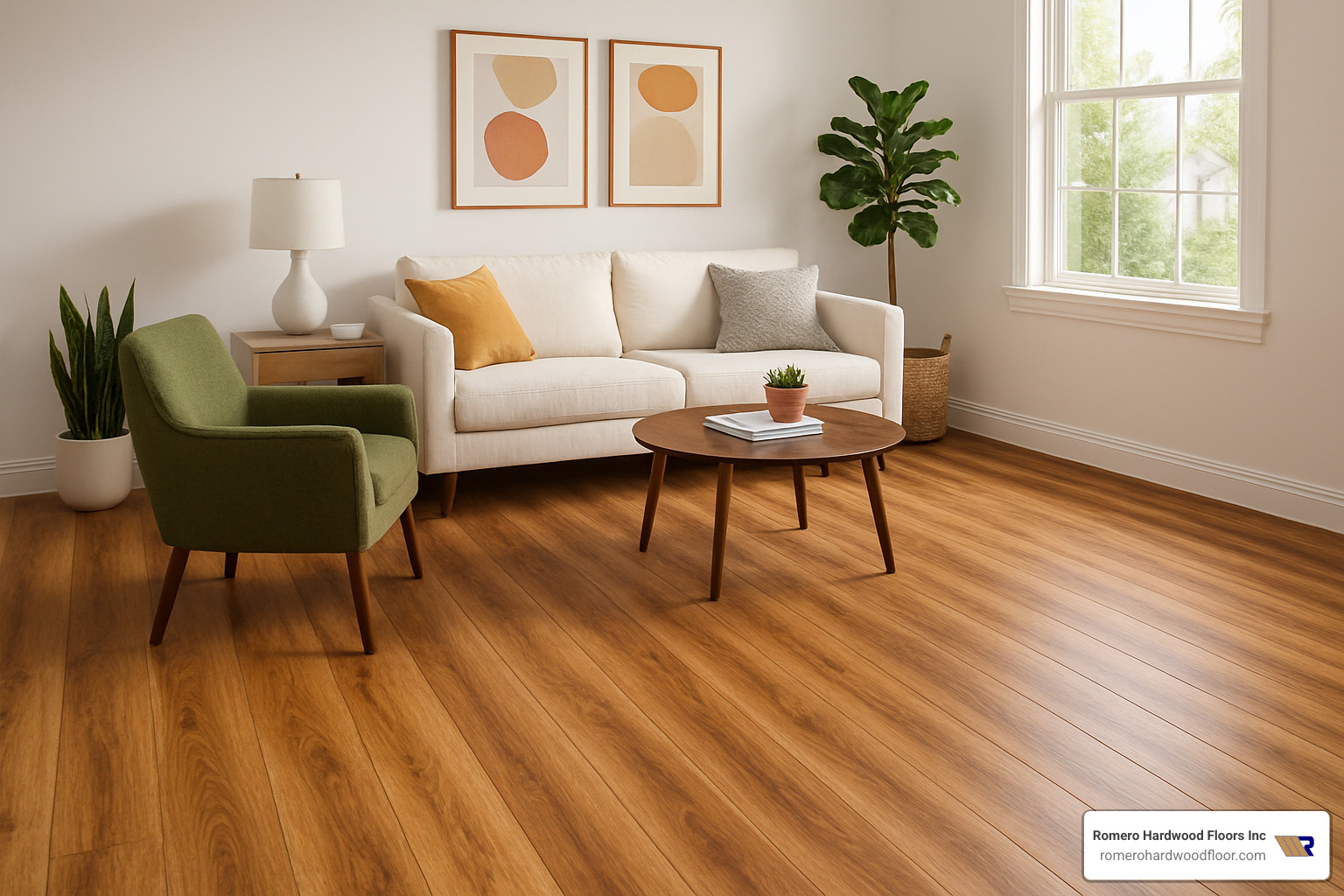
I often recommend SPC cores (Stone Polymer Composite) for high-traffic areas and homes with heavy furniture, as they resist denting impressively well. For comfort-focused spaces like bedrooms, WPC cores (Wood Polymer Composite) provide better sound absorption and a warmer feel underfoot.
Pet owners particularly love LVP – it stands up to claws, accidents, and endless paw traffic while remaining easy to clean with simple sweeping and damp mopping. Materials typically range from $2-$8 per square foot, with premium brands offering improved realism and performance at the higher end.
Engineered Wood: Real-Wood Veneer, Fake-Wood Price
Engineered hardwood occupies a special place in my recommendations because it gives you the best of both worlds – genuine hardwood on the surface with improved stability underneath.
What I love about engineered hardwood is that it’s not pretending to be wood – it IS wood on the surface. That authentic veneer develops the same beautiful patina and character as solid hardwood over time. Meanwhile, the cross-layered plywood or high-density fiberboard core resists the expansion and contraction that can plague solid hardwood floors.
This stability makes engineered wood perfect for challenging environments like basements (with proper moisture barriers) and homes with radiant heating systems. It also allows for those gorgeous wide-plank formats that would warp and cup if made from solid wood.
When selecting engineered hardwood, pay close attention to veneer thickness. I recommend products with 3mm or thicker veneers for most families, as these can be refinished 1-3 times, extending your floor’s lifespan significantly. Thinner veneers cost less upfront but offer fewer renewal options down the road.
Materials typically cost $3-$10 per square foot, placing engineered hardwood between laminate/vinyl and solid hardwood in terms of budget. More info about Engineered Hardwood Versus Laminate.
Tile Planks: Indestructible Imitation
When absolute durability is the priority, wood-look tile is my go-to recommendation. These porcelain or ceramic tiles might be the most indestructible option among best fake hardwood floors, making them perfect for moisture-prone areas like bathrooms, kitchens, and even outdoor living spaces.
The technology behind wood-look tile has advanced tremendously. Digital printing creates remarkably detailed grain patterns, while surface texturing adds dimensional character that mimics sawn wood. Some premium tiles even incorporate subtle variations in gloss level across the surface, eliminating the uniform shine that once made tile look artificial.
What sets tile apart is its maintenance simplicity – it can be safely steam-mopped for deep cleaning, handles radiant heating beautifully, and can last 50+ years with proper installation. For busy entrances or commercial spaces, nothing matches its resilience.
The tradeoffs are hardness underfoot, cooler surface temperature (unless paired with radiant heating), and more complex installation. This isn’t typically a DIY-friendly project, as proper installation requires specific skills and tools.
Material costs generally range from $3-$12 per square foot, with installation adding significantly due to the specialized labor involved. For high-moisture areas where other wood looks would fail, however, the investment delivers exceptional long-term value.
Eco Exotics: Bamboo, Cork & Hemp
For environmentally conscious homeowners, I’ve been increasingly recommending alternative materials that combine sustainability with impressive performance.
Bamboo flooring has become a favorite for eco-minded clients seeking hardness and durability. As a grass that reaches maturity in just 3-5 years (compared to decades for hardwood trees), bamboo represents a rapidly renewable resource. The strand-woven varieties often exceed oak on the Janka hardness scale, making them surprisingly tough for active households. Available in natural blonde tones or darker carbonized finishes, bamboo offers distinctive grain patterns that stand out from traditional hardwoods.
Cork flooring provides best comfort underfoot. Harvested from cork oak bark without harming the trees, it’s inherently sustainable and naturally antimicrobial. The cellular structure that made it perfect for wine bottles also makes it warm, sound-absorbing, and slightly springy underfoot – perfect for kitchens, playrooms, or anywhere you stand for extended periods.
Hemp wood flooring represents the newest frontier in sustainable flooring. This material reaches harvest maturity in just 120 days and scores an impressive 2750 on the Janka hardness scale (twice as hard as oak). Its environmental credentials are equally impressive, absorbing more carbon during growth than hardwood trees while producing more flooring per acre than traditional timber.
Most of these eco-friendly options come with FloorScore® or GREENGUARD Gold certifications, ensuring they meet strict indoor air quality standards with minimal VOC emissions. While still gaining market share, they’re becoming increasingly popular as homeowners prioritize both sustainability and performance in their flooring choices.
These trending alternatives offer distinctive looks that can make your space truly unique while aligning with environmental values – a win-win that more of my clients are embracing each year.
Smart Buyer’s Guide: Choosing the Right Option
Finding the best fake hardwood floors for your home doesn’t have to feel overwhelming. Think of this as your personal roadmap to making a choice you’ll love for years to come. Let’s break down what really matters when shopping for faux wood flooring.
Budget Considerations
Your budget often determines where your flooring journey begins, but the good news is that fake hardwood spans nearly every price point:
For budget-conscious projects, basic laminate and entry-level vinyl plank ($1-$3/sq ft) offer impressive wood looks without breaking the bank. If you can stretch to the middle range ($3-$6/sq ft), you’ll find premium laminate, quality LVP, and even some basic engineered wood options. For those seeking the absolute best in realism and performance, premium options ($6-$12/sq ft) include high-end LVP, quality engineered wood, and beautiful wood-look tile.
Installation adds significantly to your total project cost. Based on internet averages (not Romero Hardwood Floors Inc. pricing), professional installation typically runs $3-$5/sq ft for floating floors like laminate or click-lock vinyl, $4-$8/sq ft for glue-down products, and can reach $8-$15/sq ft for tile work.
When budgeting for a 200 square foot room, your total might range from around $800 (if you DIY laminate) to $5,400 (for professionally installed premium tile). Weighing these costs against longevity and performance is key to finding true value. More info about Cheap But Good Laminate Flooring.
Traffic Level Assessment
Your grandmother’s formal living room sees a fraction of the foot traffic your main hallway endures, and your flooring choice should reflect these differences.
For high-traffic zones like entryways, kitchens, and main hallways, durability is non-negotiable. Look for laminate with AC4-AC5 ratings, SPC vinyl plank with 20+ mil wear layers, or porcelain wood-look tile that can handle constant use without showing wear.
In medium-traffic spaces like living and dining rooms, you have more flexibility. AC3 laminate, vinyl plank with 12+ mil wear layers, or engineered hardwood with aluminum oxide finishes all perform beautifully while maintaining their looks.
Bedrooms and home offices typically see lighter use, opening the door to virtually any quality option. Here, comfort might take priority, making cork or WPC vinyl especially appealing for their softer feel underfoot.
Moisture Considerations
Water and wood don’t naturally mix, which is one of the biggest advantages of best fake hardwood floors over the real thing.
For bathrooms, laundry rooms, and basements where moisture is a constant concern, 100% waterproof luxury vinyl plank or porcelain tile provide peace of mind. Even an overflowing bathtub won’t damage these resilient floors.
In splash zones like kitchens and entryways where spills happen but standing water is less common, waterproof laminate, vinyl plank, or tile all perform admirably. The occasional dropped ice cube or tracked-in snow won’t cause lasting damage.
For typically dry areas like bedrooms and living rooms, any quality option works well, including engineered hardwood which offers the most authentic wood experience.
Subfloor Compatibility
What lies beneath your new floor dramatically impacts which products will work best.

Concrete slabs welcome all fake wood options, though moisture barriers become essential for laminate and engineered wood to prevent damage from ground moisture. Similarly, plywood subfloors play nicely with all options, giving you maximum flexibility.
If you’re hoping to install over existing tile or vinyl, floating floors like laminate, click-lock LVP, and some engineered wood can often go right on top, saving considerable demolition work. Existing hardwood typically requires removal or significant preparation before new installation – something our team at Romero Hardwood Floors can help assess during an in-home consultation.
Style Goals and Design Considerations
The look you’re trying to achieve should guide your flooring selection just as much as practical concerns.
For the most authentic wood appearance, engineered hardwood leads the pack with its genuine wood veneer, followed closely by premium laminate and LVP with textured surfaces that mimic natural wood grain. If you’re drawn to wide-plank rustic styles, look for 7″+ width planks in distressed or hand-scraped finishes that bring character and warmth.
Contemporary spaces often benefit from gray-toned woods or white-washed finishes available in laminate or vinyl, while traditional homes typically shine with oak, maple, or cherry looks in medium tones that complement classic décor.
Pay special attention to pattern repeat in laminate and vinyl products. Budget options might repeat every 5-6 planks, creating a noticeable pattern across your floor. Premium products offer 10-12 unique planks before repeating, creating a more natural, varied appearance that’s nearly indistinguishable from real wood.
Plank width dramatically impacts your room’s overall feel – wider planks (5″+ wide) create a more contemporary, spacious look, while narrow planks (3″) feel more traditional and classic.
Eco-Friendly Considerations
For environmentally conscious homeowners, today’s best fake hardwood floors offer impressive green credentials.
Look for FloorScore® certification, which ensures strict indoor air quality standards, or GREENGUARD Gold certification that verifies low chemical emissions. For wood products, FSC certification confirms responsible sourcing practices.
Rapidly renewable materials like bamboo, cork, and hemp offer exceptional sustainability profiles, reaching harvest maturity in a fraction of the time needed for hardwood trees. Some manufacturers now offer PVC-free alternatives to traditional vinyl, addressing environmental concerns about plastic-based flooring.
Warranty Evaluation
Warranties reveal a manufacturer’s confidence in their product – but reading the fine print matters.
Residential warranties typically range from 10 years to “lifetime” (usually meaning 25-30 years), while commercial warranties are shorter to reflect heavier use patterns. The most comprehensive protection comes from warranties that cover both wear-through (surface damage) and structural integrity (core stability and plank construction).
For kitchens and bathrooms, specific waterproof warranties provide crucial protection against moisture damage. Always read warranty details carefully, as they often include maintenance requirements and exclusions that could affect your coverage.
Room-By-Room Recommendations
Different spaces in your home have unique requirements for the best fake hardwood floors:
In kitchens, luxury vinyl plank reigns supreme with its 100% waterproof construction and comfortable feel underfoot during long cooking sessions. Waterproof laminate or wood-look tile make excellent alternatives, while standard laminate or engineered wood without waterproof protection should be avoided.
Bathrooms demand truly waterproof solutions, making wood-look porcelain tile the gold standard for handling moisture, steam, and cleaning products. Luxury vinyl plank runs a close second, while even “waterproof” laminate and engineered hardwood are risky choices in these high-moisture environments.
Basements benefit most from luxury vinyl plank with vapor barrier underlayment to protect against ground moisture. Waterproof laminate with proper moisture barriers works well too, and wood-look tile offers exceptional durability (though it feels cold without radiant heating). Traditional engineered hardwood rarely performs well below grade unless your basement is exceptionally dry and climate-controlled.
Entryways need to withstand dirt, moisture, and heavy traffic, making wood-look tile or high-wear-layer LVP ideal choices. AC5-rated laminate also performs admirably, while softer materials like cork should be avoided in these high-impact areas.
For rental properties, durable and budget-friendly laminate or vinyl plank offers the best balance of looks and longevity, though upscale rentals might justify engineered hardwood to attract quality tenants. The key is finding the sweet spot between durability and replacement cost.
Home offices benefit from engineered hardwood’s professional appearance, though premium laminate or LVP offer excellent alternatives. If you stand frequently at your desk, consider cork for its exceptional comfort during long work sessions.
DIY or Pro? Installation Snapshots
The installation method you choose significantly impacts both cost and performance of your best fake hardwood floors.
Floating floor installation (used for most laminate, click-lock LVP, and some engineered wood) ranks as the most DIY-friendly approach. With basic tools like a saw, rubber mallet, spacers, and tapping block, moderately handy homeowners can achieve professional-looking results. The benefits include no messy adhesives and the ability to install over most existing floors, though floors can sound hollow without quality underlayment.
Glue-down installation (common for some vinyl plank and engineered wood) requires more skill and specific tools including trowels, adhesive, and rollers. While the result is extremely stable with no movement or noise concerns, the process can be messy and makes future removal challenging.
Nail-down installation, primarily used for some engineered hardwood, requires specialized equipment like pneumatic flooring nailers and compressors. This traditional method creates a very secure floor but demands a wood subfloor and considerable skill.
Tile installation for wood-look porcelain or ceramic requires the most technical expertise and specialized tools including tile saws, trowels, and grout tools. While the result is exceptionally durable, the process is labor-intensive and demands significant skill.
No matter which method you choose, proper acclimation of your flooring material is essential – most products should rest in your home for 24-72 hours before installation to adjust to temperature and humidity.
Underlayment selection also plays a crucial role in your floor’s performance. Basic foam underlayment provides sound absorption and minor subfloor imperfection correction, while premium cork underlayment offers superior sound deadening and thermal insulation. Vapor barriers become essential over concrete or in moisture-prone areas, and many manufacturers now offer combination products that provide both moisture protection and sound absorption in one layer.
At Romero Hardwood Floors Inc., we’ve found that professional installation often pays for itself through reduced waste, proper technique, and warranty protection. However, confident DIYers can successfully tackle floating floors with proper preparation and patience.
Care & Maintenance Tips for Long-Life Floors
Let’s face it – we all want our floors to look as gorgeous on day 1,000 as they did on day one. The good news? With some simple care routines, your best fake hardwood floors can maintain their beauty for years to come.
Sweeping or vacuuming regularly is your first defense against the enemy of all beautiful floors: grit. Those tiny particles act like sandpaper when walked on, gradually dulling your floor’s finish. I recommend a soft-bristle broom or vacuum with a hard floor attachment (those rotating brushes meant for carpet can scratch your lovely new floors!).
Spills happen in real homes with real people. The key is quick action, even with waterproof flooring options. While luxury vinyl might withstand that spilled juice for hours, wiping it up promptly prevents liquid from seeping into seams where it could potentially cause problems.
Protective measures make a huge difference. Place felt pads under furniture legs to prevent scratches when someone inevitably drags a chair across the room. And don’t underestimate the power of strategically placed entrance mats – they’re your first line of defense against outdoor dirt and moisture.
When it comes to cleaning products, less is definitely more. Manufacturer-approved cleaners are worth their weight in gold because they’re specifically formulated for your floor type. For laminate and engineered wood, use a barely damp mop – never saturated. Vinyl plank floors can handle a bit more moisture during cleaning, while tile floors benefit from appropriate tile cleaners that keep both the surface and grout lines looking fresh.

Certain practices can quickly damage your beautiful floors. Steam mops are a big no-no for laminate and engineered wood – even those marketed as “waterproof.” The intense heat and moisture can cause swelling and damage the core materials. Similarly, avoid oil soaps, waxes, or polishes unless specifically recommended by your flooring manufacturer. These products often leave residue that attracts more dirt or makes floors dangerously slippery.
For long-term protection, consider area rugs in high-traffic zones (just avoid rubber backing, which can trap moisture and discolor your floors). If your room gets lots of direct sunlight, UV-protective window coverings are worth the investment to prevent uneven fading.
Maintaining proper indoor humidity between 35-55% might sound fussy, but it really does prevent unnecessary expansion and contraction that can damage your floors over time. In winter, you might need a humidifier; in summer, air conditioning helps keep humidity in check.
Pet owners, I feel your pain! Those clickety-clack nails can do a number on floors. Regular nail trims for your furry friends can significantly reduce scratch potential. And rotating furniture periodically ensures more even wear patterns throughout your rooms.
Even with the best care, accidents happen. Minor scratches on laminate and vinyl can often be addressed with manufacturer repair kits that match your floor color. For engineered wood, touch-up markers can work wonders on light scratches. And one advantage of most floating floors? If a plank gets seriously damaged, it’s possible to replace just that section rather than the entire floor.
For more detailed advice on addressing specific types of damage, our guide on Fixing Scratches on Fake Wood walks you through the process step by step.
Can I Install Over Existing Floors?
One of the most appealing aspects of best fake hardwood floors is that many can be installed right over existing surfaces. This can save you significant time, money, and the headache of demolition. But there are important considerations for each type of subfloor.
Concrete subfloors work with virtually all fake hardwood types, but proper preparation is crucial. We always recommend moisture testing before installation – concrete can harbor invisible moisture that wreaks havoc on flooring. A quality vapor barrier is non-negotiable, and any uneven areas need proper leveling compounds to prevent future issues.
Got existing tile that’s still in good shape? Many floating floors can go right over it, saving you from the dusty, time-consuming process of tile removal. The key requirements are that all tiles must be securely attached (no hollow sounds when tapped), grout lines should be filled if they’re deep, and the surface needs to be reasonably level. One challenge to watch for: the added height might create awkward transitions at doorways.
Installing over old hardwood can be tricky but doable. The existing floor must be structurally sound without significant warping or damage. Those charming but annoying squeaks should be addressed first – they won’t magically disappear under new flooring! We typically secure any loose boards and ensure the surface is clean and level before proceeding.
For vinyl flooring, most floating systems can be installed overtop as long as the vinyl is well-adhered and non-cushioned. However, if the old vinyl contains asbestos (common in homes built before the 1980s), professional testing and possibly removal is essential for your family’s safety.
Height transitions between rooms can be one of the trickiest aspects of installing over existing floors. Reducer strips create smooth transitions between different floor heights, while threshold transitions work beautifully at doorways. For significant height differences, custom solutions might be necessary – this is where professional installation really shows its value.
At Romero Hardwood Floors Inc., we carefully evaluate existing floors in Revere homes to determine if overlay installation is appropriate. While DIY installation over existing floors is possible, manufacturer guidelines must be followed precisely to maintain warranty coverage. Sometimes removal of the old flooring is actually the better long-term solution, even if it seems more work initially.
Frequently Asked Questions about the Best Fake Hardwood Floors
Are fake hardwood floors durable enough for pets and kids?
Let’s face it – kids and pets can be tough on floors! The good news is that many best fake hardwood floors are specifically engineered to handle the chaos of family life.
For homes with active children and four-legged friends, I typically recommend luxury vinyl plank with a wear layer of 20 mil or higher. This flooring can handle everything from spilled juice to muddy paw prints without breaking a sweat. It’s completely waterproof (hello, potty training accidents!) and has enough give to make falls a little less painful.
Laminate with an AC4 or AC5 rating is another excellent choice. These ratings essentially mean the floor can take a beating from toy trucks, dropped sippy cups, and the occasional art project gone wrong. The scratch-resistant surface often outperforms natural hardwood when it comes to pet claws.
For the ultimate in “nothing can destroy this” durability, wood-look tile is practically bulletproof. It’s perfect for that dog who refuses to have his nails trimmed or the child who somehow turns everything into a science experiment.
Just remember – while these floors are tough, they’re not invincible. Even the most durable floor can be damaged by a Great Dane with unclipped nails or a chair being dragged across the room. A little maintenance (like trimming pet nails and using furniture pads) goes a long way!
Which option looks most like real wood?
The quest for authentic-looking wood floors without the maintenance headaches is something I help homeowners with daily. If you’re after the most convincing wood appearance, here’s my honest ranking:
Engineered hardwood takes the crown because, well, it’s actually topped with real wood! That genuine wood veneer gives you authentic grain patterns and texture that simply can’t be replicated. When installed, most people can’t tell the difference between engineered and solid hardwood.
Premium laminate has come incredibly far in recent years. The best products feature high-definition printing combined with embossed-in-register texturing, where the surface texture perfectly aligns with the printed grain pattern. When you run your hand over a knot, you can actually feel it! Look for products with at least 10-12 unique planks before pattern repetition for the most natural look.
Luxury vinyl plank offers impressive realism with advanced printing technologies. The better products include subtle color variations and textured surfaces that mimic wire-brushed or hand-scraped wood. Opt for matte or satin finishes rather than glossy ones, which tend to look more artificial.
Wood-look tile can be visually stunning, but the feel underfoot and those telltale grout lines usually give it away. However, newer large-format tiles with minimal grout lines are getting closer to fooling the eye.
I’ve installed floors in Revere homes that have genuinely surprised visitors who assumed they were walking on real hardwood. The technology improves every year, with the latest products offering remarkable authenticity.
What’s the most eco-friendly faux wood choice?
More and more Massachusetts homeowners are prioritizing sustainability in their flooring choices, and I’m happy to say there are several earth-friendly options that don’t sacrifice performance.
Cork flooring is a natural winner in the eco-friendly category. It’s harvested from the bark of cork oak trees without harming the tree itself – the bark simply regrows over time. It’s naturally antimicrobial, comfortable underfoot, and provides excellent thermal and acoustic insulation. Plus, it’s biodegradable at the end of its lifespan.
Hemp flooring is the exciting newcomer that’s making waves in sustainable design. This remarkable plant grows to harvest maturity in just 120 days (compared to decades for hardwood trees), absorbs significant carbon during growth, and requires minimal pesticides. The resulting flooring is surprisingly hard and durable – often exceeding traditional hardwood in performance tests.
Bamboo has earned its place as an eco-friendly staple. As a grass rather than a tree, bamboo reaches harvest maturity in 3-5 years and regrows from the same root system. The strand-woven variety offers exceptional hardness that can surpass many traditional hardwoods.
For those who prefer the look of traditional wood, FSC-Certified Engineered Wood ensures the materials come from responsibly managed forests. This certification is essentially the gold standard for sustainable forestry practices.
When evaluating how green your flooring choice is, consider not just the raw material but also the manufacturing process, indoor air quality impact, and end-of-life disposal options. Look for FloorScore® or GREENGUARD Gold certifications to ensure your floors won’t off-gas harmful chemicals into your home.

Many manufacturers now offer innovative alternatives like PVC-free vinyl and laminate with recycled content. The industry continues to evolve, making it easier than ever to find best fake hardwood floors that are beautiful, durable, and kind to our planet.
Conclusion
The world of best fake hardwood floors has truly evolved into something remarkable. Today’s alternatives don’t just mimic the timeless beauty of wood—they improve it with practical advantages that make these options suitable for every corner of your home, even spaces where traditional hardwood would quickly deteriorate.
I’ve seen how these modern flooring solutions transform homes throughout Revere and beyond. Whether you’re dealing with active pets, energetic children, or moisture-prone areas, there’s a perfect fake hardwood option waiting for you.
Luxury vinyl plank shines with its waterproof performance and comfortable feel underfoot—perfect for bathrooms and basements where traditional wood would fail. Laminate flooring delivers exceptional scratch resistance at budget-friendly prices, making it ideal for busy households watching their spending. For those seeking the most authentic experience, engineered hardwood provides real wood beauty with improved stability against humidity changes. And specialized options like bamboo and cork add unique character while offering impressive environmental credentials.
At Romero Hardwood Floors Inc., we’ve been installing both traditional hardwood and the best fake hardwood floors throughout Revere, MA and surrounding communities since 2006. Our experienced team doesn’t just sell flooring—we guide you through the selection process to find the perfect match for your specific lifestyle, design preferences, and budget constraints.
What sets us apart is our commitment to excellence at every step. We pride ourselves on competitive pricing that respects your budget, punctuality that values your time, and guaranteed workmanship that improves your property’s value with expert flooring solutions. From the first consultation to the final inspection, we treat your home with the same care we would our own.
Ready to transform your space with beautiful, durable flooring that captures all the warmth and character of real wood without the drawbacks? Contact Romero Hardwood Floors Inc. today for a friendly consultation and estimate. We serve Beverly, Chelsea, Danvers, East Boston, and communities throughout the greater Boston area with professional installation services custom specifically to your needs.
More info about professional installation