Why Sustainable Flooring Companies Matter for Your Home and Planet
Sustainable flooring companies are changing how we think about the floors beneath our feet. These businesses prioritize environmental responsibility through certified materials, ethical manufacturing, and transparent reporting—all while delivering beautiful, durable products for your space.
Top characteristics of sustainable flooring companies include:
- Third-party certifications like FSC, FloorScore, Green Label Plus, and Cradle to Cradle
- Transparent sustainability reporting with Environmental Product Declarations (EPDs)
- Recycled and renewable materials such as reclaimed wood and FSC-certified hardwood
- Low VOC emissions for healthier indoor air quality
- Circular economy practices including take-back programs and waste reduction
- Fair labor practices and community engagement throughout their supply chain
The flooring industry has evolved dramatically. Leading manufacturers now have nearly 90% of their products Cradle to Cradle Certified, while innovative recycling programs prevent billions of plastic bottles and millions of pounds of materials from reaching landfills each year. For hardwood specifically, sustainable sourcing from secondary-growth forests, carbon-negative manufacturing using wind power, and designs built to last 100+ years are setting new standards.
But sustainability isn’t just about the environment. It’s about your home too—lower chemical emissions mean cleaner air for your family, while durable materials reduce long-term costs and waste.
As Francisco Romero, owner of Romero Hardwood Floors Inc with over 15 years of experience, I’ve witnessed how sustainable flooring companies are revolutionizing hardwood installation with eco-friendly practices that don’t compromise on quality or beauty. Throughout this guide, I’ll help you understand what makes a flooring company truly sustainable and how to choose the best options for your space.
Sustainable flooring companies vocab to learn:
Defining Sustainable Flooring Companies and Their Initiatives
When we talk about sustainable flooring companies, we aren’t just talking about companies that sell “green” products. We are looking at organizations that bake environmental responsibility into every single layer of their business. In our experience working across the North Shore and Greater Boston—from the historic homes of Salem, MA to the modern builds in Somerville, MA—transparency is the biggest differentiator.
True innovators in this space prioritize Sustainability Reporting. This isn’t just a fancy PDF on a website; it’s a detailed account of their Environmental, Social, and Governance (ESG) impacts. For example, industry leaders have demonstrated a commitment to transparency by disclosing product ingredients through Declare, a voluntary labeling program. This allows you to see exactly what is in your floor, ensuring it complies with the “Red List” of harmful chemicals.
Green Manufacturing and Waste Management
Sustainability starts at the factory. We’ve seen incredible statistics from industry leaders:
- Top-tier manufacturers have prevented 92.7% of all returned material from going into the waste stream since 2005.
- Their facilities have not discharged process waste-water to local municipal sewer systems for more than a decade.
- Leading brands use advanced recycling processes, which prevent 3 billion plastic bottles from entering oceans or landfills annually. Each square yard of their recycled carpet contains about 63 plastic bottles!
Social Fairness and Fair Labor
It’s not just about the trees; it’s about the people. Leading sustainable flooring companies focus on social fairness. This includes ensuring fair labor practices in their supply chains and engaging with local communities. Innovative companies emphasize living wages for their craftsmen, viewing “green jobs” as an investment in sustainable rural communities. When we install these floors in places like Medford, MA or Winchester, MA, we know we are supporting a chain of ethical production.
The Role of Certifications in Verifying Eco-Friendly Claims
With so much “greenwashing” out there, how do you know if a company is actually walking the walk? That’s where third-party certifications come in. These act like a “nutrition label” for your flooring.
The Heavy Hitters of Certification
- FSC Certification: The gold standard for wood. It ensures the timber was harvested from forests that are responsibly managed to provide environmental, social, and economic benefits.
- FloorScore: This is the most recognized indoor air quality (IAQ) certification. It ensures that hard surface flooring meets strict emission standards for volatile organic compounds (VOCs). Leading brands carefully feature FloorScore and GreenGuard Gold on their collections to guarantee safe air.
- Cradle to Cradle (C2C): This evaluates a product’s safety for humans and the environment and its design for future life cycles. Major manufacturers produce nearly 90% of their products to be Cradle to Cradle Certified.
- Green Label Plus: Specifically for carpets, this ensures very low VOC emissions. High-quality carpet products carry this certification.
- GREENGUARD Gold: This certification is even stricter than standard GREENGUARD, considering safety factors for “sensitive” populations like children and the elderly. It is essential for nurseries or homes in towns like Reading, MA or Lynnfield, MA where health is a top priority.
Transparency Through Documentation
Companies that are truly proud of their work provide Environmental Product Declarations (EPDs) and Health Product Declarations (HPDs). These are third-party verified documents that detail the life cycle impact and chemical makeup of the product. Top manufacturers provide an extensive library of these documents for their modular carpets and resilient flooring.
Material Impact: How Hardwood Floors Meet Sustainability Goals
As hardwood specialists, we may be a little biased, but the data supports us: hardwood is one of the most sustainable materials on the planet when sourced correctly. Unlike synthetic options like vinyl (LVP), which often contain PVC and are difficult to recycle, benefits of hardwood floors include being naturally biodegradable and having a massive capacity for carbon sequestration.
Hardwood Material Comparison Table
| Feature | Solid Hardwood | Engineered Hardwood | Traditional Vinyl (LVP) |
|---|---|---|---|
| Lifespan | 100+ Years | 25–50 Years | 10–20 Years |
| Carbon Footprint | Negative (Stores Carbon) | Low to Neutral | High (Plastic-based) |
| Recyclability | High (Biodegradable/Reclaimable) | Moderate | Low |
| Refinishing | Multiple Times | 1–3 Times | Cannot Refinish |
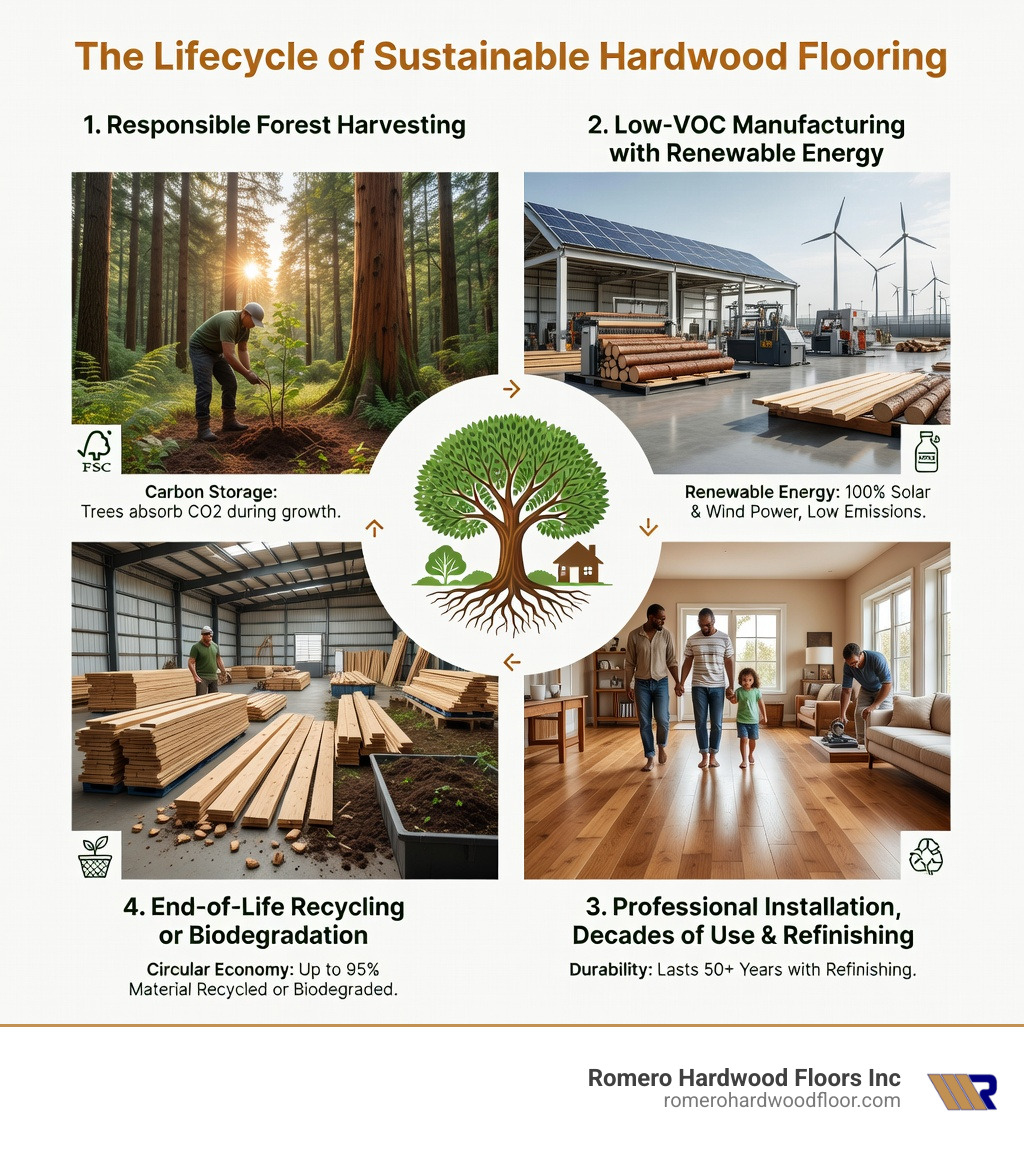
Choosing sustainable wood flooring options means you are essentially installing a “carbon sink” in your home. Trees absorb CO2 as they grow, and that carbon remains trapped in the wood for the life of the floor.
Hardwood and the Innovation of Sustainable Flooring Companies
The innovation in hardwood is staggering. Some innovators, for example, produce floors that are actually carbon negative. Their manufacturing process stores more carbon in the wood than is emitted during production. Furthermore, they source 100% of their on-site electricity from renewable sources like wind power—without even using carbon credits!
Other innovators use FSC 100% Hardwood and sustainably sourced limestone for their cores. This blend of natural materials ensures durability while keeping the environmental footprint small. For our clients in coastal areas like Gloucester, MA or Rockport, MA, these resilient hardwood options offer the perfect mix of local aesthetics and global responsibility.
Responsible Sourcing and Recycled Content
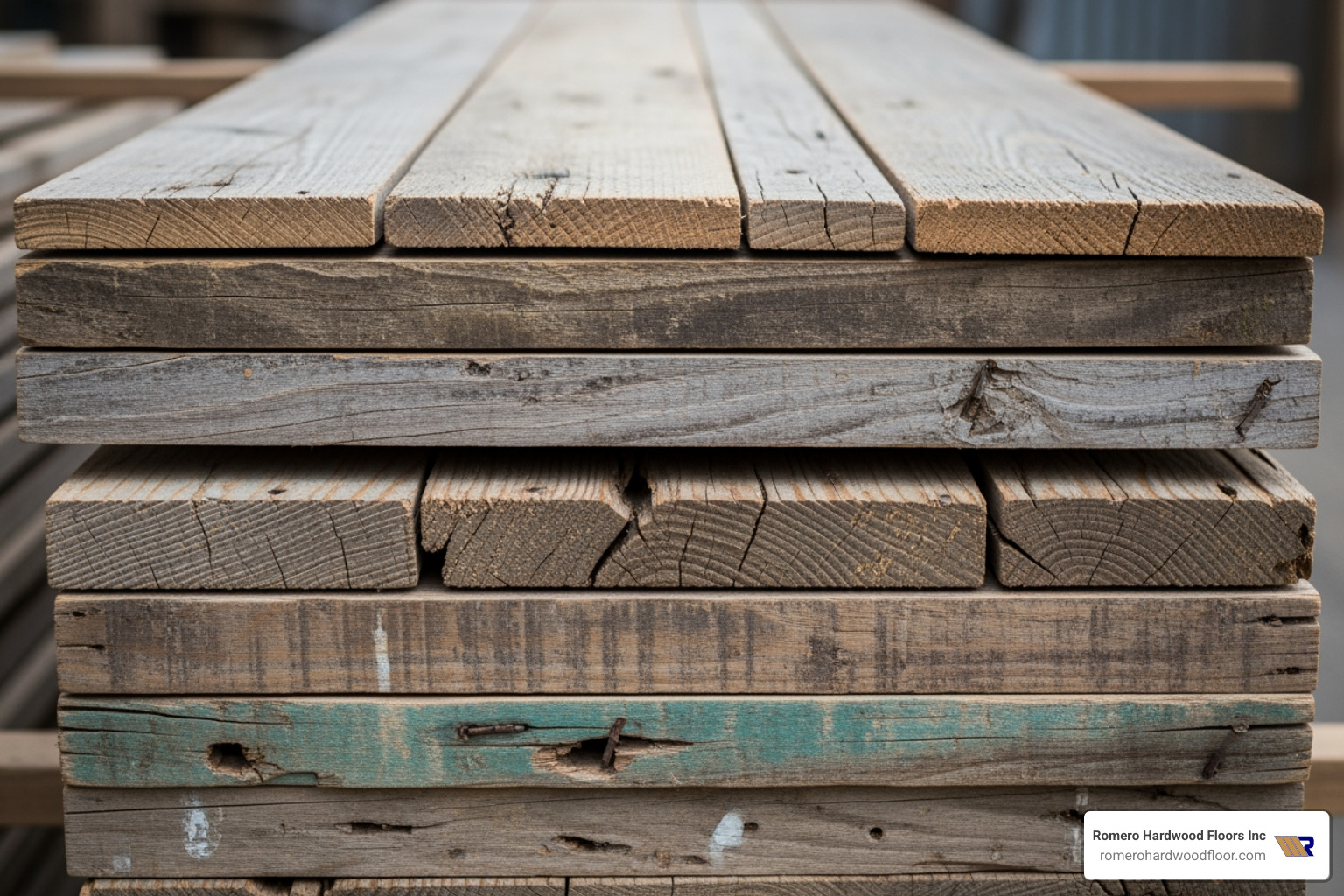
We always encourage our clients to look for reclaimed wood or wood sourced from secondary-growth forests. Reclaimed wood gives a second life to timber from old barns or industrial buildings, preventing it from ending up in a landfill.
Beyond the wood itself, sustainable-wood-flooring-options also involve the finishes. We prioritize bio-based, low-VOC finishes that don’t off-gas harmful chemicals into your home. This is especially important during a hardwood-flooring-installation-guide to ensure the air stays fresh from day one.
Balancing Cost, Durability, and Aesthetics
We know what you’re thinking: “This sounds great, but is it going to break the bank?”
It’s a common misconception that “eco-friendly” always equals “expensive.” While some high-end certifications like FSC can sometimes increase costs, the lifecycle cost of sustainable flooring is often much lower. A cheap vinyl floor might need replacing in 10 years, whereas a high-quality hardwood floor can be refinished and repaired for a century.
Understanding the Investment
When budgeting for your project in Peabody, MA or Woburn, MA, consider these general price ranges.
Note: All average pricing referenced is based on internet data and not actual costs for Romero Hardwood Floors. Actual costs vary based on material choice, subfloor condition, and project complexity.
- Sustainable Hardwood (Materials & Installation): Average costs range from $8.00 to $15.00 per square foot, with high-end reclaimed or specialized carbon-negative options reaching $35.00+ per square foot.
- Sustainable Carpet/Tile: Average costs range from $4.00 to $10.00 per square foot, with luxury sustainable materials exceeding $25.00 per square foot.
To help make these world-class floors more accessible, many homeowners look into financing. You can Apply now for Flooring Payment Plans to find a budget that fits your specific project needs, including 0% interest options.
Durability Meets Beauty
You don’t have to sacrifice style for the planet. Modern sustainable flooring companies offer everything from the sleek, minimalist look of floor-sanding-services to the rustic charm of wide-plank European Oak. Our wood-floor-refinishing-contractors can even use custom stains to match your specific aesthetic while maintaining eco-standards.
Frequently Asked Questions about Sustainable Flooring
How can I identify truly sustainable flooring companies?
Look for a “paper trail.” A truly sustainable company will have their certifications (FSC, FloorScore, etc.) clearly listed on their product specifications. Check if they provide HPDs or EPDs. Also, look at their manufacturing—do they use renewable energy? Do they have robust recycling programs that keep millions of pounds of material out of landfills? Lastly, best-local-flooring-contractors should be able to tell you exactly where their wood is sourced.
What are the environmental benefits of choosing eco-friendly hardwood floors?
The benefits are twofold: your home and the Earth.
- Earth: Hardwood is a renewable resource that sequesters carbon. Choosing it reduces the demand for plastic-based flooring that sits in landfills for centuries.
- Home: Eco-friendly floors use low-VOC adhesives and finishes, significantly improving indoor air quality. This reduces asthma triggers and allergens. Plus, if a board gets scratched, you can perform a hardwood-floor-repair rather than replacing the whole floor.
How do companies handle end-of-life disposal and recycling?
This is the “circular economy” in action. Some companies have “take-back” programs where they will reclaim old flooring to recycle it into new products. For hardwood, the “recycling” is often built-in—old floors can be sanded down and refinished to look brand new. If a floor truly reaches the end of its life (after 100 years!), natural wood is biodegradable, unlike synthetic alternatives.
Conclusion: Your Partner in Sustainable Flooring
Choosing the right floor is a big decision, and choosing to go sustainable is an even bigger—and better—one. At Romero Hardwood Floors Inc, we are proud to serve our neighbors from Saugus, MA to Manchester by the Sea, MA. Since 2006, we’ve built our reputation on punctuality, competitive pricing, and a deep commitment to quality.
Whether you are looking for hardwood-flooring-installation-companies-near-me or need expert contractor-for-hardwood-flooring advice on the most eco-friendly options, we are here to help. We don’t just lay boards; we build the foundation for a healthier home and a greener planet.
Ready to transform your space with a floor that gives back? Request an estimate today and let’s discuss how we can bring sustainable beauty to your home. You can also find us by searching for flooring-companies-near-me in any of our 25+ Massachusetts service locations.
Note: All average pricing referenced in this guide is based on internet data and not actual costs for Romero Hardwood Floors Inc. High-end pricing is shown at least 3x the average to reflect the wide range of luxury and reclaimed materials available in the market.
