
Cost of wood floor repair: 9 Key 2025 Factors & Smart Savings
How Much Does Wood Floor Repair Really Cost in 2025?
Looking at your once-pristine hardwood floors now showing battle scars from daily life can be disheartening. But before you start imagining emptying your savings account, let’s talk real numbers.
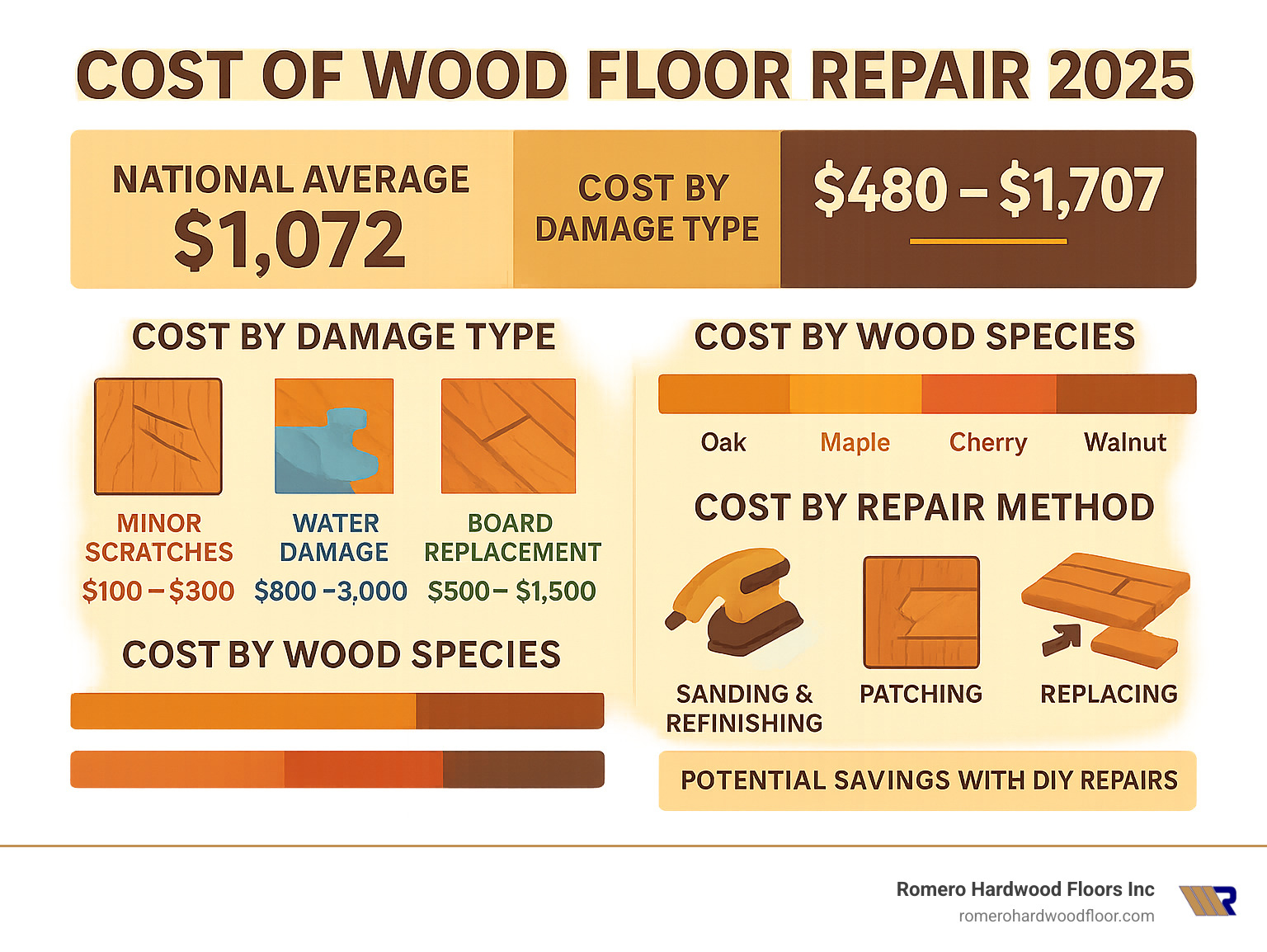
The cost of wood floor repair in 2025 typically ranges from $480 to $1,707, with most homeowners paying around $1,072 nationally. Of course, every floor tells its own story, and so does its repair bill.
| Repair Type | Cost Per Square Foot | Average Total Cost |
|---|---|---|
| Minor Scratches | $1 – $8 | $100 – $300 |
| Water Damage | $8 – $100 | $800 – $3,000 |
| Board Replacement | $7 – $25 | $500 – $1,500 |
| Structural Repairs | $35 – $80 | $3,000 – $12,000 |
For basic repairs, you’re generally looking at $2 to $20 per square foot. That scratched spot where your puppy decided to dig? That’s on the lower end. But if you’re dealing with severe water damage that’s affected your subfloor? Those costs can climb to $80 per square foot in extreme cases.
It’s worth noting that these figures represent internet-based averages, not actual quotes from Romero Hardwood Floors Inc. Real-world pricing will depend on your specific situation, and 2025’s inflation rates have been factored into these ranges.
Cost of wood floor repair per project
When thinking about your repair budget, consider whether you need a full-room restoration or just spot fixes. A few isolated scratches might cost you a couple hundred dollars, while refinishing an entire living room could run into four figures.
The type of wood makes a substantial difference too. Economy woods like pine will be gentler on your wallet than premium exotic hardwoods like Brazilian cherry or teak, which can cost 2-3 times more to repair properly.
Cost of wood floor repair per square foot
Different types of damage command different prices:
Scratches and surface damage typically cost $1–$8 per square foot to address. These are often the most common repairs and fortunately the most affordable.
Water damage is more serious business, ranging from $8 for minor issues up to $100 per square foot for severe cases where moisture has penetrated deeply.
Rot repairs represent the most intensive work, ranging from $50–$250 per square foot depending on how far the damage extends and whether structural elements are compromised.
I’m Francisco Romero, owner of Romero Hardwood Floors Inc., and after 15+ years restoring hardwood floors throughout Revere, MA, I’ve seen it all—from wine spills on Christmas Eve to flooding from broken pipes. While every project is unique, understanding these cost factors helps my clients prepare realistically for their floor restoration journey.
These prices reflect industry averages. The best way to get an accurate picture of your specific repair costs is through an in-home assessment, where we can evaluate the damage and provide a custom estimate for your unique situation.
How Much Does Wood Floor Repair Really Cost in 2025?
Looking at your beautiful hardwood floors showing signs of wear and tear? You’re probably wondering what it might cost to bring them back to life. In 2025, the national average for wood floor repair sits at $1,072, with most homeowners spending between $480 and $1,707 for typical repairs. But don’t be surprised if you see prices ranging from as little as $185 for minor touch-ups to over $4,000 for extensive restoration work.
I should mention that these figures represent internet-based averages from national data sources, not actual costs for Romero Hardwood Floors Inc. services. Every project we handle receives custom pricing based on your specific needs and our Greater Boston market conditions.
“The days of one-size-fits-all pricing are long gone,” explains our lead estimator. “In 2025, material costs continue to fluctuate due to supply chain adjustments and inflation. That’s why we always provide an in-person assessment rather than relying solely on national averages.”
When professionals like us calculate repair costs, we typically price on a per-square-foot basis, usually between $2 and $20 depending on damage extent and wood type. For severe damage involving structural components, those costs can climb as high as $80 per square foot.
Cost of wood floor repair per project
The scope of your repair dramatically impacts the bottom line. A small spot fix in your entryway will obviously cost much less than restoring an entire living room floor.
Small spot fixes covering just 1-10 square feet might run $100-$500 total, while partial room repairs (10-50 square feet) typically cost between $500-$1,500. If you’re looking at full room restoration covering 100-300 square feet, budget for $1,500-$6,000. And for whole-house repairs exceeding 1,000 square feet? You’re looking at $5,000-$15,000 or more.
Your choice of wood creates natural price differences too. Economy woods like pine may cost 30-50% less to repair than premium exotic hardwoods like Brazilian cherry or teak.
Just last month, we helped a client in Revere with water damage affecting about 35 square feet of red oak flooring. The total repair, including subfloor inspection and board replacement, came to approximately $1,200. Had this been exotic mahogany, the same project might have run closer to $1,800.
Cost of wood floor repair per square foot
When we break down costs per square foot by damage type, the variations become even clearer:
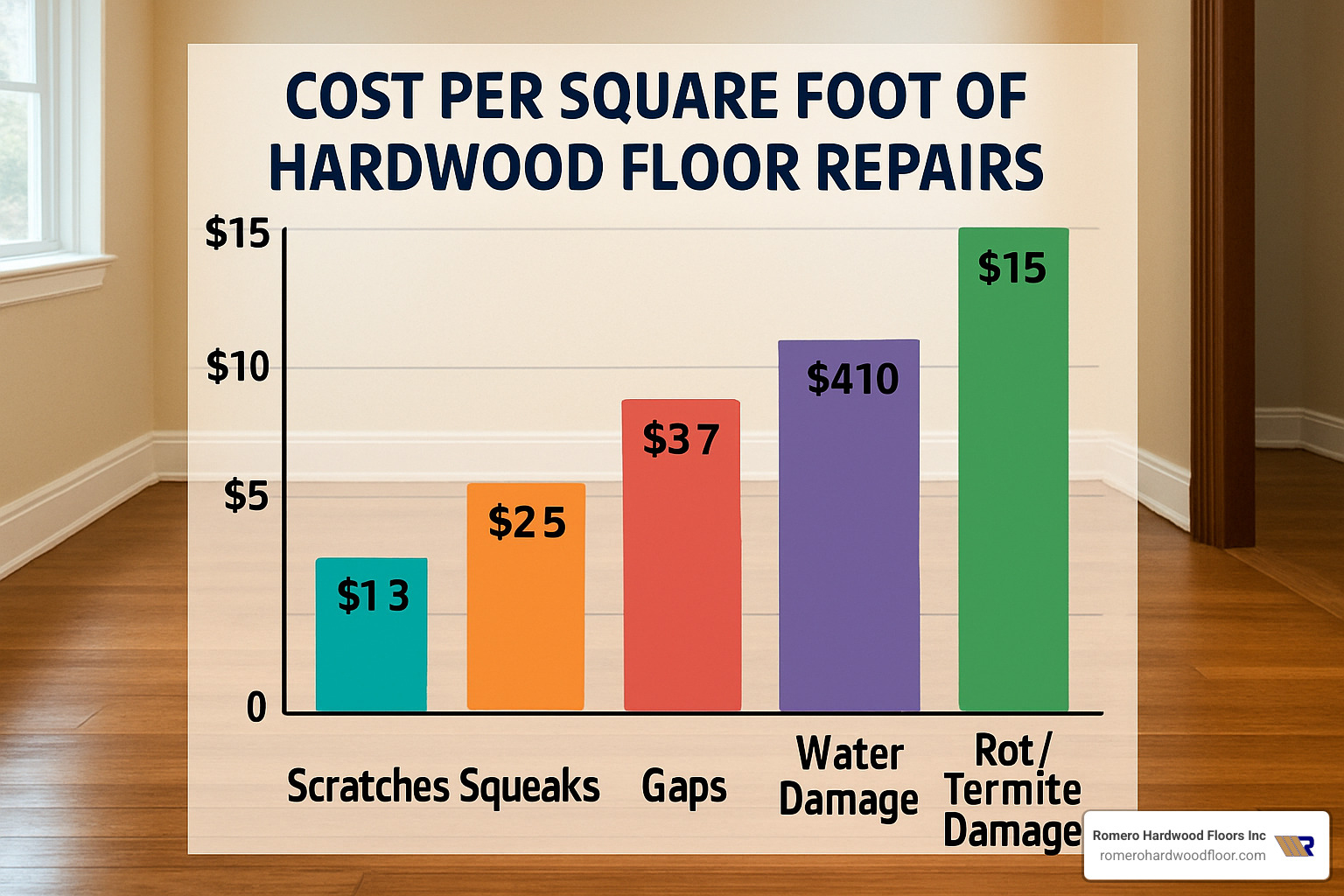
Surface scratches and minor dents are the most affordable fixes at $1-$8 per square foot. Squeaky floors typically run $2-$10 per square foot to silence those annoying creaks. Gaps between boards usually cost $3-$12 per square foot to address properly.
Water damage gets significantly pricier at $8-$100 per square foot, depending on severity and depth of penetration. And if you’re dealing with rot or termite damage, prepare for $50-$250 per square foot since these often involve structural repairs beneath the visible flooring.
A homeowner in Malden recently called us about repairing scratches in their living room floor. The affected area was approximately 20 square feet, and the total came to $260 ($13 per square foot), which included spot refinishing to blend the repaired area with the surrounding floor. The smile on their face when they saw the finished result? Priceless.
9 Major Factors That Influence Repair Pricing
When you’re budgeting for floor repairs, the final price tag can vary dramatically depending on several key factors. As someone who’s priced hundreds of projects over the years, I’ve seen how these variables can make the difference between a $300 touch-up and a $3,000 overhaul.
Area size naturally plays a major role in your total cost. While larger areas often cost less per square foot (thanks to economies of scale), they’ll still have a higher total price. A recent customer in Revere saved about 30% per square foot when repairing their entire living room rather than just a small section.
Wood species dramatically affects your repair budget. Those gorgeous exotic woods that caught your eye during installation? They’ll command premium prices when they need fixing too. Brazilian cherry repairs might cost double what you’d pay for pine or red oak.
“The first question I always ask homeowners is what type of wood they have,” shares our head technician. “That immediately gives me a ballpark for their repair costs.”
Damage severity creates perhaps the widest swing in pricing. A few surface scratches might need simple buffing and refinishing, while water damage that’s reached your subfloor could require extensive reconstruction work.
The repair method needed directly impacts your bottom line. Simple techniques like filling small gaps cost far less than complete board replacement or structural repairs. Similarly, labor rates in the flooring industry typically range from $35 to $125 per hour depending on the contractor’s experience and reputation.
Your geographic location significantly influences pricing too. Here in the Greater Boston area, you can expect to pay more than homeowners in rural New Hampshire or western Massachusetts for the same repairs due to higher overhead costs and wage requirements.
Hidden subfloor issues are the unwelcome surprises that can double or triple your repair costs. What looks like simple water damage on the surface might reveal rotted joists underneath once we start the work.
Additional services often become necessary during repairs. Mold remediation after water damage, joist reinforcement, or floor leveling can add significant costs to your project. And finally, timing and seasonality can work in your favor—winter months typically offer better pricing in the Northeast as it’s our slower season.
Damage severity scale
We categorize hardwood floor damage into three main levels, each with distinct cost implications:
1. Minor Cosmetic Damage ($1-$8 per sq ft)
– Surface scratches and scuffs
– Small dents and dings
– Light water spots
– Minor color fading
2. Moderate Structural Damage ($8-$25 per sq ft)
– Deep gouges requiring wood filler
– Water damage affecting finish only
– Loose boards or minor squeaking
– Gaps between boards requiring filling
3. Major Structural Damage ($25-$80+ per sq ft)
– Warped or buckled boards
– Extensive water damage affecting subfloor
– Rotted sections requiring replacement
– Structural sagging requiring joist repair
A Winthrop customer recently called us about what they thought was minor water damage from a planter that had leaked. What began as a seemingly simple repair revealed moderate damage once we removed the affected boards. The lesson? Always budget for the possibility of moving up one damage category once work begins.
Wood species price tiers
The type of wood in your floors creates natural price tiers for repairs. Think of it like car repairs—fixing a Toyota typically costs less than repairing a Mercedes, even for similar issues.
Economy woods like pine and red oak typically range from $2-$8 per square foot for repairs. These common domestic species are readily available, making replacement boards more affordable and matching easier.
Mid-range species including white oak, maple, and hickory usually cost between $8-$15 per square foot to repair. These harder woods require more specialized tools and techniques but still remain reasonably priced.
Premium exotic woods such as Brazilian cherry, mahogany, and teak can cost $15-$25+ per square foot for proper repairs. The specialized knowledge required and the higher material costs contribute to this premium pricing.
“About 60% of our repair calls in the Boston area involve oak flooring,” notes our scheduling manager. “It’s popular for good reason—it’s durable and relatively affordable to repair compared to exotic options.”
These figures represent internet-based averages from national data sources and not actual costs for Romero Hardwood Floors Inc. services. Our pricing is customized to each project’s specific requirements and the Greater Boston area market.
Cost by Damage Type & Repair Method
Your beautiful hardwood floors face different enemies – from surface scratches to serious structural damage. Each problem requires a specific fix, and naturally, each comes with its own price tag. Let’s walk through the common issues we see every day and what you might expect to pay.
Scratches ($1-$8 per sq ft)
Those frustrating scratches happen in even the most careful homes. The good news? They’re often the most affordable to fix:
Light scratches often need just a buffing and recoating, running about $1-$3 per square foot. For medium scratches, expect to pay $3-$5 per square foot for spot sanding and refinishing. When dealing with deep scratches that cut into the wood itself, the cost jumps to $5-$8 per square foot for wood filler and refinishing work.
“Most scratch repairs we do in Revere homes are actually quite affordable,” says our lead technician. “It’s when people wait too long and let them worsen that costs start climbing.”
Cupping ($5-$15 per sq ft)
That wavy, bowl-like appearance (where boards curl upward at the edges) usually signals a moisture problem. The cost of wood floor repair for cupping depends on severity:
Minor cupping typically requires moisture correction and refinishing at $5-$8 per square foot. Moderate cupping needs more aggressive sanding to flatten the boards, costing $8-$12 per square foot. For severe cupping where boards are permanently damaged, expect to pay $12-$15 per square foot for complete board replacement.
Gaps ($3-$12 per sq ft)
Those spaces between your floorboards – whether from seasonal changes or age – can be addressed at various price points:
For small gaps, simple wood filler applications run $3-$5 per square foot. Medium gaps might require board repositioning and securing, costing $5-$8 per square foot. Large gaps often need complete board replacement at $8-$12 per square foot.
Squeaks ($2-$10 per sq ft)
Nobody enjoys a talkative floor announcing your midnight snack run. Fixing those annoying squeaks varies in complexity:
Simple squeaks can often be resolved with strategic screw installation through carpet or from below ($2-$4 per square foot). Moderate squeaks typically require board re-nailing and shim installation ($4-$7 per square foot). For complex squeaks stemming from structural issues, subfloor reinforcement might be necessary ($7-$10 per square foot).
Water Damage ($8-$100 per sq ft)
Water is perhaps wood’s greatest enemy, and repair costs reflect this challenging relationship:
Surface water damage caught early might need only spot refinishing ($8-$15 per square foot). Moderate water damage often requires partial board replacement ($15-$30 per square foot). Severe water damage that has affected the subfloor and possibly joists can run $30-$100 per square foot for complete system replacement.
Rot ($50-$250 per sq ft)
Rot represents the most serious damage we encounter, often extending deep into your home’s structure:
Localized rot typically requires board replacement at $50-$80 per square foot. Extensive rot affecting the subfloor jumps to $80-$150 per square foot. Structural rot that compromises joists and support systems can reach $150-$250 per square foot for complete system replacement.
| Repair Method | Cost Range | Typical Lifespan | Best For |
|---|---|---|---|
| Filling | $1-$5/sq ft | 1-3 years | Small scratches, minor gaps |
| Patching | $5-$15/sq ft | 5-10 years | Isolated damage areas |
| Refinishing | $3-$8/sq ft | 7-10 years | Surface damage across larger areas |
| Resurfacing | $6-$10/sq ft | 10-15 years | Moderate damage across full rooms |
| Board Replacement | $7-$25/sq ft | 20+ years | Severe damage, rot, water damage |
Quick-fix methods under $300
Not every floor problem requires a second mortgage. For budget-conscious homeowners, several approaches can address minor issues affordably:
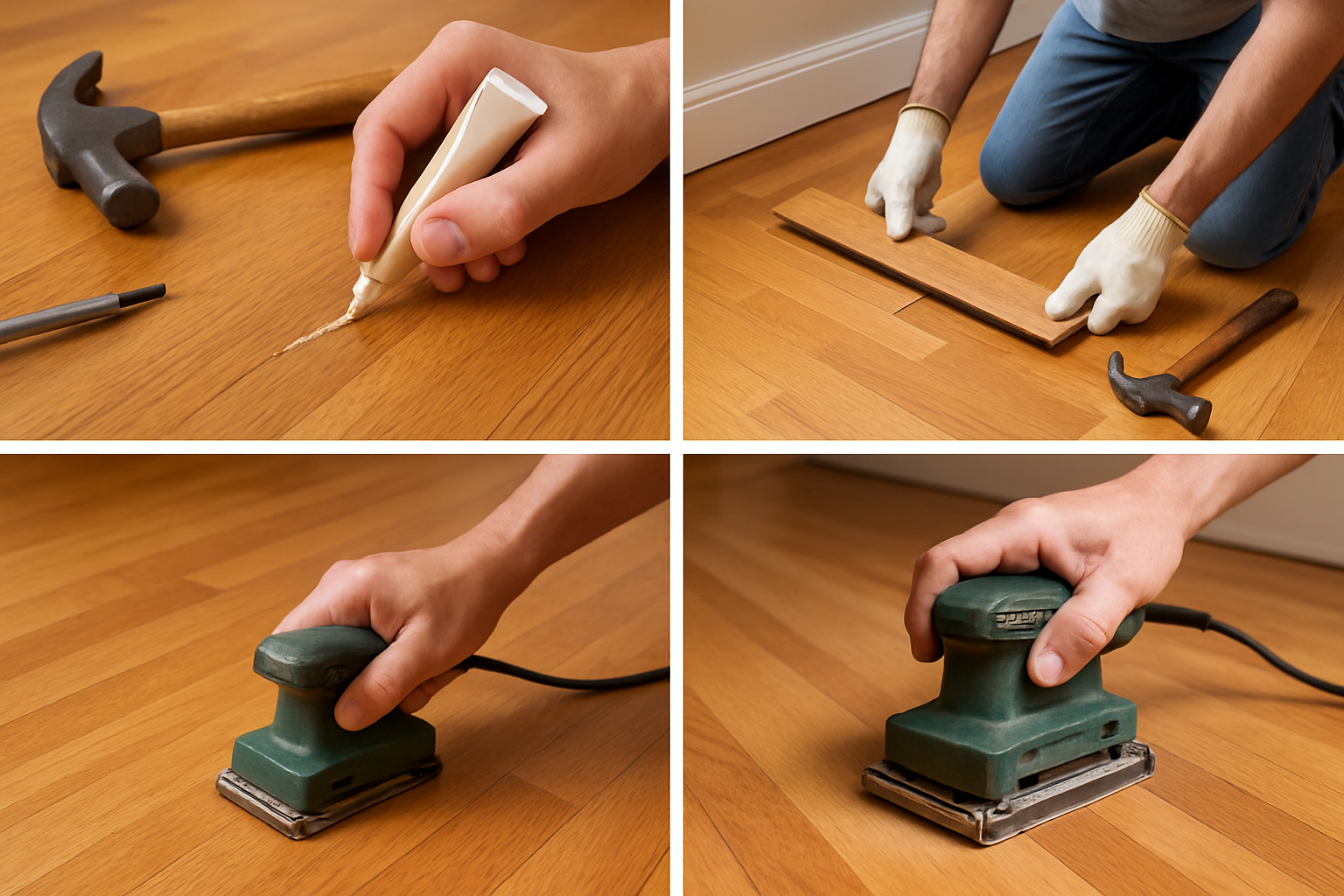
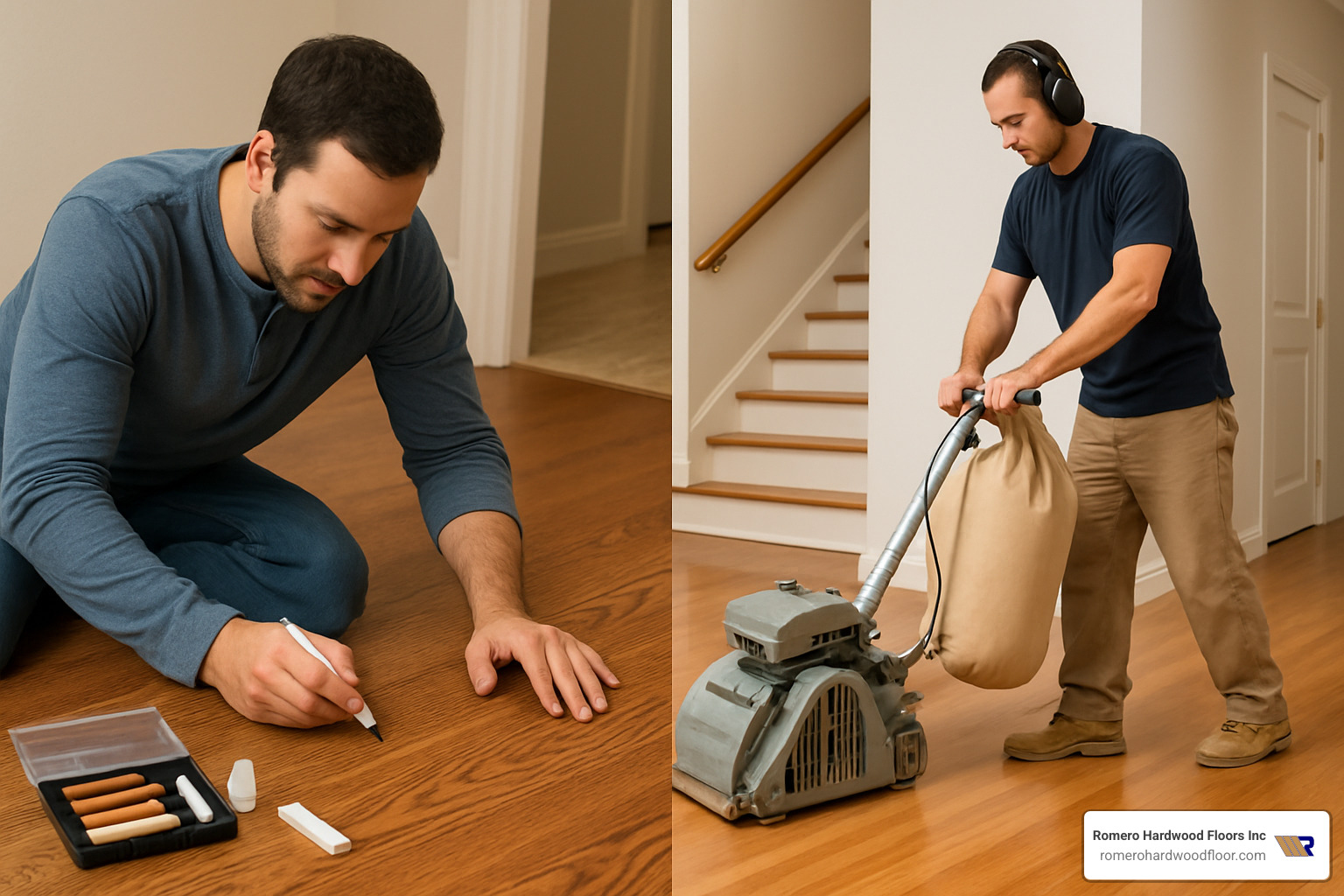
DIY Filler Kits run $25-$100 and include wood filler, matching stain, and application tools. They’re perfect for addressing small scratches and minor dents. Just last month, a homeowner in Swampscott used this method to fix dog scratches in their entryway for only $75.
Board Re-nailing costs $100-$200 and can quickly resolve loose boards causing those annoying squeaks. This typically takes under two hours of professional labor but makes a world of difference in your daily comfort.
Buff and Recoat services ($200-$300) can breathe new life into floors with minor surface wear. This quick refresh applies new polyurethane without the expense of complete refinishing.
Mid-range structural repairs $500–$3,000
When damage goes beyond cosmetic issues, more substantial repairs enter the picture:
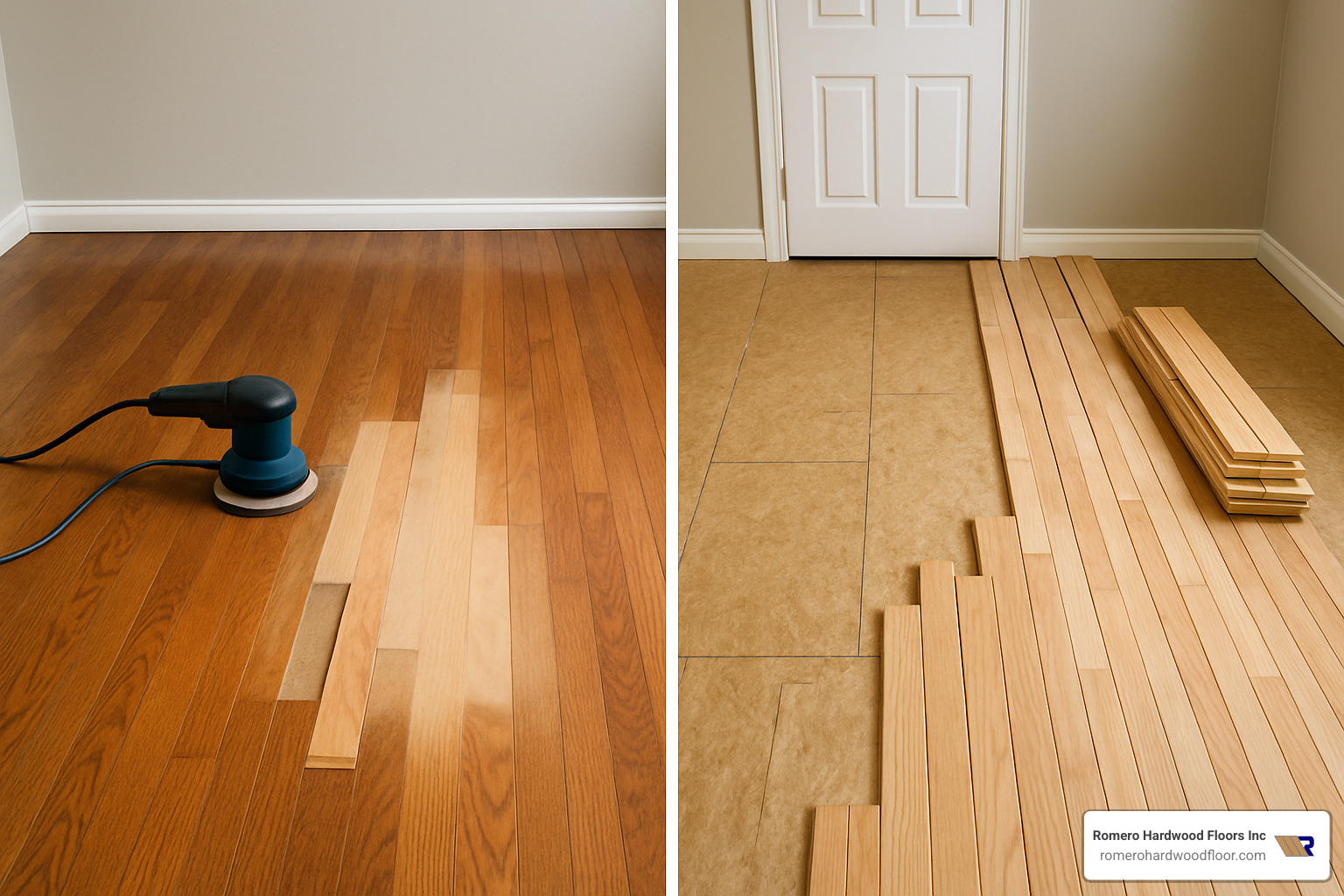
Board Swaps ($500-$1,500) involve replacing individual damaged boards with precisely matched new ones. The price varies based on quantity and accessibility. Recently, we helped a Peabody client replace five water-damaged dining room boards after a refrigerator leak for $950, including matching and refinishing to blend seamlessly with existing flooring.
Localized Refinishing ($800-$1,600) addresses damage affecting a significant portion of a room. This process involves sanding, staining, and applying new finish to make the repaired area indistinguishable from surrounding flooring.
Water Damage Remediation ($1,000-$3,000) tackles moderate water issues by removing affected boards, treating the subfloor, and installing properly finished replacements. This repair is common after appliance leaks or small flooding events.
High-end structural fixes $3,000–$12,000+
Sometimes, problems extend deep below your visible flooring, requiring substantial structural work:
Joist Sistering ($4,000-$8,000) reinforces weakened floor joists by attaching new supports alongside damaged ones. This strengthens your floor’s foundation without complete replacement.
Subfloor Replacement ($3,000-$7,000) becomes necessary when water damage or rot extends below your hardwood. This major repair involves removing flooring to access and replace the damaged subfloor beneath.
Sagging Floor Correction ($5,000-$12,000+) addresses structural issues that cause uneven floors. While expensive, this investment prevents further deterioration of your home’s structure. A Salem homeowner recently required extensive repairs after finding termite damage that had compromised both flooring and joists. The complete repair, including treatment, joist replacement, subfloor installation, and new hardwood, totaled approximately $11,500.
For more detailed information on structural floor repairs, you can review the HUD study on partition wall and floor system connections, which provides valuable insights into how these systems work together in your home.
At Romero Hardwood Floors Inc, we always provide detailed assessments before beginning work, so you’ll know exactly what repairs are needed and what they’ll cost. While these figures represent industry averages based on internet data (not our specific pricing), they give you a general idea of what to expect when budgeting for wood floor repair.
Repair vs. Replace: Which Saves You Money?
One of the most common questions we hear from homeowners staring down at damaged floors is whether they should repair what they have or start fresh. In most cases, repairing hardwood floors is 30-70% cheaper than complete replacement, especially when damage affects less than 30% of your floor area.
To put this in perspective, complete hardwood floor replacement typically costs $7-$25 per square foot installed, varying widely based on wood species and finish quality. For a standard 300-square-foot living room, that translates to $2,100-$7,500 for replacement versus potentially $600-$2,500 for thoughtful repairs.
“Last year, a client in Winthrop was convinced they needed to replace their entire 1920s oak floor due to water damage in one corner,” shares our operations manager with a smile. “By repairing just the affected area and refinishing the whole floor, we saved them over $4,000 while preserving the character of their historic home.”
Beyond immediate cost savings, choosing repair over replacement offers several financial advantages most homeowners don’t initially consider:
Increased home value is a significant benefit – well-maintained original hardwood floors, especially in historic homes, can increase property value by 3-5%. Potential buyers often pay premium prices for authentic, restored features.
Environmental impact matters too – repairing uses fewer resources and produces substantially less waste. This approach might even qualify your home for certain green certifications, an increasingly valuable selling point.
Return on investment typically favors repairs – floor restoration projects generally return 70-100% of their cost in added home value, compared to just 50-80% for full replacements.
When replacement beats repair
Despite the cost advantages of repair, there are honest situations where replacement makes more financial sense:
When extensive water or rot damage affects more than 30% of your floor, the cost of piecemeal repairs may exceed replacement costs. This is particularly true when damage extends to the subfloor or joists, creating a cascade of necessary repairs.
If your floor has undergone multiple past refinishings, you might be running out of wood to work with. Solid hardwood can typically be refinished 4-5 times before becoming too thin. When you’re at that limit and facing severe damage, replacement becomes your only viable option.
During design or functional changes like a major remodel or upgrading to radiant floor heating, combining these changes with floor replacement often proves more economical than tackling them as separate projects later.
When repair is smarter
Repair almost always makes more financial sense in these scenarios:
With historic floors, preservation is golden. Original hardwood in homes built before 1960 often features wood quality and craftsmanship that’s difficult (and expensive) to replicate today. These floors tell stories that new installations simply cannot, and maintaining them through skilled repair preserves both character and property value.
When you have small affected zones – damage limited to less than 20% of your floor area – targeted repairs are almost always more cost-effective than wholesale replacement. This approach is particularly valuable for addressing isolated water damage or pet accidents.
If you’re facing budget constraints, phased repairs allow you to address critical issues now while planning for optional improvements later. This approach lets you spread costs over time while still maintaining a safe, functional floor.
A young family in Medford recently contacted us after finding their new puppy had caused urine damage to several boards in their living room. Rather than replacing the entire floor at a cost of approximately $5,800, we replaced only the affected boards and refinished the room for $1,950 – saving them nearly $4,000 while achieving a result that looked brand new.
Labor, Regional & Hidden Costs You Should Budget For
When planning your wood floor repair budget, it’s easy to focus on the visible damage and forget about the other factors that influence your final bill. Let me walk you through what else you should expect to pay for beyond just fixing those damaged boards.
Professional hardwood floor repair specialists typically charge between $35 and $125 per hour for their expertise. Most repair projects require anywhere from 5 to 30 hours of work, depending on how complex the job is. Here in the Greater Boston area, we tend to see labor rates on the higher end of this spectrum – that’s just the reality of our region’s higher cost of living and the strong demand for skilled flooring professionals.
According to data from the Bureau of Labor Statistics, flooring contractors in Massachusetts earn about 15-20% above the national average. This directly affects what you’ll pay for repairs in our service area around Revere and the surrounding communities.
“Most homeowners budget for materials and labor, but forget about the supporting costs that can add up quickly,” explains our customer service manager. “It’s these hidden costs that often catch people by surprise.”
Cost of wood floor repair and location
Your address plays a surprisingly big role in what you’ll pay for floor repairs:
In dense urban areas like East Boston or Somerville, expect to pay a 10-20% premium compared to suburban locations. This urban premium exists because of higher labor costs and logistical challenges – everything from finding parking for our service vehicles to navigating material deliveries through busy streets adds time and expense.
If you’re in more outlying areas like Manchester-by-the-Sea or Rockport, you might see slightly lower base pricing due to reduced overhead costs, though this advantage is often balanced out by travel charges our team incurs to reach your location.
Seasonal timing matters too. In our New England climate, hardwood floor repair costs typically drop by 10-15% during the slower winter months (January-March). Conversely, summer months, particularly June through August, usually come with peak pricing due to higher demand. If your repair isn’t urgent, scheduling during the off-season could save you hundreds.
One Chelsea homeowner told us: “I saved nearly $300 by scheduling my dining room floor repair in February instead of waiting until my summer gathering. The work was done faster too since the crew wasn’t juggling multiple jobs.”
Surprise add-ons that blow budgets
Beyond the basics, several unexpected factors can significantly increase your repair costs:
Permit fees can range from $50 to $500, particularly when repairs affect structural elements of your home. These fees vary widely depending on which town or city you live in within our service area.
Furniture moving costs between $100 and $300 for most rooms. While Romero Hardwood Floors includes basic furniture moving in our quotes, particularly large, heavy, or fragile items may incur additional charges.
Disposal fees typically run $100 to $500 depending on volume. Removing and properly disposing of damaged wood, especially materials treated with older finishes, often involves special handling and disposal fees.
Mold remediation is a big one that surprises many homeowners. At $15 to $30 per square foot, addressing mold that’s developed beneath water-damaged floors can quickly become the most expensive part of your repair. This specialized service is essential for both your family’s health and ensuring proper repairs.
Subfloor repairs costing $35 to $80 per square foot often become necessary once damaged boards are removed. These hidden problems weren’t visible during the initial assessment but must be addressed before new flooring goes down.
Additional technical services can also impact your bottom line:
Moisture testing ($75-$200) is often necessary for water-damaged floors to ensure the underlying structure is sufficiently dry before repairs begin.
Dustless sanding equipment ($100-$300 premium) protects your home’s air quality during refinishing but comes at an additional cost.
Material delivery ($50-$150) for special order materials, particularly when matching exotic woods, may not be included in initial estimates.
Stain matching ($200-$500) becomes especially important when blending repaired sections with existing floors that have developed a unique patina over time.
A recent client in Winthrop experienced this cascade of costs firsthand. What began as what seemed like a straightforward repair for a few water-damaged boards near their dishwasher revealed extensive subfloor rot once we removed the damaged section. Their initial estimate of $750 ultimately grew to $2,400 once all the necessary repairs were completed.
“I always recommend homeowners budget an additional 20% beyond their initial estimate for hardwood floor repairs,” advises our senior project coordinator. “This buffer helps account for those unexpected issues that often only become visible once work begins.”
The prices mentioned above reflect internet-based averages from national data sources, not actual costs for Romero Hardwood Floors Inc. services. Our pricing is customized to each project’s specific requirements and the Greater Boston area market.
DIY vs. Hiring a Pro: How to Cut Costs Safely
When your beautiful hardwood floors need repair, the question inevitably arises: should you tackle it yourself or hire a professional? The cost of wood floor repair isn’t just about the bottom line—it’s about balancing immediate savings against long-term results.
As a homeowner facing floor damage, you’re right to weigh your options carefully. DIY repairs can save money in some situations, but they can also lead to costly mistakes in others.
“I’ve seen too many homeowners come to us with DIY repairs gone wrong,” shares our senior technician with a sympathetic smile. “What should have been a $300 professional fix ended up costing over $1,000 to correct the DIY attempt.”
When deciding whether to go the DIY route, consider these crucial factors:
Your actual woodworking skills matter tremendously. Those YouTube tutorials make everything look simple, but floor repairs require precision, especially when matching existing wood grain and finishes. Be honest about your abilities before proceeding.
Specialized equipment represents another significant consideration. Professional floor repairs require tools like drum sanders ($75/day rental), floor nailers ($45/day rental), and moisture meters ($30/day rental). These rental costs can quickly add up to $100-$300 per day, eating into your potential savings.
Time investment is another factor many homeowners underestimate. What takes a professional team 4-6 hours might consume your entire weekend or more. How much is your time worth?
Professional repairs typically include workmanship guarantees—often 1-2 years for repairs and up to 5 years for complete refinishing. This protection provides real peace of mind and financial security if problems emerge later.
Some repairs involve potentially hazardous materials (like stripping old finishes) or structural work that carries safety risks. Professional teams have proper training and equipment to handle these situations safely.
Even if you’re hiring professionals, there are smart ways to manage the cost of wood floor repair:
Bundle multiple repairs into one project to save 15-30% through shared setup and material efficiencies. Our clients in Cambridge recently saved nearly $400 by having us address three separate floor issues during a single visit rather than scheduling them individually.
Book during off-season months for the best rates. In the Northeast, scheduling repairs between November and March can save 10-15% compared to peak summer pricing when demand drives up costs.
Consider reclaimed wood for older floors. This approach often provides better character matching at lower cost than new premium materials, especially for historic homes with unique wood species or cuts.
Prepare the work area yourself by removing furniture and old floor coverings before professionals arrive. This simple step can reduce labor costs by $100-$300 depending on room size.
DIY-friendly fixes under $100
Some floor repairs are genuinely DIY-friendly and can save you significant money:
Surface scratch repair kits ($25-$75) work wonderfully for minor scratches that haven’t penetrated through the finish to the wood beneath. These kits typically include wood-colored filler sticks, touch-up markers, and clear topcoat applicators that can make scratches virtually disappear.
Squeaky floor fixes ($15-$50) often require nothing more than identifying the noisy spot and driving specialized screws through the flooring into the subfloor or joists. Kits like Squeeeeek-No-More provide the special screws and a clever breakaway design that leaves no visible hardware.
Stain touch-ups ($30-$80) for small worn areas can be handled with products like Minwax Wood Finish Stain Markers or touch-up kits that include matching stain and polyurethane. These work best on isolated spots rather than large areas.
A homeowner in Melrose recently used a $45 repair kit to address dog scratches in their hallway flooring. The DIY approach saved them approximately $200 compared to professional repair for this minor cosmetic issue.
Pro-only jobs to avoid costly mistakes
While DIY approaches work for minor issues, certain repairs should absolutely be left to professionals:
Water-damaged subfloors require proper assessment and remediation to prevent future structural issues and mold growth. Water damage often extends further than what’s visible, and professionals have moisture meters and thermal imaging to identify the true extent of damage. DIY attempts frequently fail to properly dry and treat affected areas, leading to more expensive problems down the road.
Structural leveling for sagging or uneven floors requires specialized knowledge of load-bearing elements and proper leveling techniques. Improper repairs can compromise your home’s structural integrity and potentially create safety hazards. This is never an area to cut corners.
Large-scale refinishing projects demand professional equipment and expertise to achieve even sanding and consistent finish application. DIY attempts often result in visible lap marks, uneven coloration, or improper cure that can ruin the appearance of your entire floor. Rental sanders are powerful tools that can quickly damage floors in inexperienced hands.
“We unfortunately see many cases where DIY repairs ended up costing more than the original professional quote,” notes our lead technician. “One homeowner in Wakefield attempted to replace water-damaged boards themselves, only to find they’d cut the replacement boards too short and damaged adjacent flooring in the process. The professional correction cost nearly three times what the original repair estimate would have been.”
For comprehensive guidance on techniques professionals use, check out our Step-by-Step Hardwood Floor Repair Techniques guide, which can help you determine which repairs might be within your skill level.
Frequently Asked Questions about the Cost of Wood Floor Repair
How do I estimate my own repair budget?
Figuring out how much to set aside for wood floor repairs doesn’t have to feel like solving a mystery. With a little measuring tape and some detective work, you can create a reasonable ballpark figure before calling in the pros.
Start by measuring the damaged area in square feet—just multiply the length by width. Next, take a close look at what type of wood you’re dealing with. Is it common red oak, maple, or something exotic like Brazilian cherry? The fancier the wood, the deeper you’ll need to dig into your wallet.
Now comes the important part—honestly assessing how bad the damage really is. Those light scratches from moving furniture are a whole different ballgame than the warped, water-damaged boards from when the dishwasher decided to flood your kitchen.
For some rough numbers to work with, minor surface damage typically runs about $2-8 per square foot, moderate damage jumps to $8-25 per square foot, and severe structural issues can soar to $25-80+ per square foot. Always add a 15-20% buffer for those surprise issues that tend to pop up once work begins.
“The most common budgeting mistake we see is underestimating the extent of damage,” explains our estimator. “What looks like surface water damage often extends beneath visible boards, potentially doubling or tripling repair costs.”
Remember though, these DIY calculations only give you a starting point. For peace of mind and accurate pricing, nothing beats having a professional actually see and assess the damage in person.
Does repairing hardwood increase my home’s value?
The short answer is a resounding yes! Investing in your hardwood floors typically offers excellent bang for your buck. Well-maintained hardwood floors can boost your home’s value by 3-5% compared to homes with visibly damaged flooring.
This isn’t just our opinion—the numbers back it up. The National Association of Realtors found that over half of home buyers (54%) are willing to pay more for homes with hardwood floors. Even better, properly maintained hardwood floors usually return between 70-100% of repair costs when you sell.
This value boost is especially pronounced in historic homes throughout our service area. In communities like Marblehead, Salem, and Winchester, where character-rich older homes command premium prices, those original hardwood floors aren’t just flooring—they’re architectural features worth preserving. Many of our clients have shared stories of potential buyers specifically commenting on their beautifully maintained original hardwood during home showings.
Think of hardwood floor repairs as both home maintenance and investment strategy rolled into one sensible package.
How many times can my floors be refinished before they must be replaced?
This question reminds me of asking how many more haircuts you can get before going bald—it really depends on what you’re starting with! The refinishing potential of your hardwood floors primarily comes down to their thickness and previous maintenance history.
For traditional solid hardwood floors (typically 3/4 inch thick), you can usually expect 4-5 refinishing cycles over their lifetime. Each professional sanding removes approximately 1/16 inch of wood. Interestingly, floors in homes built before 1950 often have more refinishing potential left in them because builders typically used thicker materials back then.
Engineered hardwood is a different story. Floors with thin veneer layers (around 1/12 inch) might only support one refinishing in their lifetime. Premium engineered products with thicker wear layers (around 1/6 inch) can usually handle 2-3 refinishings. Some engineered options can’t be sanded at all and require alternative restoration approaches.
Not sure where your floors stand? A professional can check your floor’s remaining thickness at vents, stairways, or by removing a threshold to see the cross-section.
“We recently worked on a 1930s home in Lynnfield with original oak floors that had been refinished twice in 90 years,” shares our senior technician. “The floors still had sufficient thickness for two more refinishings, potentially extending their life another 60 years with proper care.”
With proper maintenance between refinishings, your hardwood floors might actually outlast you in the home!
Conclusion
Understanding the true cost of wood floor repair empowers you to make informed decisions about maintaining one of your home’s most valuable features. While national averages provide useful reference points, actual repair costs depend on your specific situation, including damage type, wood species, home location, and chosen repair method.
At Romero Hardwood Floors Inc., we’ve been serving homeowners throughout Revere, MA and surrounding communities since 2006. Our experience across Beverly, Chelsea, Danvers, East Boston, and beyond has given us unique insight into the specific challenges and costs associated with wood floor repairs in the Northeast.
The average costs discussed in this article are based on internet data and not actual costs for our services. Every repair project is unique, and accurate pricing requires professional assessment of your specific situation.
Whether you’re dealing with minor scratches or major structural issues, we’re here to help with honest assessments, competitive pricing, and guaranteed workmanship. Our commitment to punctuality and quality has made us a trusted partner for homeowners throughout the region.
For a personalized assessment of your floor repair needs, contact Romero Hardwood Floors Inc. today. We’ll help you understand the true cost of your specific repair project and develop a plan that balances budget considerations with lasting quality. The beauty of hardwood floors is that with proper repairs and maintenance, they can continue adding warmth and value to your home for generations to come.
Our team of skilled craftsmen takes pride in restoring damaged floors to their former glory, often saving homeowners thousands compared to full replacement. We believe in transparency throughout the estimation and repair process, ensuring you understand exactly what you’re paying for and why.
Ready to restore your hardwood floors? Visit our hardwood floor repair contractors page to learn more about our services and schedule your free consultation.
