
Engineered hardwood in bathroom: Smart Choice 2025
The Modern Bathroom’s Flooring Dilemma
Engineered hardwood in bathroom installations are more viable than you might think. Here’s what you need to know:
- Yes, you can use it – Engineered hardwood is suitable for bathrooms when properly installed and maintained
- Better than solid wood – Its layered construction provides superior moisture resistance compared to traditional solid hardwood
- Requires precautions – Needs a lacquered finish, proper ventilation, immediate spill cleanup, and strategic use of bath mats
- Best for certain bathrooms – Works well in powder rooms and well-ventilated full baths with proper waterproofing measures
Homeowners face a tough choice when selecting bathroom flooring. You want the warmth and elegance of real wood, but bathrooms are moisture-heavy spaces. Traditional thinking says wood and bathrooms don’t mix.
Over 60 percent of Instagram poll respondents said they would use hardwood in a bathroom. That’s not surprising. Wood brings a spa-like feel that other materials simply can’t match. It creates a seamless flow from bedroom to bath. It adds real value to your home.
But solid hardwood in a bathroom? That’s asking for trouble. Water damage, warping, and buckling are real risks.
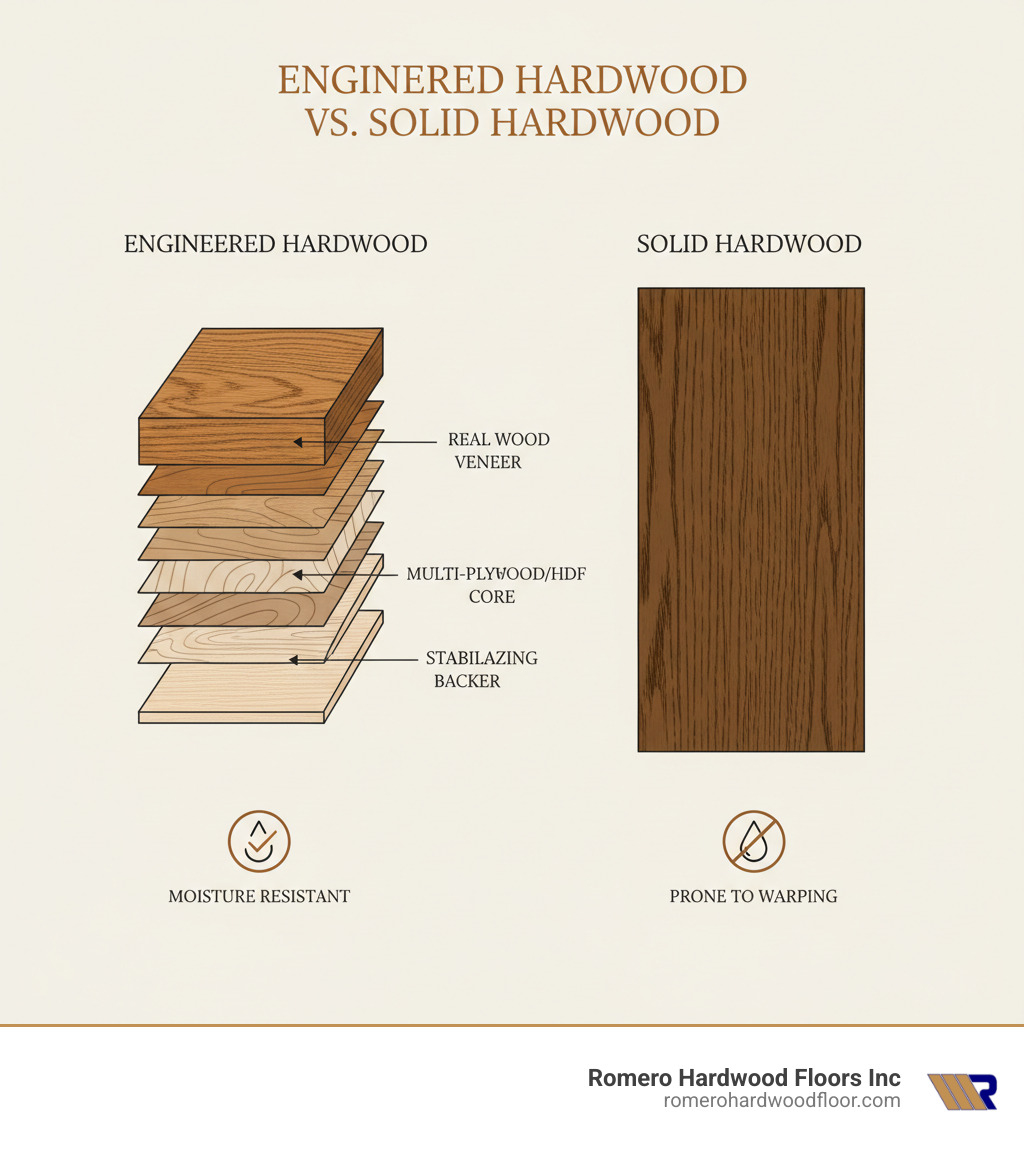
This is where engineered hardwood changes the game. Its multi-layer construction makes it far more stable than solid wood. A real hardwood veneer sits on top of 9 to 11 layers of plywood substrate. Each layer’s grain runs in a different direction. This cross-grain construction resists the expansion and contraction that destroys solid wood floors in humid environments.
The question isn’t whether wood looks good in a bathroom. It does. The question is whether it will last in a bathroom. And whether the extra care it requires fits your lifestyle.
I’m Francisco Romero, and over the past 15+ years at Romero Hardwood Floors Inc., I’ve installed countless floors in bathrooms across Revere and beyond, including many engineered hardwood in bathroom projects that still look beautiful years later. The key is understanding what works, what doesn’t, and how to protect your investment from day one.
What Exactly Is Engineered Hardwood Flooring?
If “engineered wood” sounds like something invented last week in a high-tech lab, you might be surprised to learn it’s been around since the 1960s. Back then, builders needed a solution for covering concrete slab foundations—surfaces that weren’t exactly friendly to traditional solid hardwood. What started as a practical workaround has evolved into one of the most versatile flooring options available, especially for challenging spaces like bathrooms.
So what makes engineered hardwood different from the solid wood floors your grandparents had? It’s all about the layers.
Engineered hardwood flooring consists of multiple layers bonded together with adhesives, creating a sandwich of sorts. The top layer—the one you actually see and walk on—is genuine hardwood veneer. Whether it’s oak, walnut, hickory, or maple, this is real wood that gives you the authentic look and warmth you’re after.
The magic happens underneath. The core typically consists of several cross-ply layers of either plywood or high-density fiberboard (HDF). High-quality engineered floors often feature a real wood veneer glued to 9 to 11 layers of plywood substrate. Here’s the clever part: each layer’s grain runs in a different direction.
This cross-grain construction is what gives engineered hardwood its superpower—stability. When one layer wants to expand from humidity, another layer running perpendicular to it says “not so fast.” This tug-of-war between layers keeps the floor dimensionally stable, making it far more resistant to the temperature fluctuations and humidity that are part of daily life in a bathroom.
Think of it this way: solid hardwood is like a single-minded piece of wood that reacts dramatically to every moisture change. Engineered hardwood is like a team working together to stay calm and steady. That layered stability is exactly what makes engineered hardwood in bathroom installations a realistic option. You can explore more info about engineered hardwood flooring to see how this construction translates into real-world performance.
Why Choose Engineered Hardwood in Bathrooms Over Solid Wood?
Let’s be honest about why wood floors and bathrooms have historically been enemies: solid wood and water don’t play well together.
Solid hardwood is hygroscopic, which is a fancy way of saying it’s a moisture sponge. In a bathroom’s humid environment, solid wood doesn’t need a direct flood to start having problems. The everyday steam from showers, the humidity that lingers after a hot bath, even the moisture from damp towels—it all adds up.
The result? Warping, buckling, cupping, and decay. Solid wood boards can swell, twist, and separate from the subfloor. They can cup upward at the edges or crown in the middle. Once significant moisture damage sets in, you’re often looking at costly repairs or complete replacement. It’s not a matter of if with solid wood in bathrooms—it’s a matter of when.
This is where engineered wood stability changes everything.
That cross-grain construction we talked about earlier? It’s specifically designed to resist the expansion and contraction that destroys solid hardwood. When humidity rises, engineered hardwood stays put. When temperatures fluctuate, it remains stable. The layers working against each other create a floor that’s far more forgiving of bathroom conditions.
Now, let’s be clear: engineered hardwood isn’t waterproof. Leave standing water on any wood floor long enough, and you’ll have problems. But the moisture resistance comparison between solid and engineered wood isn’t even close. Engineered hardwood gives you a fighting chance to enjoy real wood in your bathroom without the constant worry.
That’s why engineered hardwood in bathroom projects have become increasingly popular. You get the warmth and beauty of authentic wood with a level of stability that actually makes sense for moisture-prone spaces.
Can Engineered Hardwood Be Refinished?
Here’s a question we hear all the time at Romero Hardwood Floors Inc: “If I put engineered hardwood in my bathroom, can I refinish it down the road like solid wood?”
The answer is yes—but it comes with an asterisk.
Everything depends on the thickness of your wear layer, which is that top veneer of real hardwood. Think of it as your floor’s reserve tank. A thicker wear layer means more wood to work with when it’s time to sand and refinish.
High-quality engineered floors often feature wear layers thick enough to handle multiple refinishing cycles over their lifetime. Some premium options are designed with substantial top layers that can be sanded several times, just like solid hardwood. This is a genuine advantage, especially for a bathroom floor that might develop minor scratches, wear patterns, or even the occasional watermark over the years.
The refinishing process for engineered hardwood mirrors what we do with solid wood. We carefully sand the top layer to remove imperfections and old finishes, then apply fresh stains and sealants. It’s like giving your floor a fresh start without tearing anything out.
Here’s the catch: not all engineered hardwood is created equal. Cheaper options with thin wear layers might only allow for one light sanding—or none at all. That’s why understanding your floor’s construction before installation matters. It directly impacts how long you can keep extending your floor’s life through professional maintenance.
For a bathroom installation, choosing engineered hardwood with a robust wear layer is smart planning. It means your engineered hardwood in bathroom can be restored to its original beauty years down the line, protecting your investment and postponing the need for replacement.
Want to see what refinishing can do for worn floors? Take a look at our floor refinishing services to understand how we bring tired floors back to life.
Key Benefits of Engineered Hardwood in the Bathroom
When considering bathroom flooring, engineered hardwood in bathroom settings stands out for its unique combination of style and performance. For homeowners in Revere, MA, who want the beauty of wood without the traditional risks, it’s an excellent choice. Let’s break down the key benefits:
| Metric | Benefits of Engineered Hardwood |
|---|---|
| Aesthetics | Offers the natural warmth, beauty, and elegance of real wood. Creates a seamless, high-end look that flows from other living areas. According to a 2022 Remodeling Impact Report, new wood flooring can recover up to 118% of its cost at resale. |
| Water Resistance | Good, but not waterproof. The core is designed to resist swelling and warping from humidity, but standing water can still cause damage. Spills must be wiped up immediately. |
| Durability | Durable and can last for decades with proper care. The top hardwood layer can be scratched or dented. High-quality options can be refinished to remove surface damage. |
| Comfort & Warmth | Significantly warmer and softer underfoot, making it much more comfortable, especially on cold mornings. |
| Maintenance | Requires regular sweeping and cleaning with a hardwood-specific cleaner. Spills must be wiped up immediately. May need refinishing every 10-20 years. |
| Installation | Can be installed as a floating, glue-down, or nail-down floor. Professional installation is highly recommended for bathrooms to ensure proper sealing and moisture protection. |
| Cost | While it can be a higher upfront investment, it adds significant resale value to your home. |
