
How install hardwood floor: Flawless Guide 2025
Before You Begin: Planning and Preparation
#
If you’re wondering how install hardwood floor, the process involves careful planning and execution. The core steps are:
- Prepare the subfloor: Ensure it’s clean, dry, level, and secure.
- Acclimate the wood: Let planks adjust to your home’s temperature and humidity.
- Plan the layout: Determine board direction and stagger joints.
- Install the first rows: Establish a straight line and secure initial boards.
- Continue installation: Use the correct method for your flooring type.
- Handle obstacles: Make precise cuts around vents and doorways.
- Finish up: Install final rows, fill nail holes, and add trim.
Hardwood flooring adds warmth and value to any home, offering lasting beauty and durability. A DIY installation can be rewarding but requires attention to detail.
I’m Francisco Romero, owner of Romero Hardwood Floors Inc. With over 15 years of experience, I know what it takes to how install hardwood floor flawlessly.

How install hardwood floor terms at a glance:
- can you install hardwood floors over tile
- cost of hardwood floor installation
- engineered hardwood flooring installation
Before installation, planning and preparation are vital for a successful, long-lasting result.
Choosing Your Hardwood Flooring
The first step is selecting the right hardwood for your home. You’ll generally choose between solid and engineered hardwood.
- Solid Hardwood: Cut from a single piece of wood, it’s known for longevity and can be refinished multiple times. It’s best for areas with stable humidity and above-grade installations.
- Engineered Hardwood: A top layer of real wood over plywood or fiberboard, this type is more stable against moisture changes. It’s a great option for basements or over concrete subfloors and offers flexible installation methods.
Here’s a quick comparison:
| Feature | Solid Hardwood | Engineered Hardwood |
|---|---|---|
| Construction | Single piece of wood | Veneer of real wood over plywood/fiberboard layers |
| Refinishing | Multiple times | Limited number of times |
| Moisture Resist | Less resistant, prone to expansion/contraction | More stable, better resistance to moisture |
| Installation | Typically nail-down (above grade) | Nail-down, glue-down, or floating (on/above/below grade) |
| Cost | Generally higher initial cost | Can be more budget-friendly, wider range of price points |
| Applications | Living rooms, bedrooms, dining rooms | Basements, over concrete, areas with higher humidity |
The wood species also impacts your floor’s look and performance. Popular choices include durable Oak, rich Walnut, hard Hickory, and warm-toned Maple and Cherry. Wood cuts like plain-sawn or quarter-sawn also affect appearance and stability.
Finally, choose between pre-finished vs. unfinished hardwood. Pre-finished flooring has a durable, factory-applied finish, allowing you to use your floors sooner. Unfinished flooring offers unlimited custom color options as it’s stained on-site.
Gathering Your Tools and Materials
Having the right tools and materials is paramount. For a DIY project, you’ll want:
- Essential Hand Tools: Tape measure, chalk line, pry bar, hammer, nail setter, tapping block, pull bar, and 3/4-inch spacers.
- Key Power Tools: Table saw or circular saw, jigsaw, drill, and a pneumatic flooring nailer (highly recommended).
- Flooring Materials: Hardwood flooring, underlayment, flooring nails or staples, wood putty, and a moisture meter/barrier (especially for concrete).
- Safety Gear: Safety glasses, work gloves, knee pads, and a safety mask.
Key Considerations for How to Install Hardwood Floor
Before starting, consider these crucial points:
- Calculating Square Footage and Ordering Allowance: Measure your room’s square footage and add 10-15% for waste, cuts, and mistakes. Having extra is better than running short.
- Acclimation Importance: This is a non-negotiable step. Hardwood is a natural product sensitive to temperature and humidity. Let the flooring acclimate in the installation room for three to seven days to prevent movement, gaps, or buckling later. Maintain normal living conditions during this time.
- Environmental Conditions: Your HVAC system should be running. The ideal room temperature is 65°F to 75°F, with humidity between 35% and 55%.
- Subfloor Types: Your subfloor type dictates preparation.
- Wood Subfloor: Typically 3/4-inch plywood or OSB. It must be secure, flat (no more than 3/16″ variation in 10 feet), and free of squeaks.
- Concrete Subfloor: Requires careful moisture testing and a proper moisture barrier. Engineered hardwood is usually preferred for its stability.
We also offer specialized services like floor staining for a custom look. More info about floor staining services
The Step-by-Step Guide on How to Install Hardwood Floor
After planning and preparation, it’s time to learn how install hardwood floor and transform your space.
Step 1: Prepare the Subfloor
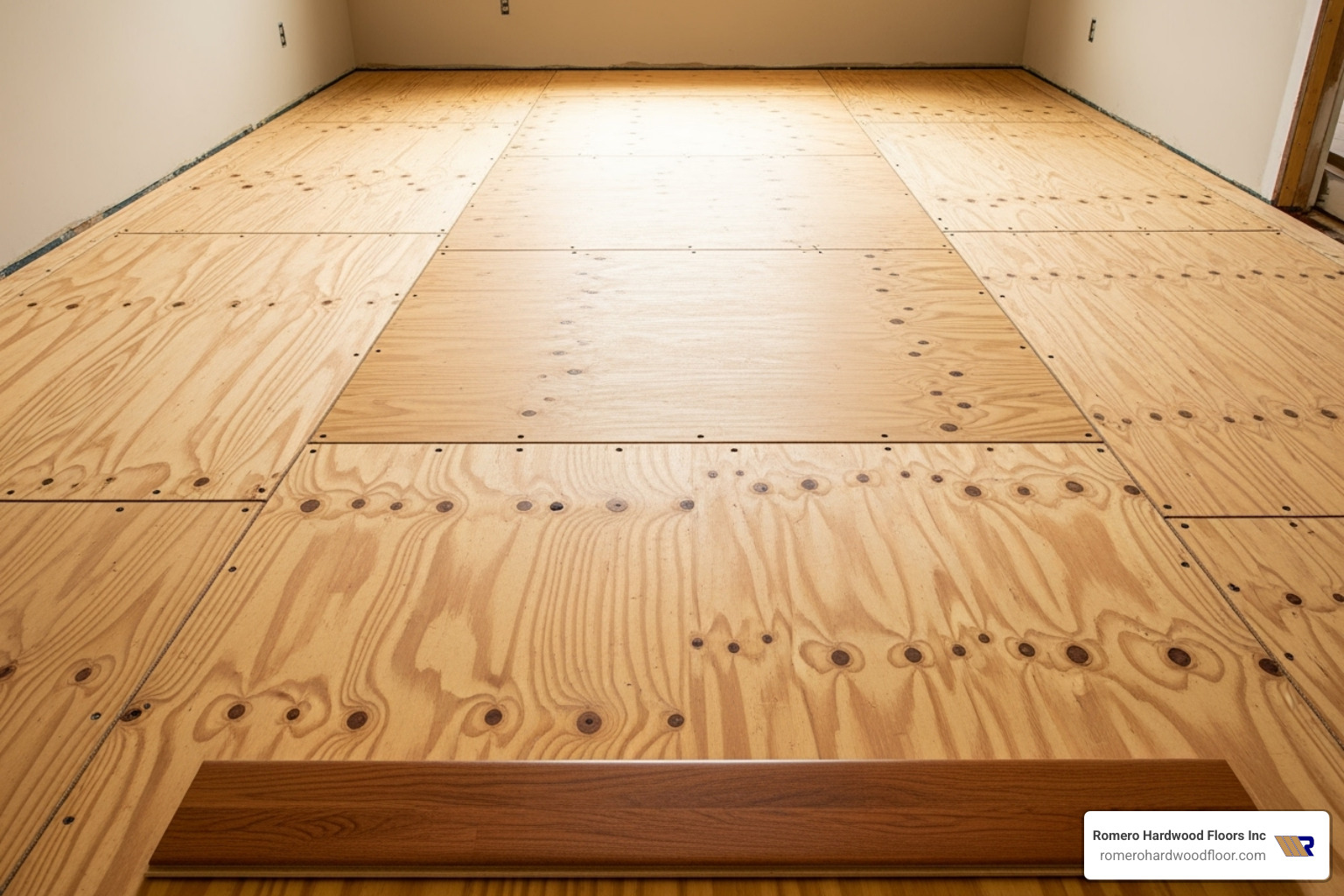
Proper subfloor preparation is critical; shortcuts here can ruin an installation. First, remove old flooring completely. Pull up carpet, vinyl, or tile, and carefully remove baseboards. If you suspect asbestos in older homes, call a professional.
Next, clean the space thoroughly. Vacuum every corner and remove all staples and nail heads, as they can cause squeaks and uneven spots.
Check for levelness with a long level. The subfloor must be flat within 3/16 of an inch over 10 feet. Sand down high spots and fill low areas with leveling compound. This step is essential for professional-looking results.
For wood subfloors, secure any loose panels to prevent squeaks. Finally, install your moisture barrier or underlayment. Concrete subfloors require a moisture barrier, while wood subfloors benefit from asphalt-saturated felt for moisture protection and sound dampening.
Step 2: Plan the Layout and Acclimate the Wood
Patience is key in this step. Your acclimating boards should have been in the room for three to seven days.
Check the moisture content with a moisture meter. The wood should be within 2-4% of the subfloor’s moisture content. Don’t rush this step; give it more time if the numbers don’t align.
Determining board direction affects the room’s feel. Running boards perpendicular to floor joists provides the strongest installation. Laying them parallel to the longest wall can make a room feel more spacious. In square rooms, consider running boards parallel to the main light source.
A pro trick is to rack your boards before permanent installation. Open several boxes and lay out boards, mixing shades and lengths for a natural, random pattern. This prevents awkward color patches.
Staggering joints is crucial for strength and appearance. Keep end joints at least 6 inches apart between adjacent rows and avoid H-patterns or stair-step effects.
Step 3: Choose and Execute Your Installation Method
The method for how install hardwood floor depends on your flooring and subfloor.
| Method | Best For | Main Benefits | Things to Consider |
|---|---|---|---|
| Nail-Down | Solid hardwood over wood subfloor | Very secure, traditional feel, excellent sound absorption | Requires specialized nailer, wood subfloor only |
| Staple-Down | Solid/engineered over wood subfloor | Strong hold, faster installation, cost-effective | Need proper technique to avoid squeaks |
| Glue-Down | Engineered over concrete or wood | Reduces noise, adds stability, works on concrete | Messy process, longer cure time |
| Click-Lock Floating | Engineered hardwood, any subfloor | DIY-friendly, quick install, easy board replacement | Can sound hollow, needs quality underlayment |
Nail-down installation is the standard for solid hardwood. Use a pneumatic nailer to drive fasteners through the tongue at a 45-degree angle every 6 to 8 inches along the board.
Glue-down methods are ideal for engineered flooring over concrete. Spread adhesive with a trowel, working in small sections to prevent it from drying prematurely.
Click-lock floating systems are popular for DIY projects as they don’t require nails or glue. Planks interlock, but you still need to secure the first row and use expansion gaps.
Step 4: Install the First and Final Rows
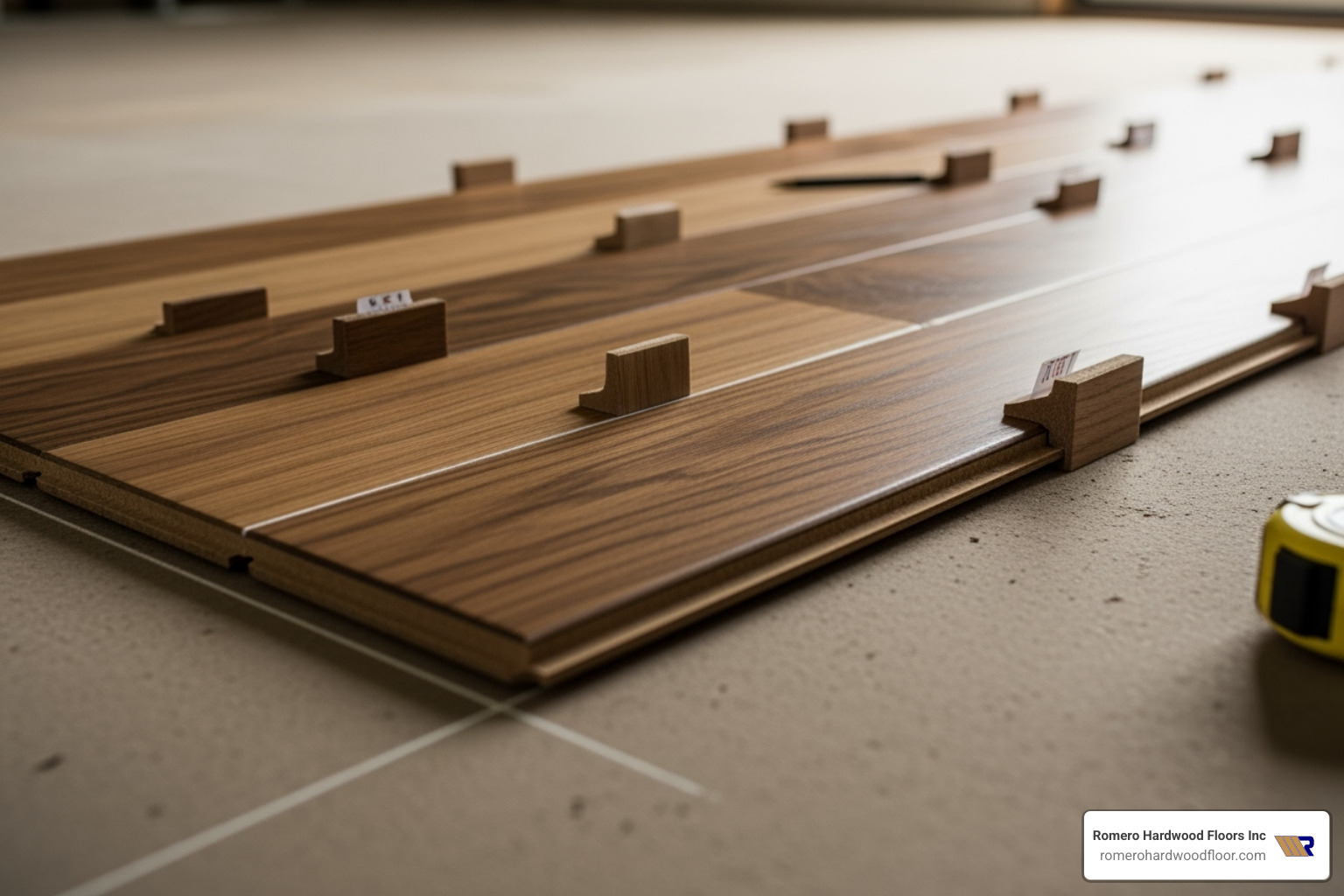
The first row sets the tone. Establish a starting line with a chalk line, accounting for the crucial three-quarter-inch expansion gap. This gap is insurance against buckling.
Use spacers along the starting wall. If the wall isn’t straight, you may need to scribe the first row to match its contours. Face-nail this first row about half an inch from the wall, then countersink the nails.
You’ll likely face-nail the first few rows until there’s enough clearance for the flooring nailer. Then, switch to the nailer for faster installation, maintaining the 6-inch minimum stagger between end joints.
Handling obstacles like vents requires careful measuring and cutting with a jigsaw. Remember to leave small expansion gaps. For doorways, undercut the frame so flooring can slide underneath for a seamless look.
Installing the final rows also requires face-nailing as you run out of nailer clearance. The last row often needs to be ripped lengthwise to fit the remaining space (minus the expansion gap). Use a pull bar to draw the final boards tight before nailing.
If you’re in the Boston area and want professional results, our team handles installations throughout Massachusetts. More info about hardwood floor installation services
Finishing Touches and Long-Term Care
With the main installation complete, it’s time for the finishing touches that make your new floor shine and ensure it lasts.
Final Steps for How to Install Hardwood Floor
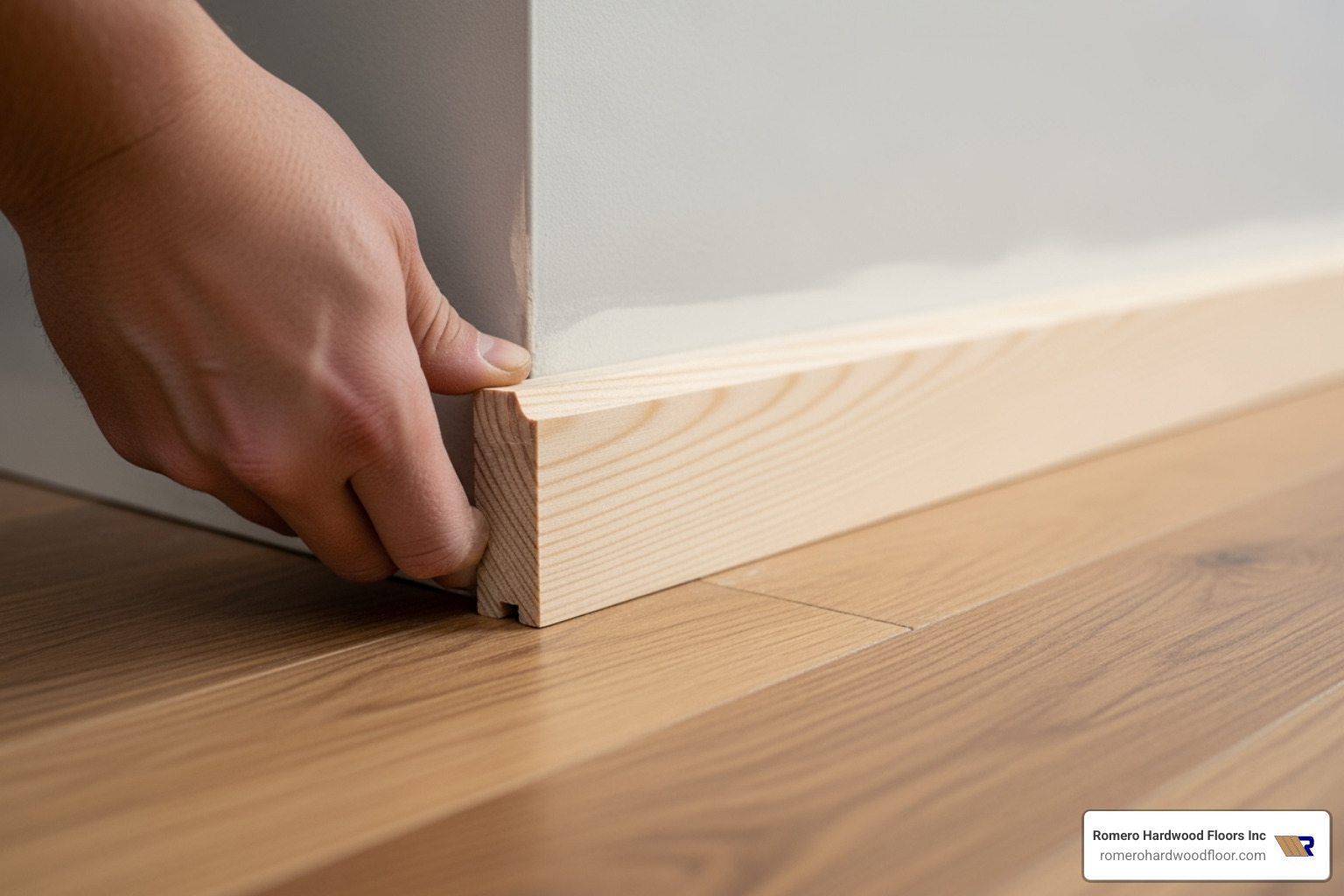
These final steps perfect the look and protect your investment. First, use matching wood putty to fill any visible nail holes from face-nailing. Press it in, wipe away the excess, and let it dry.
Next, re-install your baseboards and shoe molding. This is essential for covering the expansion gap around the room’s perimeter. The golden rule is to nail trim pieces to the wall, not the floor. This allows the hardwood to expand and contract naturally. If the gap is wide, add quarter-round molding for a snug fit.
Finally, install transition strips where your new hardwood meets other flooring, like tile or carpet. These strips create a smooth, safe transition between surfaces.
Caring for Your New Hardwood Floor
Proper care and maintenance are key to enjoying your hardwood for generations. Start with an initial cleaning by sweeping or vacuuming up any dust. Wait 24 to 48 hours before placing heavy furniture on the floor, and always use felt pads under furniture legs to prevent scratches.
For daily care, regular sweeping or vacuuming prevents grit from scratching the surface. For deeper cleaning, use a slightly damp mop, as excess water is a hardwood floor’s enemy. Clean up spills immediately.
Maintaining consistent humidity (between 30% and 50%) is also crucial to prevent the wood from expanding or contracting excessively. A humidifier or dehumidifier can help.
Over the years, your floor may need a refresh. Our team also specializes in floor sanding and refinishing services to restore its original glow. More info about floor sanding and refinishing
Troubleshooting Common Issues
Even with careful installation, minor issues can arise.
- Gaps between boards: Often related to humidity changes or improper acclimation. Increasing home humidity may help close small gaps. For larger gaps, professional advice is best.
- Squeaky floors: Usually caused by movement between boards and the subfloor. A strategically placed finish nail can sometimes quiet a squeak. For stubborn ones, shims added from below the subfloor may be an option.
- Minor burn marks: Small burns can often be gently sanded with fine-grit sandpaper. Apply a matching stain and polyurethane to blend the repair. Many issues like gaps and cupping are tied to improper acclimation or humidity problems.
Frequently Asked Questions about Hardwood Installation
Here are answers to common questions about how install hardwood floor.
Can you install hardwood flooring over a concrete subfloor?
Yes, you can install hardwood over a concrete subfloor, but it requires specific preparation. We almost always recommend engineered hardwood for concrete because its layered construction is more stable and resistant to moisture changes.
The most popular installation methods are glue-down or floating. With the glue-down method, planks are adhered directly to the concrete. For a floating floor, planks click together over an underlayment.
Regardless of the method, the concrete must be clean, completely dry, and level. Any imperfections in the subfloor will be visible in the final result, so this prep step is crucial.
How much extra flooring should I buy?
We always recommend ordering an extra 10-15% of flooring beyond your measured square footage. This overage is an insurance policy for your project.
Why the extra is important:
- Cutting Waste: You will have unusable scraps from cuts made to fit around walls and doorways.
- Mistakes: Extra planks cover any cutting or measurement errors.
- Damaged Boards: It allows you to discard any boards that have defects.
- Future Repairs: Having matching planks on hand for future repairs is invaluable, as finding an exact match years later can be difficult.
Do I have to remove baseboards to install a hardwood floor?
We highly recommend removing baseboards before installation for a professional finish. It’s worth the extra effort for several reasons:
- Hiding the Expansion Gap: Your baseboards are meant to cover the required three-quarter-inch expansion gap that allows the floor to move with humidity changes. Leaving them on results in an unsightly gap or can cause buckling if the floor is installed too tightly against them.
- Clean Installation: Removing baseboards allows for cleaner cuts and a more precise fit.
- Proper Fit: It ensures your new floor can “breathe” and move naturally without being pinched by existing trim.
You can often reuse your baseboards if they are in good condition, or you can take the opportunity to upgrade them.
Conclusion
You now have key insights into how install hardwood floor. This detailed journey is rewarding, adding warmth and value to your home. This guide shows that a DIY installation is possible if you follow two golden rules: preparation is crucial, and patience leads to professional results. Taking the time to get the planning, subfloor prep, and acclimation right will save you headaches later.
However, some projects can feel overwhelming. If your subfloor has unique challenges, or you want the peace of mind that comes with guaranteed, flawless results, bringing in a professional is the best choice.
That’s where we come in. At Romero Hardwood Floors Inc., we’ve been expertly installing hardwood floors in Revere, MA, and surrounding communities like Beverly, Chelsea, Danvers, Peabody, and Somerville since 2006. With over 15 years of experience, we pride ourselves on competitive pricing, punctuality, and guaranteed workmanship. We improve property value with stunning, expert flooring solutions.
Ready to transform your space with beautiful hardwood? We’d love to help. Request an estimate for your project today, and let’s bring your flooring dreams to life.
Like us on Facebook!
