
Solid Hardwood on Concrete Slab: 5 Proven Steps for Success 2025
Why Installing Solid Hardwood on Concrete Slab Is Possible (But Tricky)
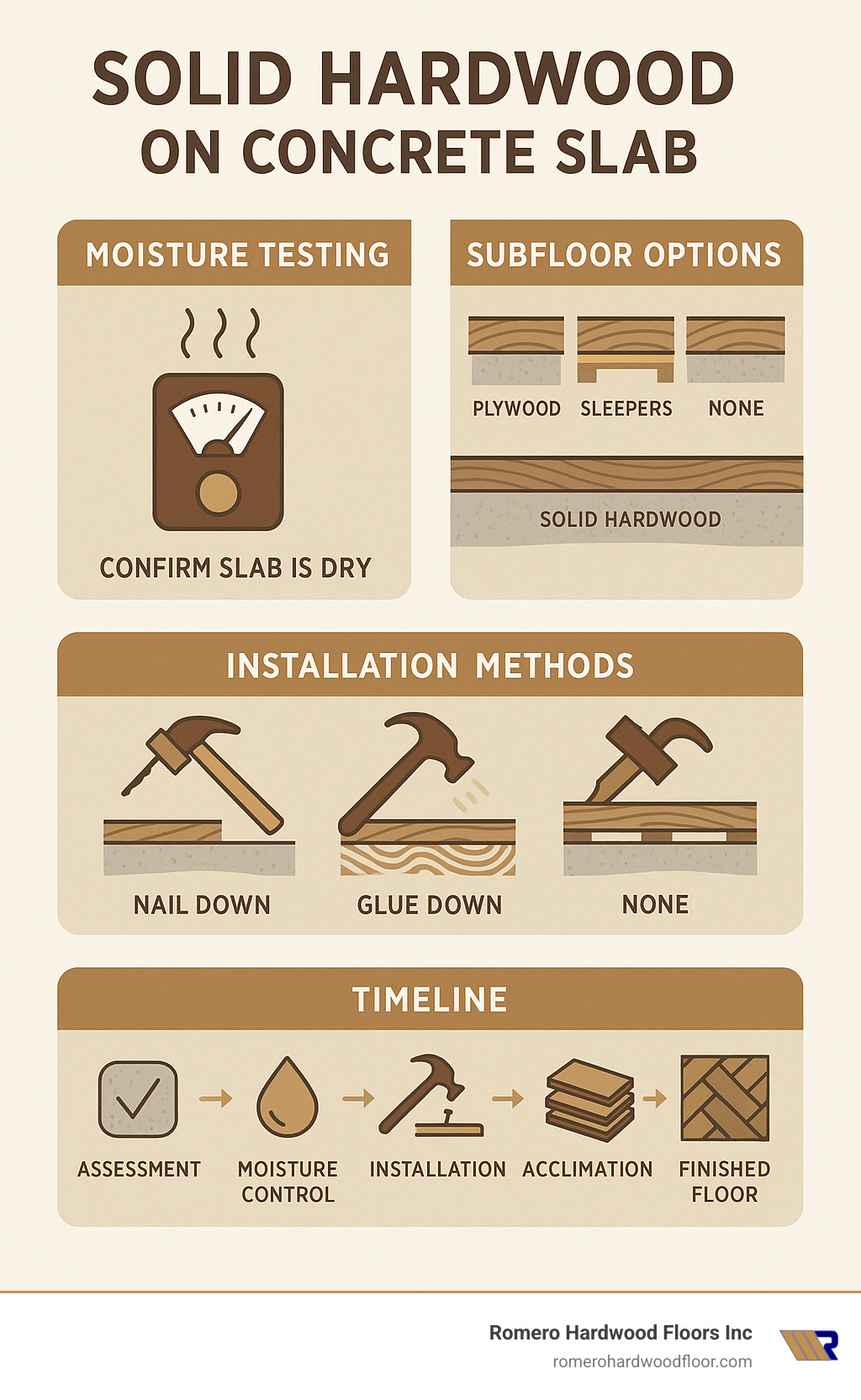
Installing solid hardwood on concrete slab is absolutely doable, but it requires the right approach to avoid costly failures. Here’s what you need to know:
Can You Install Solid Hardwood on Concrete?
- ✅ Yes – on at-grade and above-grade slabs with proper moisture control
- ❌ No – not recommended below grade (basements) due to moisture risks
- 🔧 Three main methods: Plywood subfloor, sleeper system, or direct glue-down
- 💧 Critical factor: Concrete must be dry (30+ days old, proper moisture testing)
- 📏 Flatness requirement: Within 3/16″ over 10 feet
Warning: Research shows that moisture causes upwards of 90% of hardwood flooring failures when installed over concrete slabs. Getting the moisture control right is absolutely critical.
The process involves five key steps: assessing your slab, controlling moisture, choosing an installation method, proper acclimation, and ongoing maintenance. Each step matters for long-term success.
Many homeowners wonder if they can tackle this as a DIY project or need professional help. While some steps are manageable for experienced DIYers, moisture testing and subfloor preparation often require professional expertise to avoid expensive mistakes.
I’m Francisco Romero, owner of Romero Hardwood Floors Inc., and I’ve been installing solid hardwood on concrete slab for over 15 years throughout the Greater Boston area. My team has successfully completed hundreds of these challenging installations by focusing on proper moisture control and choosing the right method for each unique situation.
Explore more about solid hardwood on concrete slab:
- gluing solid hardwood floors to concrete
- heated hardwood floors on concrete
- floating wood floor over concrete
Why Concrete Meets Wood Matters
When concrete and wood come together, we’re dealing with two materials that behave very differently. Concrete is stable and relatively unaffected by humidity changes, while solid hardwood expands and contracts with moisture fluctuations. This fundamental difference is why proper installation techniques are crucial.
The grade level of your concrete slab significantly affects moisture levels and installation viability. Above-grade slabs (second floor and higher) typically have the lowest moisture content, making them ideal for solid hardwood installation. At-grade slabs (ground level) require more careful moisture management but are still suitable with proper preparation. Below-grade installations in basements face the highest moisture risks and are generally not recommended for solid hardwood.
From an investment perspective, successfully installing solid hardwood on concrete can add significant value to your home. However, a failed installation due to moisture issues can be costly to repair and may require complete floor replacement.
Can I Install Solid Hardwood on Concrete Slab?
The short answer is yes, you can install solid hardwood on concrete slab, but success depends heavily on getting the details right. After installing floors for nearly two decades, I’ve learned that the difference between a beautiful, lasting floor and a costly disaster often comes down to understanding when and how to proceed.
The National Wood Flooring Association (NWFA) provides clear guidelines that we follow religiously. The most important factor is slab location. At-grade slabs (ground level) and above-grade slabs (second floor and higher) can work beautifully with proper preparation. The higher your slab sits above ground level, the better your chances of success.
Here’s the sobering reality: moisture causes approximately 90% of hardwood flooring failures when installed over concrete. That statistic keeps me up at night, which is why we never skip moisture testing, no matter how dry a slab looks.
One dangerous myth I encounter regularly is that you can simply glue any solid hardwood directly to concrete. While direct glue-down installation is possible, it requires exceptional conditions. The concrete must be properly cured (at least 30-60 days old), moisture levels must test within strict limits, and you need the right urethane adhesive system. Even then, it’s not suitable for every situation.
For detailed technical guidance, this industry guide on wood over concrete provides comprehensive information that aligns with our installation practices.
Solid Hardwood on Concrete Slab & Building Codes
Before you fall in love with that perfect oak flooring, check your local building codes. Trust me, it’s much easier to research requirements upfront than to tear out a finished floor later.
Soundproofing requirements are particularly strict in condominiums and apartment buildings. Many condo bylaws require specific decibel reduction standards to minimize noise transmission between units. We’ve worked on projects where associations mandated specialized sound-dampening underlayments that add both cost and complexity to the installation.
Height restrictions can catch homeowners off guard. Adding a plywood subfloor system increases your floor height by roughly ¾ to 1½ inches. This might seem minor, but it can create problems with existing doors, kitchen cabinets, or even ceiling clearances in basements.
Weight limits in some buildings restrict the use of heavy leveling compounds or multiple subfloor layers. Additionally, VOC (Volatile Organic Compound) limits are becoming more common, especially in commercial spaces and environmentally conscious residential buildings. Always verify that your chosen adhesives and sealers meet local air quality regulations.
Solid Hardwood on Concrete Slab Below Grade?
I’ll be direct: we strongly recommend against installing solid hardwood below grade. Basements and other below-grade spaces present moisture challenges that even the best installation techniques struggle to overcome.
Below-grade concrete slabs are in direct contact with soil, which means they’re constantly absorbing groundwater and transmitting moisture upward. The humidity levels in these spaces fluctuate dramatically, creating an environment where solid hardwood will likely warp, buckle, or develop more serious moisture-related problems.
I’ve seen too many beautiful basement floors fail within the first year. The disappointment and expense of replacement just isn’t worth the risk.
For basement applications, engineered hardwood offers a much smarter solution. The layered construction provides superior moisture resistance while still giving you that authentic hardwood appearance you’re after. You can learn more info about engineered wood to understand why it’s often the better choice for challenging moisture conditions.
Concrete Slab Assessment & Preparation
Think of slab assessment like getting a physical before surgery – you need to know exactly what you’re working with before diving in. After 15 years of installing solid hardwood on concrete slab, I can tell you that skipping this step is the fastest way to an expensive disaster.
The concrete itself tells a story. Fresh cracks, spalling around edges, or curling at expansion joints are red flags that need attention before any flooring goes down. Small hairline cracks? Usually no problem – we can seal those. But if you’re seeing structural cracks wider than a credit card, call in a concrete professional first.
Flatness is non-negotiable for a quality installation. The industry standard is no more than 3/16″ variation over 10 feet, and trust me, your floor will telegraph every bump and dip if you ignore this. I use a 10-foot straight edge and slide it across the entire slab, marking any problem areas with chalk.
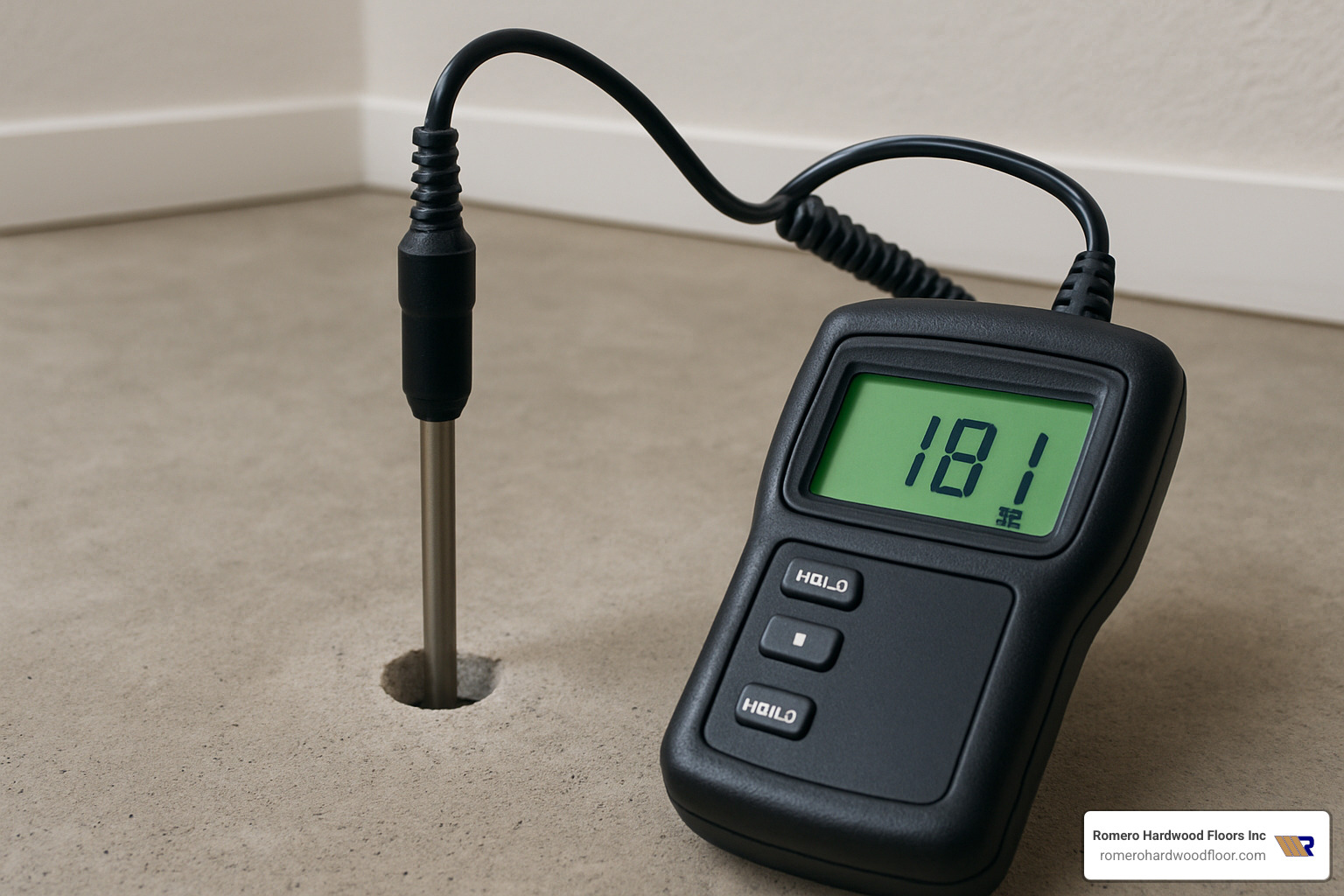
But here’s where most DIYers get into trouble: moisture testing. This isn’t optional, and it’s not something you can eyeball. We use ASTM F2170 relative humidity probes drilled right into the slab for the most accurate readings. The old calcium chloride test works too, but it’s less precise.
Here’s something that drives me crazy: builders who want to install flooring on 30-day-old concrete. Yes, the slab might be technically “cured,” but it’s nowhere near dry enough. Plan on 60 days minimum, and that’s for thin slabs in perfect conditions. Thicker slabs take even longer – roughly one month per inch to properly dry out.
Don’t forget to test surface porosity either. Drop some water on the slab and watch what happens. If it beads up like water on a waxed car, you’ve got a sealed surface that won’t bond properly. This means grinding or etching before you can proceed.
The vapor emission rate matters too, especially if you’re planning a glue-down installation. High emissions can break down adhesives over time, leading to loose planks and squeaky floors.
Leveling & Flattening Best Practices
When your slab fails the flatness test (and many do), you’ve got options. Grinding high spots is usually the cheapest fix for minor problems. Rent a good concrete grinder with dust collection – your lungs and your neighbors will thank you.
For low spots or more serious leveling issues, self-leveling compounds are your friend. But not all levelers are created equal. Choose products specifically designed for wood flooring – some general-purpose compounds don’t provide the right surface for adhesion.
Weight limits can throw a wrench in your plans, especially in condos or upper floors. Heavy leveling compounds might exceed building load limits, forcing you to grind instead of pour. Always check with your building management before bringing in tons of concrete.
The key is knowing when to call in professionals. Simple grinding? You can probably handle it. Complex leveling with multiple products? That’s when experience really pays off. For quality leveling solutions, specialized suppliers can guide you to the right products.
Moisture Barriers & Vapor Retarders
This is where the magic happens – or where everything falls apart. Proper moisture control is absolutely critical for solid hardwood on concrete slab installations. The NWFA is crystal clear: you need a vapor retarder with a perm rating of 0.15 or less.
6-mil polyethylene sheeting is the workhorse of the industry. It’s cheap, effective, and proven. Overlap those seams by at least 4 inches and seal them with quality tape. Sounds simple, but I’ve seen installations fail because someone got sloppy with the overlaps.
Liquid moisture barriers like Bostik MVP make life easier, especially on uneven slabs. Roll it on with a notched trowel, and it self-levels to create a seamless barrier. The downside? You’ll wait 72 hours for it to cure, and it costs more upfront.
Asphalt felt with mastic is the old-school method that still works great. It’s more labor-intensive, but some installers swear by it for problem slabs. Coverage runs about 50 square feet per gallon with a notched trowel.
| Barrier Type | Cost | Ease of Install | Effectiveness | Best Use |
|---|---|---|---|---|
| 6-mil Poly | Low | Moderate | High | Most installations |
| Liquid MVP | Medium | Easy | Very High | Uneven slabs |
| Asphalt Felt | Medium | Difficult | High | Traditional method |
| Combination | High | Moderate | Highest | Problem slabs |
For more detailed information on moisture control strategies, check out our guide on sub-slab moisture control.
Installation Methods for Solid Hardwood on Concrete Slab
When it comes to installing solid hardwood on concrete slab, you have three main paths to choose from. Each method has its own personality, if you will, and the right choice depends on your specific situation, budget, and what you’re trying to achieve.
Let’s talk money first because, let’s face it, that’s usually the first question. Based on internet averages, you’re looking at total installation costs ranging from $6 to $20+ per square foot, including materials and labor. These are general estimates from various online sources, not actual pricing from Romero Hardwood Floors. The wide range reflects the significant differences between methods and local market conditions.
Your plywood subfloor system is like the luxury sedan of hardwood installations. It adds about 3/4″ to your floor height but gives you that solid, traditional feel underfoot that many homeowners love. This method lets you nail down your hardwood just like you would over a wooden subfloor, and you can refinish the floor multiple times over its lifetime.
The sleeper system is the engineering solution. It creates an air gap under your floor using 2×4 lumber, which helps with moisture management and even allows for insulation. Think of it as building a mini floor system right on top of your concrete.
Then there’s the direct glue-down method, which is the minimalist approach. It adds almost no height to your floor, but it demands absolutely perfect moisture control. When done right, it works beautifully. When done wrong, well, let’s just say it can get expensive quickly.
Each method affects how your floor feels and sounds. Nail-down systems over plywood or sleepers feel solid and traditional. Glue-down installations have a slightly different feel underfoot and may transmit more sound between floors.
Here’s something crucial: if you have radiant heating in your concrete slab, not all methods play nicely with that setup. Some manufacturers won’t honor warranties if you don’t follow their specific requirements for radiant installations.
Plywood Subfloor System
The plywood-on-slab method is our go-to recommendation for most solid hardwood on concrete slab projects. It’s tried and true, and there’s something reassuring about installing hardwood the traditional way, even when you’re starting with concrete.
You’ll want exterior-grade plywood, minimum 5/8″ thick, though 3/4″ is better if your ceiling height allows it. The plywood can either be fastened directly to the slab or installed as a floating system. When we fasten it down, we use powder-actuated fasteners or concrete screws every 6-8 inches around the edges and every 12 inches throughout the field.
Floating plywood systems avoid puncturing your vapor barrier, which some installers prefer. However, you need to be careful about panel gaps and expansion. Leave 1/4″ to 1/2″ gaps between panels and a full 3/4″ at the walls. Install the panels diagonally to your finished flooring direction so the panel edges don’t telegraph through your beautiful new hardwood.
The beauty of this system is that it feels exactly like a traditional hardwood floor. You can refinish it multiple times, and most contractors are comfortable working with it. The downside? You’re adding about 1.5″ total height to your floor, and it costs more in both materials and labor.
For a deeper dive into this approach, check out our detailed guide on the plywood method.
Sleeper System
The sleeper system is like building a tiny house frame right on your concrete. You embed kiln-dried 2×4 lumber in asphalt mastic, spacing them 6-7 inches on center. This creates a nailing surface for your hardwood while providing that all-important air gap underneath.
The lumber must be kiln-dried to prevent it from moving around as it adjusts to moisture changes. Embed the sleepers in ribbons of asphalt mastic, stagger the end joints by at least 4 inches, and make sure everything is level across the entire area. You’ll install polyethylene film over the sleepers before laying your hardwood.
One nice benefit of this system is the opportunity to add insulation between the sleepers. This can make your floor more comfortable and help with energy efficiency. The air gap also provides some ventilation, though it’s not a substitute for proper moisture control at the slab level.
This method gives you that traditional nail-down installation feel while offering good moisture management. The material costs are slightly lower than plywood, but the installation is more complex and requires careful attention to leveling.
Direct Glue-Down Method
Direct glue-down is the method that makes some installers nervous and others swear by it. When conditions are right and it’s done properly, it creates a beautiful, low-profile installation. When conditions aren’t right, it can turn into a very expensive lesson.
The concrete must be properly sealed, moisture levels must be within strict limits, and you absolutely must use the right adhesive system. Products like Bostik’s Best adhesive over a cured MVP vapor barrier can create a rock-solid installation when used correctly.
Apply the adhesive with a 1/4″ V-notch trowel and work in sections you can manage before the adhesive skins over. Expect about 130 square feet of coverage per 5 gallons of adhesive. Use flooring clamps and painter’s tape to hold boards in place while the adhesive cures.
One installer told me, “You couldn’t move these boards with a sledgehammer” once they’re properly cured. That’s the kind of bond you’re looking for.
The advantages are clear: lowest profile, no fasteners required, and it can work over properly sealed slabs. The drawbacks include requiring perfect moisture control, limited refinishing potential, and a different feel underfoot compared to nail-down systems.
For complete details on this challenging but rewarding method, see our guide on gluing solid hardwood floors to concrete.
Alternatives When Slab Conditions Fail
Sometimes your concrete slab just isn’t ready for solid hardwood, no matter which installation method you consider. High moisture levels, structural issues, or building restrictions might require you to consider other options.
Engineered hardwood is usually the first alternative we discuss with clients. It offers the real wood appearance you want with much better moisture resistance. Often, it can be installed directly on concrete with appropriate underlayment, making it faster and less expensive than solid hardwood systems.
Luxury vinyl plank has come a long way in recent years. It’s completely waterproof and much more forgiving of slab imperfections and moisture issues. Some products look remarkably like real hardwood, though you’ll know the difference underfoot.
Tile handles moisture beautifully and can be installed on most concrete slabs with proper preparation. Carpet provides warmth and comfort but requires excellent moisture control to prevent mold problems.
Each alternative offers cost and height advantages compared to solid hardwood installation systems. Based on internet averages, engineered hardwood materials typically run $5-7 per square foot, while luxury vinyl can range from $3-8 per square foot depending on quality. These alternatives also add minimal height to your floor, which can be crucial in some situations.
Acclimation, Maintenance & Long-Term Performance
Getting your solid hardwood on concrete slab installation right doesn’t end when the last board goes down. The real test comes in those first few weeks and months as your floor adjusts to its new home.
Think of acclimation as introducing your hardwood to its new environment before the big commitment. Your wood flooring needs time to adjust to the actual humidity and temperature conditions in your home, not just the warehouse where it’s been sitting.
The moisture content difference between your wood flooring and subfloor is critical. For boards under 3 inches wide, keep this difference within 4%. For wider boards (3 inches or more), that tolerance drops to just 2%. Miss this mark, and you’re setting yourself up for gaps, cupping, or worse.
Store your hardwood in the actual installation rooms for 3-7 days minimum with your HVAC system running at normal settings. Don’t cheat this step by cranking the heat or AC to speed things up. Your floor needs to experience real-world conditions, not artificial ones.
Expansion gaps of 3/4 inch at all walls and vertical surfaces aren’t optional—they’re insurance against buckling when humidity rises. I’ve seen beautiful floors ruined because someone thought they could skip this step to avoid using quarter round molding.
Maintaining indoor relative humidity between 35-55% year-round is your floor’s best friend. Too dry in winter creates gaps. Too humid in summer causes expansion problems. A good humidifier and dehumidifier are worthwhile investments.
Here’s the payoff: properly installed solid hardwood on concrete slab can be refinished multiple times, giving you 50+ years of beautiful flooring. Monitor for wear patterns and plan refinishing before the finish wears completely through to the wood.
Document everything for warranty purposes. Take photos of moisture readings, installation steps, and any issues that arise. Manufacturers want proof you followed their guidelines before honoring warranty claims.
For comprehensive guidance on proper installation procedures, visit our page about acclimation & install.
Acclimating Solid Hardwood on Concrete Slab
Don’t just dump the flooring boxes in the room and call it acclimated. Open those packages and stack the boards with spacers between them. Air needs to circulate around all surfaces for proper moisture adjustment.
Use small pieces of scrap wood or commercial stickers to separate the boards. Think of it like stacking lumber at a yard—air flow is everything. Take moisture readings from both the wood and your subfloor materials using a calibrated moisture meter.
Record daily readings during the acclimation period. You’ll know the wood is ready when moisture content differences fall within spec and stay stable for 24-48 hours. Rushing this step is like baking a cake at double temperature—it never works out well.
Detecting & Preventing Installation Failure
Learn to listen to your floor. Hollow sounds when walking often mean adhesive failure or loose subfloor attachment. It’s your floor’s way of saying “help me” before bigger problems develop.
Cupping (when board edges sit higher than centers) usually signals moisture coming up from below. This is especially common with solid hardwood on concrete slab installations where vapor barriers fail or weren’t installed properly.
Buckling or lifting boards scream expansion problems, typically from excess moisture or insufficient expansion gaps. Address these issues quickly before they spread to other areas.
Check for new cracks in your concrete slab that might allow moisture penetration. Monitor humidity levels and investigate any significant changes in your home’s environment.
Minor settling cracks are normal, but significant concrete movement may indicate foundation issues requiring professional evaluation. Small areas of loose flooring can often be re-secured, but widespread problems usually mean starting over with part or all of the installation.
The key is catching problems early. A few loose boards are fixable. An entire floor that’s failed due to moisture? That’s a much more expensive conversation.
Cost, Height & Feel: Choosing the Right System
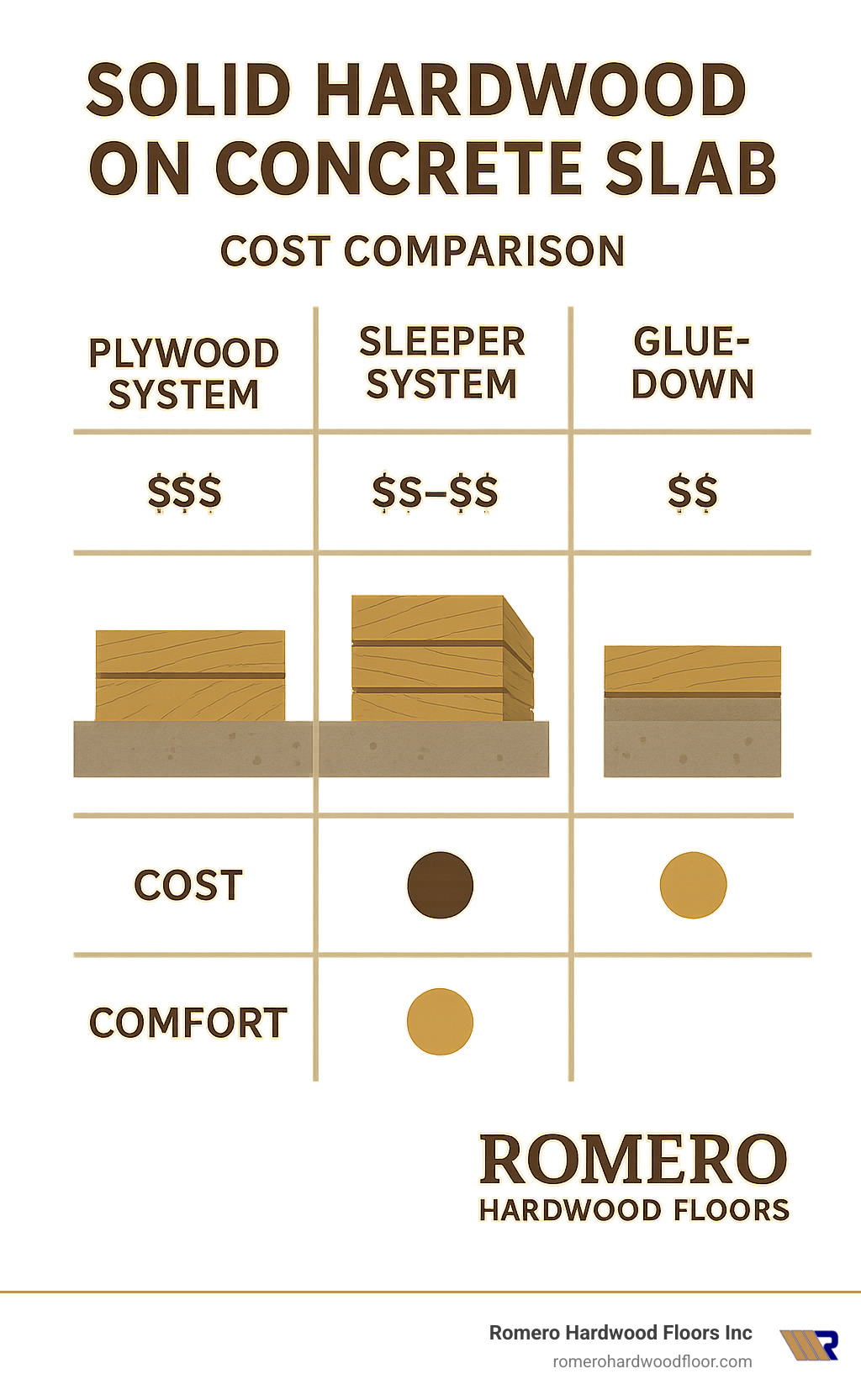
Choosing the right installation method for solid hardwood on concrete slab comes down to balancing three key factors: your budget, how much height you can add, and the feel you want underfoot. Let me break down what you can expect from each approach.
Understanding the Real Costs
Based on internet averages (not specific to our pricing at Romero Hardwood Floors), you’re looking at quite a range depending on your situation. Simple installations might start around $8 per square foot, while complex projects requiring extensive slab preparation can reach $25-30+ per square foot.
The sleeper system typically adds $2-4 extra per square foot compared to direct glue-down, mainly due to additional materials and labor. A plywood subfloor system usually costs $3-6 more per square foot than glue-down because you’re essentially building a floor on top of your slab.
Adhesive systems for direct glue-down run about $1.50-4 per square foot for materials, but remember – this method only works if your slab conditions are nearly perfect. If they’re not, you’ll end up spending more on preparation than you’d save on installation.
Here’s something many homeowners don’t realize: the slab preparation often costs as much as the installation itself. Grinding, leveling, and moisture control can easily add $3-8 per square foot to your project, especially if your slab needs significant work.
Height Impact on Your Space
The height question matters more than most people think. Direct glue-down only adds the thickness of your hardwood (typically 3/4 inch), making it ideal for tight spaces or areas with low clearances under doors.
Both plywood and sleeper systems add about 1.5 inches to your floor height. That might not sound like much, but it can create headaches with existing trim, appliances, and transitions to other rooms. I’ve seen projects where homeowners had to trim door bottoms, adjust cabinet toe-kicks, and even lower light switches.
The Feel Factor
This is where personal preference really comes into play. Nail-down systems over plywood or sleepers give you that solid, traditional hardwood feel that most people expect. When you walk across the floor, it feels substantial and quiet.
Glue-down installations feel slightly different – not bad, just different. Some people describe it as having a bit more “give” underfoot. The sound transmission can also be different, which matters if you live in a condo or have rooms below the installation.
From an acoustic standpoint, nail-down systems generally perform better for sound control between floors. If your building has noise restrictions or you want to be considerate of downstairs neighbors, the extra cost of a subfloor system often pays off in peace of mind.
Making Your Decision
In my experience, most homeowners who can handle the height increase are happier long-term with plywood or sleeper systems. Yes, they cost more upfront, but they provide better moisture protection, feel more solid, and give you more refinishing options down the road.
If height is your main constraint and your slab is in excellent condition, glue-down can work beautifully. Just make sure you’re realistic about the moisture testing and preparation requirements – cutting corners here usually leads to expensive problems later.
The bottom line? Don’t choose based on cost alone. A cheaper installation that fails in two years isn’t really cheaper. Focus on the method that best matches your slab conditions, space requirements, and long-term goals for the floor.
Frequently Asked Questions about Solid Hardwood over Concrete
After installing hundreds of solid hardwood on concrete slab projects over the years, I hear the same questions from homeowners again and again. Let me share the answers to the most common concerns that come up during our consultations.
What vapor barrier thickness is required?
This is probably the most technical question I get, and it’s really important to get it right. For solid hardwood on concrete slab installations, you need a vapor barrier with a perm rating of 0.15 or less – that’s the magic number according to NWFA standards.
Most people think thicker is automatically better, but that’s not necessarily true. A properly installed 6-mil polyethylene film will outperform a thicker barrier that’s poorly sealed. The key is in the details: overlapping seams by 4-6 inches, sealing with quality tape, and making sure there are no tears or gaps.
Liquid-applied barriers like Bostik MVP are another excellent option. They self-level and create a seamless barrier, which eliminates the seam issues you can have with sheet materials. Just remember that liquid barriers need 72 hours to cure properly before you can walk on them.
How flat must my slab be before installation?
Here’s where a lot of DIY projects run into trouble. The NWFA requires concrete slabs to be within 3/16″ over a 10-foot radius or 1/8″ over a 6-foot radius. That might not sound like much, but even small variations can cause major problems down the road.
I always tell my clients to check flatness with a long straight edge or laser level before ordering any materials. High spots need grinding, and low areas need self-leveling compound. Don’t try to “make it work” with an uneven slab – you’ll regret it when boards start rocking or gaps appear.
Floating floors are even pickier about flatness than nail-down systems. If you’re planning a glue-down installation, perfect flatness becomes absolutely critical for proper adhesive contact.
Will radiant heat damage solid hardwood on concrete?
This question comes up a lot in our area, especially with newer construction. The good news is that radiant heating can work with solid hardwood, but it requires careful planning from day one.
The key is keeping surface temperatures at 85°F or less – any hotter and you risk damaging the wood. You’ll also want to choose stable wood species like oak or maple rather than something that moves a lot with temperature changes.
Some installation methods work better with radiant heat than others. Direct glue-down systems tend to transfer heat more efficiently, while plywood subfloor systems create more insulation. Make sure your radiant system installer knows you’re planning hardwood flooring so they can design the system appropriately.
Always follow the flooring manufacturer’s specific guidelines for radiant installations. Some warranties have special requirements, and you don’t want to void your coverage by skipping important steps.
Conclusion
Installing solid hardwood on concrete slab is absolutely achievable when you start with the right foundation of knowledge. The most important lesson we’ve learned after hundreds of installations? Always think moisture first. Get that right, and everything else becomes much more manageable.
Your method selection should match your specific situation perfectly. Need that traditional solid feel underfoot with maximum refinishing potential? The plywood subfloor system is your best bet. Want better ventilation and insulation benefits? Consider the sleeper system. Working with height restrictions or a well-controlled moisture environment? Direct glue-down might be the answer.
But here’s the thing – the installation is just the beginning of your floor’s story. Proper acclimation sets the stage for success, and ongoing maintenance keeps your investment looking beautiful for decades. Keep those humidity levels steady between 35-55%, watch for early warning signs like hollow sounds or cupping, and address any issues quickly before they spread.
At Romero Hardwood Floors Inc, we’ve been mastering the art of solid hardwood on concrete slab installations throughout Greater Boston since 2006. From the coastal challenges in Revere and Salem to the urban environments of Medford and Woburn, we’ve seen every type of concrete slab condition imaginable.
What makes each project successful isn’t just following a checklist – it’s understanding that every slab tells its own story. Some need extra moisture control, others require careful leveling, and a few need creative solutions to work within building restrictions. That’s where our experience really shines.
We’ve built our reputation on competitive pricing, showing up when we say we will, and standing behind our work with guaranteed craftsmanship. When you choose solid hardwood over concrete, you’re making an investment that can add serious value to your property – but only when it’s done right the first time.
Ready to explore your options? Learn more about our professional flooring installation services. Whether you’re dealing with a challenging basement-level slab or a straightforward above-grade installation, we’ll help you steer every step of the process and create a floor that’s built to last.
Your dream of beautiful solid hardwood on concrete slab is closer than you think – let’s make it happen together.
