
Why Understanding Hardwood Sanding Costs Matters
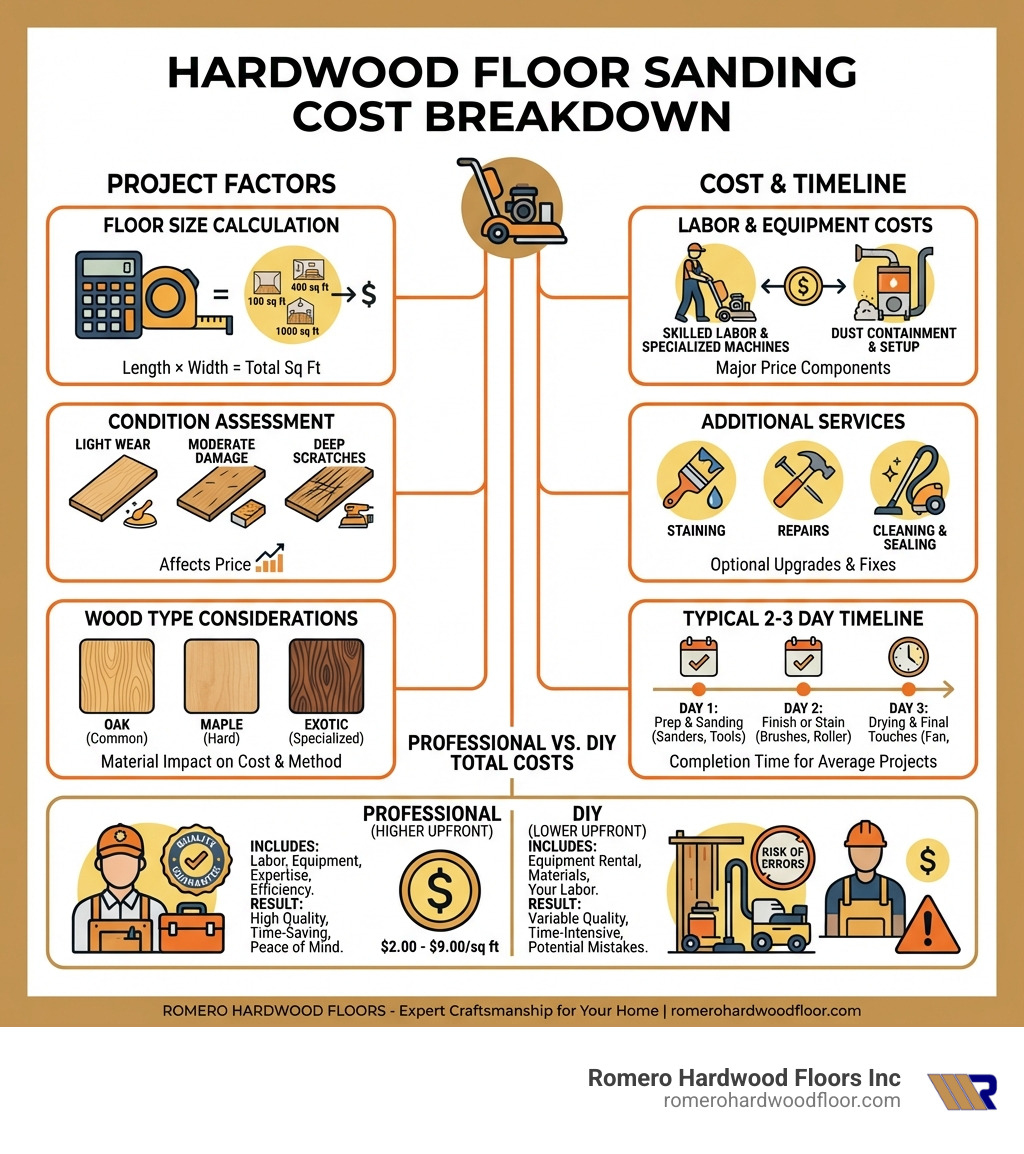
Cost to sand hardwood floors typically ranges from $0.50 to $9.00 per square foot based on national averages, with most professional projects landing between $2.00 and $4.00 per square foot. Here’s what you need to know:
| Room Size | Average Sanding Cost Range* |
|---|---|
| 100 sq ft | $200 – $900 |
| 400 sq ft | $800 – $3,600 |
| 1,000 sq ft | $2,000 – $9,000 |
*Based on internet average data, not Romero Hardwood Floors pricing
Key factors affecting your total cost:
- Floor condition and damage level
- Type of wood (oak, maple, pine, exotic hardwoods)
- Geographic location and local labor rates
- Additional services like staining or repairs
- Choice between professional or DIY approach
If you’ve been quoted a price for hardwood floor sanding, you’re probably wondering if it’s fair. The truth is, sanding costs vary dramatically based on dozens of factors—and without the right information, it’s easy to overpay or choose a service that cuts corners.
Many homeowners in Massachusetts discover that prices for the same 500 square foot room can range from $1,000 to $4,500 depending on the service level. Some estimates seem too good to be true (and usually are), while others feel inflated without clear justification.
The problem isn’t just the wide price range. It’s that most homeowners don’t know what they’re actually paying for. Is that $3 per square foot quote including preparation work? Does it cover edge sanding? What about dust containment? And why does one quote come in at $2 while another is $6 for seemingly identical work?
Understanding these costs helps you make informed decisions, avoid common pitfalls, and ensure you’re getting quality work at a fair price. Whether your floors have light scratches or deep damage, knowing the baseline costs and what drives them higher gives you negotiating power and peace of mind.
I’m Francisco Romero, and I’ve been installing and refinishing hardwood floors in the Boston area since 2006. Through Romero Hardwood Floors Inc., I’ve helped hundreds of homeowners understand the true cost to sand hardwood floors and make smart decisions about their flooring investments.
Key Cost to sand hardwood vocabulary:
- Hardwood Floor Installation Cost Guide
- Wood Flooring Calculator
- Estimated Cost of Installing 1000 Feet of Hardwood Flooring
Understanding the Average Cost to Sand Hardwood
When we talk about the cost to sand hardwood, we are looking at the most labor-intensive part of the floor restoration process. Sanding isn’t just about making the floor smooth; it’s about removing years of wear, old finishes, and deep scratches to reveal the fresh, vibrant wood underneath.
In our experience serving the North Shore and Greater Boston areas, square footage is the primary driver of any estimate. However, it isn’t a simple linear calculation. Smaller jobs often come with a “minimum charge” because the time it takes to transport heavy equipment, set up the dust containment systems, and prep the site is the same for a 100-square-foot hallway as it is for a 500-square-foot living room.

Based on internet average data, professional sanding and refinishing typically costs between $3 and $8 per square foot. However, if you are looking specifically at the “sanding only” portion of a project, those costs can range from $0.50 to $3.00 per square foot. It is important to note that most reputable contractors (including us) rarely perform “sanding only” without applying a finish, as leaving bare wood exposed to the humidity of Massachusetts can cause the boards to warp or stain almost immediately.
Here is a breakdown of how project size influences the total bill, based on wide-ranging internet averages:
| Project Scope | Square Footage | Est. Cost Range (Internet Average)* |
|---|---|---|
| Small Room / Entryway | 100 sq ft | $300 – $1,200 |
| Average Living Room | 400 sq ft | $1,200 – $4,800 |
| Full Main Floor | 1,000 sq ft | $3,000 – $12,000 |
| Large Estate | 3,000 sq ft | $9,000 – $30,000+ |
*Note: These are average costs based on internet data and are not actual costs for Romero Hardwood Floors.
For more details on the specific steps involved in a professional job, you can explore our page on professional sanding services.
Breaking Down the Cost to Sand Hardwood per Square Foot
If you are trying to calculate a budget, you will see a lot of conflicting numbers online. Some sources suggest you can get your floors done for $2.00 a foot, while premium service options might be valued at $9.00 or more.
Why the massive gap? It usually comes down to the level of detail. A “basic” sand might only involve two passes with a drum sander. A high-end, professional sand involves multiple passes with progressively finer grits (typically 36, 60, 80, and 100), detailed edging, and a final buffing or “screening” to ensure the surface is perfectly smooth before the first coat of finish.
Based on internet data, here is the range of what you might pay per square foot for different levels of service:
- Sanding Only (Bare Wood): $0.50 – $3.00 per sq ft.
- Sanding & Refinishing (Standard): $3.00 – $8.00 per sq ft.
- Specialty Sanding (Exotic woods/Historic restoration): $6.00 – $14.00 per sq ft.
If you want to get a more tailored idea for your specific home, we recommend using a detailed cost calculator to plug in your room dimensions.
Regional Pricing and Massachusetts Market Trends
Location matters—a lot. In Massachusetts, we face higher labor costs and stricter environmental regulations than many other parts of the country. Whether you are in a historic home in Salem or a modern condo in Somerville, the local market dictates the price.
In urban centers like Malden, Medford, or Chelsea, service providers have to deal with parking challenges, narrow staircases, and the logistical nightmare of hauling a 200-pound drum sander into a third-floor walk-up. These “hidden” labor factors are why a project in Malden might cost 20% more than a similar project in a more rural part of the state.
We take pride in our local roots. If you are looking for specific insights into your neighborhood, check out our guide on hardwood floor sanding in Malden MA to see how we handle local projects.
Factors That Influence Your Total Sanding Estimate
Not all floors are created equal. When we walk into a home in Peabody or Lynnfield to provide an estimate, we aren’t just looking at the size of the room. We are looking at the “story” the floor tells.
The condition of your floor is the biggest “X-factor.” A floor that has been buried under carpet for thirty years might have hundreds of staples that need to be pulled by hand. A floor in a kitchen might have layers of wax or grease that clog up sandpaper, requiring us to use three times as many abrasive belts as a standard bedroom.
One of the most important aspects of a professional estimate is the safety protocol. Sanding creates an incredible amount of wood dust. According to scientific research on wood dust safety, prolonged exposure to fine wood particles can be a health hazard. This is why we invest heavily in dust-containment systems. If dust control is not mentioned, it may be a sign of cost-cutting by letting that dust settle into your HVAC system and furniture—a “saving” that costs you much more in cleaning later.
Ready to see what your specific project might look like? You can request a professional estimate directly from our team.
How Wood Type Impacts the Cost to Sand Hardwood
Believe it or not, the species of wood under your feet changes the cost to sand hardwood.
- Oak and Cherry: These are the “bread and butter” of Massachusetts homes. They sand predictably and are generally included in standard pricing ($3–$5 per sq ft internet average).
- Maple and Mahogany: These are much denser. Maple is notoriously difficult to sand because it is so hard; if the technician isn’t careful, the sander will leave “chatter marks” that only show up after the finish is applied. Expect to pay a premium for these woods ($6–$18 per sq ft internet average).
- Pine: Because pine is soft, it “clogs” the sandpaper with resin. We often have to change belts twice as often, which increases material costs.
- Engineered Hardwood: This is the trickiest of all. Engineered floors have a thin “wear layer” of real wood on top of plywood. If you sand too deep, you’ll hit the plywood and ruin the floor. Only experienced pros should handle refinishing engineered hardwood.
Condition and Preparation Requirements
Before the big machines even turn on, there is preparation work.
- Deep Scratches and Gouges: If a dog has spent ten years “digging” into the entryway, we have to sand deeper into the wood to level it out. This removes more of the floor’s lifespan.
- Pet Stains: Urine stains often turn the wood black. Sometimes sanding can’t fix this, and we have to perform a “patch” or board replacement.
- Carpet Removal: If we have to rip up old carpet and pad, expect an additional charge of $1.00 to $5.00 per square foot (internet average).
For a deeper look at how we handle these challenges, visit our page on hardwood floor repair and refinishing.
Professional Sanding vs. Doing It Yourself: What to Consider
We get it—the “DIY itch” is real. You see the rental sander available for $60 a day and think, “I can save a fortune!” But before you head out, there are some harsh realities to consider.
The biggest risk of DIY sanding is the drum sander itself. These machines are powerful. If you pause for even a second while the drum is down, you will create a permanent “dip” or gouge in your floor that no amount of finishing can hide. We have spent years perfecting the “feathering” technique required to keep the floor perfectly flat.
Furthermore, rental machines are often poorly maintained. A wobbly drum or a worn-out belt on a rental machine can leave “waves” across your entire floor. By the time you realize it, you’ve already sanded away a significant portion of your floor’s thickness.
For more on why homeowners in Saugus and Stoneham choose the pro route, read our article on why hire a professional for hardwood floor sanding.
The Real Cost of DIY Materials and Rentals
When you calculate the DIY cost to sand hardwood, don’t just look at the machine rental.
- Rental Package: $200 – $600 per week for the drum sander and edger.
- Abrasives: You will need dozens of belts and disks. If you buy the cheap ones, they’ll snap.
- Safety Gear: Respirators, eye protection, and ear muffs are non-negotiable.
- Finishes: A high-quality finish like Bona Traffic HD can cost $150 per gallon.
Based on internet average data, a DIY project for a 400-square-foot area typically costs between $400 and $1,500. When you realize that a professional might do the same job for a bit more—and finish it in half the time with a guarantee—the “savings” of DIY start to look like a lot of hard labor for a risky result.
Why Professional Results Command a Premium
When you hire Romero Hardwood Floors Inc., you aren’t just paying for the machine; you’re paying for master craftsmanship.
- Dust Containment: Our professional vacuums capture 99% of the dust at the source.
- Insurance: If a DIYer hits a water pipe or an electrical wire under the floorboards, they are on the hook. We are fully insured and bonded.
- Speed: What takes a DIYer a week, we can often complete in 2–3 days.
Check out our professional refinishing standards to see how we maintain high quality across all our service areas.
Beyond the Sanding: Additional Service Costs to Consider
Once the sanding is done, you have a blank canvas. This is where the aesthetic magic happens, but it’s also where the costs can climb.
The choice of finish is critical. Most homeowners choose between oil-based and water-based polyurethane. Water-based options are popular in places like Marblehead and Swampscott because they dry faster and don’t have that heavy chemical smell, but they are typically more expensive.
To see our favorite options, visit our recommended finishes and coatings page.
Staining and Custom Color Finishes
Do you want a classic natural oak look, or are you dreaming of a modern “Ebony” or “Jacobean” dark finish?
- Natural Finish: Included in most standard refinishing quotes.
- Staining: Adding a color layer usually adds $1.00 to $9.00 per square foot (internet average data). This is because it adds an entire day to the process and requires meticulous cleaning to ensure no dust particles are trapped in the pigment.
Explore our color refinishing guide to see how different stains look on various wood species.
Stairs, Furniture, and Specialized Labor
Don’t forget the details!
- Stairs: Sanding a staircase is almost entirely handwork. It is slow and physically demanding. Internet averages suggest a cost of $40 to $225 per stair tread.
- Furniture Moving: It is standard for rooms to be empty. If you need us to move your heavy piano or dining set, expect a fee of $50–$150 per room.
- Vents and Trim: Removing and replacing baseboards or shoe molding is often a separate line item.
If you are in the North Shore area, you can find more specific local info on our hardwood floor sanding in Peabody MA page.
Refinishing vs. Replacing: Which is More Cost-Effective?
This is the million-dollar question. Is it better to save the old floor or just tear it out and start over?
In 90% of cases, refinishing is the winner. Refinishing usually costs about 1/3 the price of a new installation. When you install new floors, you aren’t just paying for the wood; you’re paying for the demolition of the old floor, subfloor preparation, the new material, and the labor to install and finish it.
So, is refinishing hardwood floors worth it? Absolutely. It preserves the original character of the home and is much more environmentally friendly.
Comparing Long-Term Value and ROI
Hardwood floors are one of the few home improvements that offer a nearly 100% return on investment. A freshly sanded and refinished floor can increase your home’s resale value by thousands of dollars. Buyers in competitive markets like Winchester and Reading specifically look for well-maintained original hardwoods.
For a broader look at the numbers, check out our hardwood flooring cost guide.
When Sanding is No Longer an Option
Sometimes, the floor is just too far gone.
- The “Three-Sanding” Rule: Most solid hardwood can only be sanded 3–5 times in its life. If you can see the “tongue and groove” or the nails peeking through, the wood is too thin to sand again.
- Structural Damage: If there is widespread rot or severe water damage that has buckled the subfloor, sanding won’t help.
In those cases, we pivot to our hardwood floor installation services.
Frequently Asked Questions about Sanding Costs
How long does the sanding and refinishing process take?
For a standard 3-room project, expect the process to take about 3 to 5 days.
- Day 1: Site prep and heavy sanding.
- Day 2: Fine sanding, edging, and buffing.
- Day 3: Staining (if applicable) and first coat of finish.
- Days 4-5: Final coats and drying.
For a more detailed breakdown, see how long does it take to sand hardwood floors?.
What is the difference between full sanding and screening?
- Full Sanding: We take the floor down to bare wood. This removes deep scratches and allows you to change the color.
- Screening (Buffing): We only scuff up the very top layer of the existing finish and apply a fresh “top coat.” This is much cheaper ($1–$2 per sq ft internet average) but only works if the wood itself isn’t damaged.
Learn more about sandless floor finishing options.
Are there ways to save money on hardwood floor sanding?
Yes!
- Bundle Rooms: It is much cheaper per square foot to do the whole house at once than to do one room at a time.
- Clear the Area: Move your own furniture and remove the old carpet yourself to save on labor fees.
- Off-Peak Scheduling: Discounts may be available during the slower winter months.
Check out our hardwood floor estimates guide for more pro tips.
Conclusion
The cost to sand hardwood is an investment in your home’s future. While the numbers can seem daunting at first, understanding what goes into a professional quote—from the grit progression to the dust containment—helps you see the value in expert craftsmanship.
At Romero Hardwood Floors Inc, we’ve been serving our neighbors in Revere, MA, and the surrounding towns for nearly two decades. We believe in punctuality, competitive pricing, and workmanship that we can stand behind. Whether you are in Gloucester, Woburn, or East Boston, we are here to help you bring your floors back to life.
Ready to transform your home? Get your free hardwood floor cost estimate today and let’s get started!
