
Adhesive for subfloor: 1 Pro Squeak-Free Floor
Why Proper Subfloor Adhesive Application Determines Your Floor’s Longevity
Adhesive for subfloor systems is the critical foundation component that transforms loose panels and joists into a unified, squeak-free floor assembly. Whether you’re installing hardwood, engineered flooring, or any other floor covering, the right subfloor adhesive prevents the micro-movements that cause squeaks, nail pops, and structural weakness over time.
Key Subfloor Adhesive Options:
- Polyurethane Construction Adhesive – Works on wet, frozen, and treated lumber; 8x more coverage than traditional cartridges
- Solvent-Based Construction Adhesive – Proven formula with excellent bond strength; application range 0°F to 100°F
- Foam Adhesive Systems – Fast-grab tack with 2-hour initial bond; re-startable dispensers for efficiency
Essential Application Requirements:
- Clean joist surfaces free of debris
- Continuous bead application (1/4″ to 3/8″)
- 10-20 minute working time per panel
- Proper fastening within open time
As one Reddit user finded: “I had to add a layer of subfloor and found that the section installed without adhesive squeaked, leading them to remove and re-glue it.” This real-world example shows why professional contractors never skip the adhesive step, even when using screws.
I’m Francisco Romero, owner of Romero Hardwood Floors Inc., and in my 15+ years installing hardwood floors throughout Revere, MA, I’ve seen how proper adhesive for subfloor application separates amateur work from professional results. Every squeak-free floor we deliver starts with this critical foundation step that many DIYers overlook.
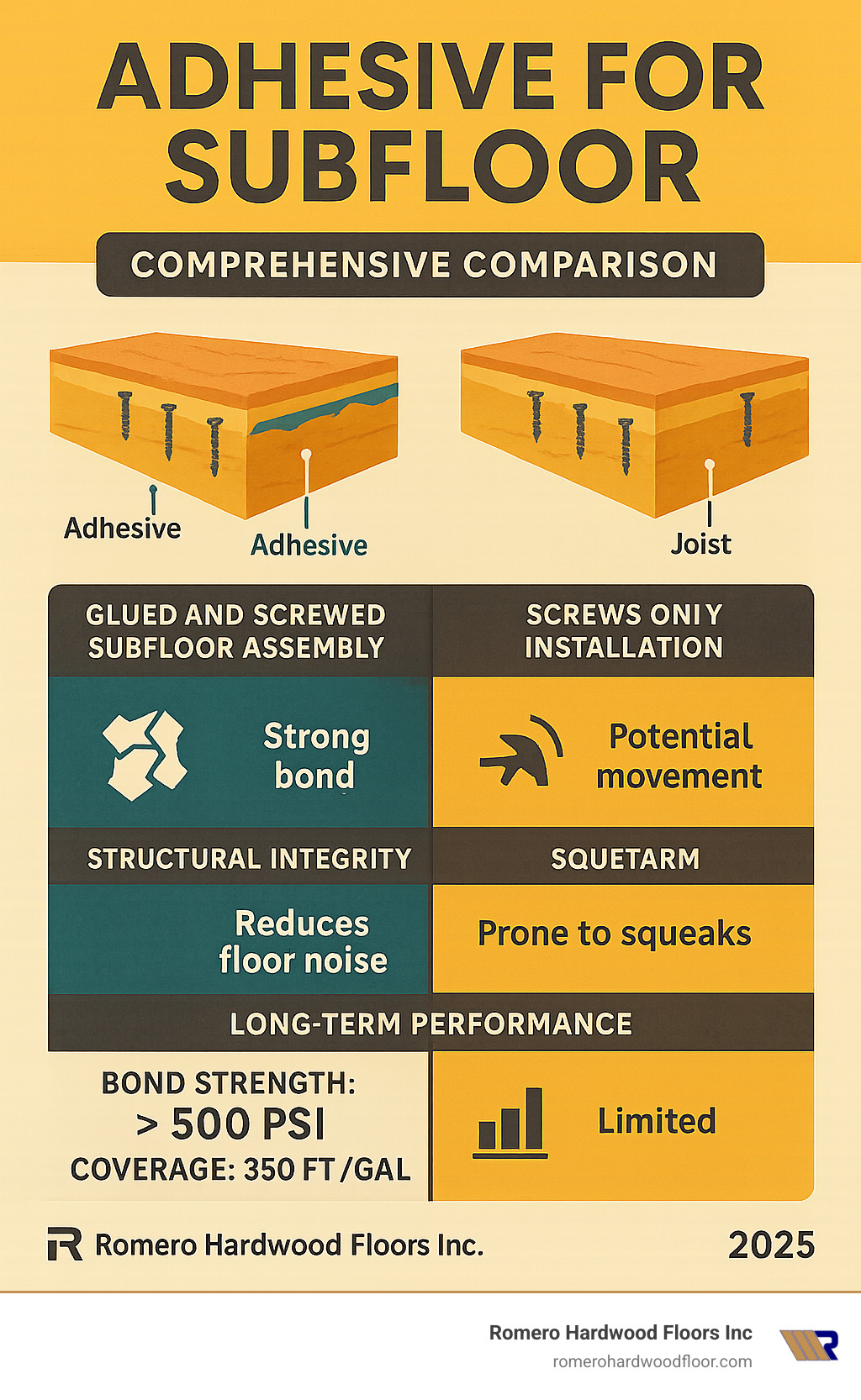
The Unsung Hero: Why Adhesive is Non-Negotiable for a Quality Floor
Think of your subfloor as the foundation of your entire flooring system. Most people focus on the beautiful hardwood or engineered planks on top, but the real magic happens underneath with adhesive for subfloor applications. This isn’t just any construction glue – it’s the difference between a floor that creaks and groans with every step and one that stays silent for decades.
I’ve seen too many DIY projects where homeowners skip the adhesive step, thinking screws alone will do the job. Six months later, they’re calling us to fix the squeaks that have turned their dream floor into a noisy nightmare.
What is Subfloor Adhesive and Why is it Important?
Subfloor adhesive is a specially engineered construction-grade glue that creates a permanent bond between your subfloor panels and the underlying wood joists. While regular construction adhesive might work for some projects, subfloor adhesive is formulated to handle the unique stresses of a floor system.
Here’s what makes it so important: screws and nails provide initial holding power, but wood moves. It expands in summer humidity, contracts in winter dryness, and shifts as your house settles. Those mechanical fasteners can loosen over time, creating tiny gaps that lead to squeaks and movement.
The adhesive fills every microscopic gap and irregularity between the joist and subfloor panel. It creates a continuous, flexible bond that moves with the wood while maintaining structural integrity. Think of it as creating one solid piece instead of separate components held together with metal fasteners.
This unified connection dramatically increases structural strength and provides excellent sound dampening properties. Your floors become quieter, more stable, and perform better over the long haul. For anyone following our Hardwood Flooring Installation Guide, this step is absolutely critical for professional results.
How Adhesive Prevents Squeaks and Nail Pops
Floor squeaks are like that one friend who always shows up uninvited – annoying and surprisingly hard to get rid of once they’re there. But adhesive for subfloor installation is your best defense against these unwanted guests.
The science is actually pretty simple. Squeaks happen when two pieces of wood rub against each other as you walk across the floor. Even perfectly cut lumber has tiny imperfections and gaps. When weight is applied, these gaps allow for micro-movements that create friction – and friction creates that telltale squeak.
Subfloor adhesive eliminates the gaps where movement can occur. It fills every void, creating a solid connection that prevents the subfloor from shifting against the joist. No movement means no friction, and no friction means no squeaks.
The adhesive also minimizes the effects of wood shrinkage over time. As lumber dries and contracts, screws can lose their grip. But the adhesive maintains contact even as dimensions change, keeping everything locked in place.
Nail pops – those annoying bumps that appear in your finished floor – happen when subfloor panels move enough to push fasteners up and out of the joist. With adhesive holding everything rock-solid, those fasteners stay exactly where they belong.
If you’re planning a DIY Hardwood Floor Installation, don’t let anyone convince you that adhesive is optional. It’s the difference between amateur work and professional results that will last for decades.
Comparing Your Options: Types of Subfloor Adhesives
When you’re standing in the construction aisle, staring at different bottles and tubes of adhesive for subfloor, it can feel overwhelming. Trust me, I’ve been there with my clients countless times. The good news? There are really just two main categories you need to understand, and each has its sweet spot depending on your project needs.
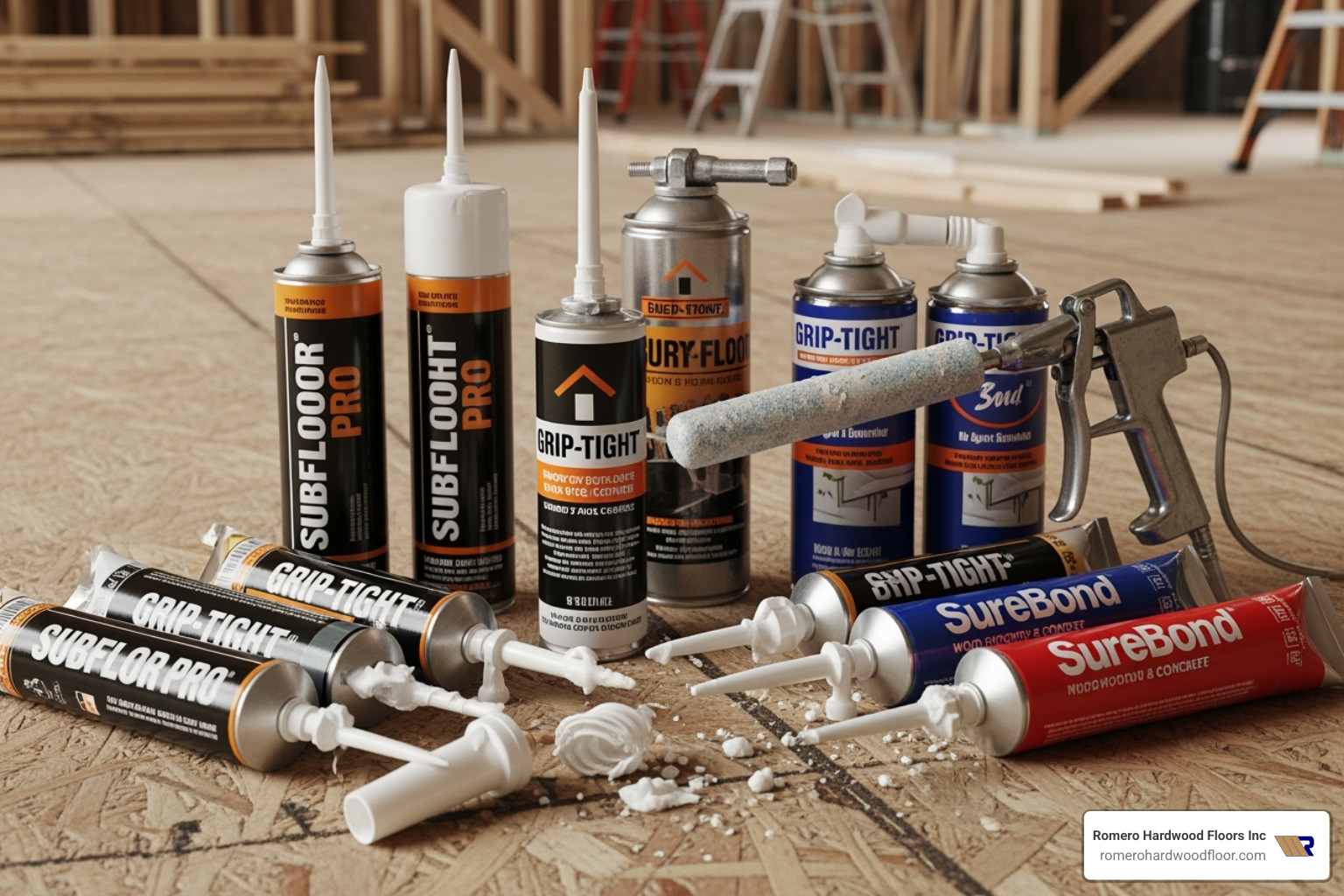
The main factors you’ll want to consider are application speed (how fast can you get the job done), coverage (how much area one container will handle), cost-effectiveness (getting the best bang for your buck), and bonding strength (how well it’ll hold over time). Let’s break down your options.
High-Performance Subfloor Adhesives
These are the new kids on the block, and honestly, they’re pretty impressive. Advanced formulas like polyurethane foam adhesives have changed the game for professional installers and serious DIYers alike.
What makes these high-performance options special? First, the high yield is incredible. We’re talking about getting eight times more coverage than traditional cartridge adhesives. That means fewer trips to reload your applicator and more time actually getting work done.
The fast-grab tack is another game-changer. While traditional adhesives might take their sweet time to set up, these advanced formulas can form an initial bond in about two hours. That’s huge when you’re trying to keep a project moving.
But here’s where these really shine: wet and frozen wood adhesion. I can’t tell you how many jobs I’ve been on where the lumber wasn’t perfectly dry or the temperature dropped unexpectedly. These advanced adhesives work on wet, dry, or frozen lumber, and they can handle temperatures from 20°F all the way up to 105°F. No more waiting around for perfect conditions.
The bonding strength is also impressive – we’re talking about adhesion that’s two to five times stronger than industry standards. When you’re putting down a floor that needs to last decades, that extra strength matters.
| Feature | High-Performance Foam | Traditional Cartridge |
|---|---|---|
| Coverage | 8x more than traditional | Standard (86 ft. per 28 oz with 1/4″ bead) |
| Application Speed | Up to 40% faster | Standard caulk gun pace |
| Temperature Range | 20°F to 105°F | 0°F to 100°F |
| Substrate Compatibility | Wet, dry, frozen lumber | Wet, dry, frozen lumber |
| Bonding Strength | 2-5x stronger than ASTM standards | Meets ASTM standards |
Traditional Cartridge Adhesives
Don’t count out the tried-and-true solvent-based options just yet. These caulk gun application adhesives have been the backbone of quality subfloor installations for decades, and there’s good reason they’re still popular.
The beauty of traditional cartridge adhesives lies in their known performance. When you squeeze out that viscous bead, you know exactly what you’re getting. The application is straightforward – load up your standard caulk gun and go to work.
These adhesives create a flexible bond that moves with your subfloor as it expands and contracts with seasonal changes. That flexibility is crucial for long-term performance, especially in climates with significant temperature swings.
The working time with traditional adhesives gives you about 10 to 20 minutes to position and fasten your panels after applying the adhesive. That’s a comfortable window for most installers, whether you’re working solo or with a helper.
Temperature-wise, these workhorses perform well from 0°F to 100°F, and they’ll stick to wet or frozen lumber just fine. While they might not have the extended temperature range of some newer formulas, they cover the conditions you’ll encounter on most job sites.
For professional guidance on selecting the right adhesive for subfloor for your specific project, contact us. We’ve worked with both types extensively and can help you choose based on your timeline, budget, and job conditions.
Mastering the Application: A Step-by-Step Guide
Getting your adhesive for subfloor application right makes the difference between a floor that stays quiet for decades and one that starts squeaking within the first year. Don’t worry though – the process is straightforward once you know the key steps. Let me walk you through exactly how to apply subfloor adhesive like a pro.
Surface and Temperature Guidelines
Before you crack open that first cartridge or foam can, take a moment to prep your work area properly. Clean joists are absolutely essential – I can’t stress this enough. Any sawdust, dirt, grease, or debris on your joists will create a barrier between the adhesive and the wood, weakening the bond significantly. A quick sweep with a broom or a pass with your shop vac will do the trick.
Temperature matters more than most people realize. The good news is that modern subfloor adhesives are incredibly forgiving. Most quality products work beautifully in the 0°F to 100°F range, which covers pretty much any condition you’ll encounter during construction.
Here’s where things get really interesting: many of today’s advanced adhesives actually work on wet or frozen lumber. This is a game-changer for contractors working in less-than-perfect conditions. Some foam adhesives can bond to lumber down to 20°F, while others handle wet, dry, or frozen wood without missing a beat. This flexibility means you don’t have to shut down your project just because the weather isn’t cooperating.
If you’re planning an installation that involves Engineered Wood with Underfloor Heating, proper adhesive application becomes even more critical. The thermal cycling from the heating system makes that solid bond between subfloor and joists absolutely essential.
Application and Cleanup
Now comes the fun part – actually applying your adhesive for subfloor. The technique is simple, but the details matter.
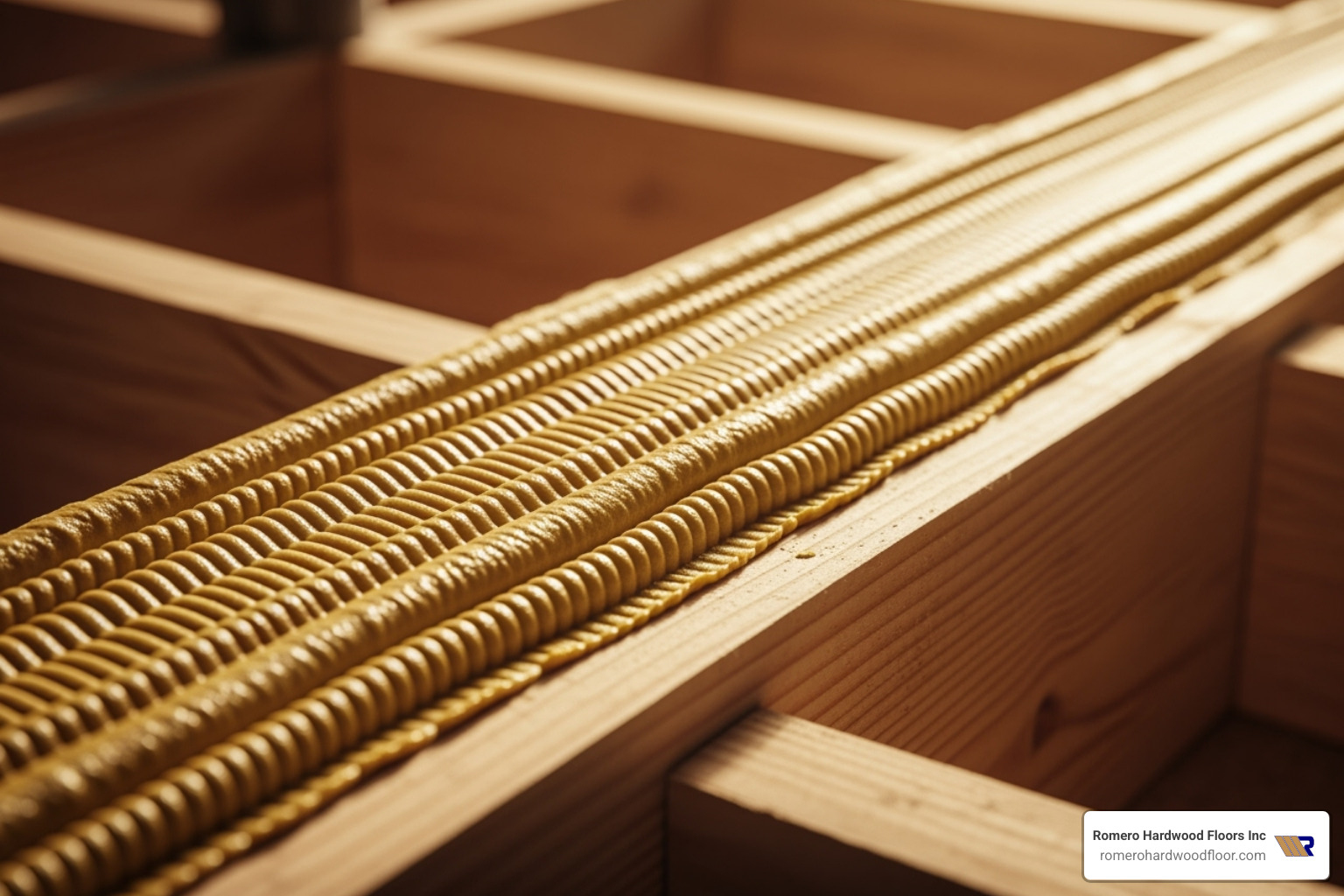
Start by applying a continuous bead of adhesive along the top of each joist where your subfloor panel will sit. For standard 2x joists, aim for a 1/4″ to 3/8″ bead size. On wider joists or areas where you want extra holding power, try an “S” or serpentine pattern – this gives you more adhesive contact without waste.
Here’s where timing becomes crucial: pay attention to your adhesive’s working time. This is your window to get that panel positioned and fastened after applying the adhesive. Traditional cartridge adhesives typically give you about 10-20 minutes for a 1/4″ bead, while some high-performance foam adhesives offer a bit more flexibility with their fast-grab formulations.
My advice? Only apply adhesive to enough joists for one or two panels at a time. It’s tempting to speed things up by doing more, but you’ll end up rushing the installation or, worse, dealing with adhesive that’s started to skin over.
Once you’ve got your bead down, lay the subfloor panel onto the joists and press it firmly into place. You want maximum contact between the panel, adhesive, and joist. Follow up immediately by fastening the panel with screws or nails according to standard spacing recommendations. Those fasteners provide the clamping pressure while the adhesive cures into that rock-solid bond.
Cleanup is much easier if you stay on top of it. For wet, uncured adhesive, mineral spirits or acetone work well – just follow all safety precautions with these solvents. Once the adhesive has cured, you’re looking at mechanical removal like scraping or sanding. Trust me, it’s worth wearing old clothes and keeping some solvent-soaked rags handy.
For the complete picture of professional hardwood installation, check out our guide on How to Install Hardwood Flooring.
Safety and Environmental Considerations
Working with construction adhesives requires some common-sense safety measures, but nothing too complicated.
Ventilation is your first priority. Most adhesives release VOCs (those volatile organic compounds you’ve probably heard about), and some solvent-based products can have VOC content over 350 g/L. Open your windows, set up some fans, and keep air moving through your work area. Your lungs will thank you.
Always wear gloves and eye protection. Chemical-resistant gloves are worth the few extra dollars, and safety glasses should be standard gear anyway. Adhesive splashes happen, and getting this stuff in your eyes or on your skin isn’t fun.
Be aware that many adhesives have very low flashpoints – some below 0°F, meaning they’re highly flammable. Keep them away from any open flames, pilot lights, or spark-producing tools. Store containers in a cool, dry place away from heat sources.
When it comes to proper disposal, follow your local regulations. Never pour leftover adhesive down drains or toss cartridges in regular trash without checking first. For detailed safety information, manufacturers provide Safety Data Sheets (SDS) for their specific product lines. These are typically available on their websites or by request.
The environmental impact of adhesives has improved significantly over the years. While some solvent-based products still have higher VOC content, many manufacturers now offer low-VOC or even solvent-free formulations that meet green building standards. If environmental impact is important to your project, ask about these options – they often perform just as well as traditional formulations.
Choosing the Right Adhesive for Subfloor Projects
Selecting the ideal adhesive for subfloor involves more than just grabbing the first tube you see at the hardware store. It’s about understanding your specific project conditions, the materials you’re working with, and what kind of long-term performance you expect from your floor system.
Compatibility with OSB and Plywood
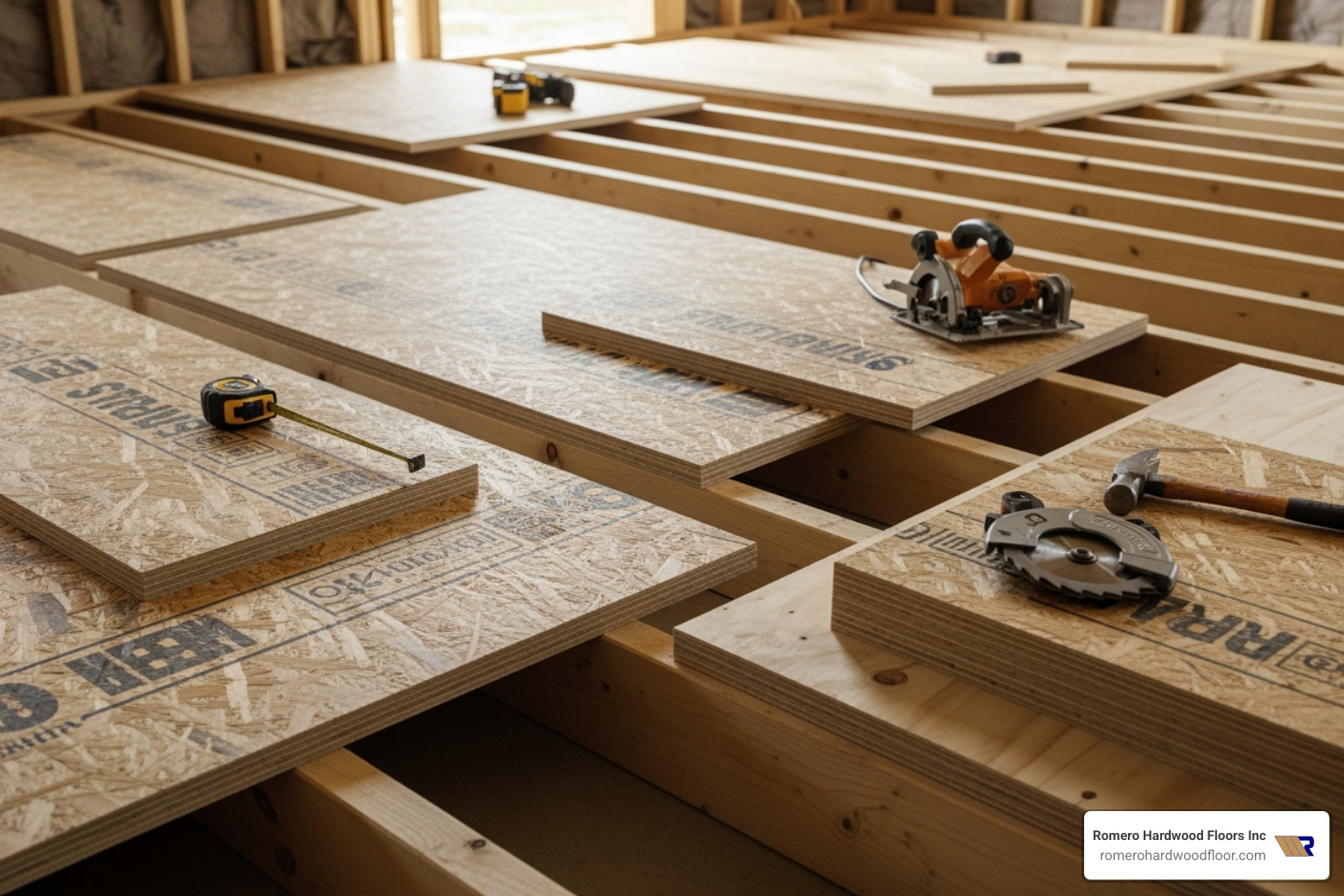
The good news is that most modern subfloor adhesives play well with the two most common subfloor materials you’ll encounter: plywood and OSB (Oriented Strand Board). However, there are some nuances worth knowing about.
Most quality adhesive for subfloor products are formulated to bond effectively with both plywood and OSB, as well as engineered lumber and particleboard. This versatility means you won’t need different adhesives for different panel types on the same job.
Treated lumber compatibility is another consideration. If your joists are pressure-treated, make sure your chosen adhesive explicitly states it works with treated lumber. Most modern formulations handle this without issue, but it’s always worth double-checking the product specifications.
Here’s where things get interesting: some premium OSB subflooring products come with surface coatings that can affect adhesion. In these cases, you’ll want to use an adhesive specifically engineered for coated surfaces, typically a polyurethane formula that can create a proper chemical bond despite the coating.
Quality standards matter too. Look for adhesives that meet or exceed ASTM D3498 standards – this ensures the product has been tested for performance under various real-world conditions, including wet, frozen, and dry lumber scenarios.
Calculating Coverage for Your Adhesive for Subfloor
Nothing’s more frustrating than running out of adhesive halfway through a subfloor installation. Understanding coverage rates helps you buy the right amount and avoid those costly trips back to the store.
Coverage depends primarily on bead size and cartridge size. For a standard 28-ounce cartridge, you’ll typically get about 355 linear feet with a 1/8″ bead, 86 feet with a 1/4″ bead, or 39 feet with a 3/8″ bead. The larger the bead, the less distance you’ll cover per cartridge.
High-yield foam adhesives change this math dramatically. These newer products can deliver up to 8 times more coverage than traditional cartridges, meaning one foam canister might replace six or more traditional tubes. This efficiency can be a game-changer for larger projects.
To calculate your needs, measure the total linear feet of joists in your project area, then divide by your chosen adhesive’s coverage rate for your preferred bead size. Always buy about 10% extra – it’s better to have a little leftover than to run short when you’re in the middle of installation.
Shelf Life and Warranty Considerations
Storage matters more than you might think. Most subfloor adhesives have an 18-month shelf life when stored properly in tightly closed containers at moderate temperatures. Keep them in a cool, dry place away from extreme heat or cold, and they’ll be ready when you need them.
Manufacturer warranties can provide valuable peace of mind. Many companies stand behind their products with comprehensive warranties that cover both the adhesive performance and squeak prevention. Some manufacturers even offer system guarantees when you use their adhesive with their specific subfloor panels.
These warranties aren’t just marketing fluff – they reflect the manufacturer’s confidence in their product and can save you significant headaches if something goes wrong. When you’re investing in a quality floor system, having that backup support makes all the difference in your long-term satisfaction with the project.
Frequently Asked Questions about Subfloor Adhesives
Over my years installing hardwood floors in Revere and surrounding areas, I’ve heard just about every question you can imagine about adhesive for subfloor applications. These three questions come up on nearly every job, so let me share what I’ve learned from thousands of installations.
Can I use regular construction adhesive for my subfloor?
This is probably the most common question I get, and I understand why homeowners ask it. You’re standing in the hardware store, looking at a wall of adhesive tubes, and thinking “glue is glue, right?” Well, not exactly.
While some general construction adhesives might technically work, I always recommend using a specialized adhesive for subfloor for one simple reason: your floor experiences unique stresses that other construction joints don’t face. Think about it – people walk across your floor thousands of times, furniture gets moved around, and the wood constantly expands and contracts with humidity changes.
A dedicated subfloor adhesive is specifically formulated to handle these shear stresses and vibrations. It provides superior bond strength while remaining flexible enough to accommodate wood movement. Most importantly, it has the gap-filling properties needed to eliminate those tiny spaces where squeaks love to hide.
I’ve seen too many floors installed with regular construction adhesive that started squeaking within a year. Save yourself the headache and use the right product from the start.
Is gluing the subfloor really necessary if I’m using screws?
Absolutely, yes! This question always makes me chuckle because I can see the logic behind it. You’re thinking, “If I’m screwing everything down tight, why do I need glue too?”
Here’s the thing: screws provide the muscle, but adhesive provides the permanence. Those screws create the clamping pressure needed while the adhesive cures, but over time, wood naturally moves. It expands when it’s humid, contracts when it’s dry, and even the tiniest movement between the subfloor panel and joist creates friction – and friction creates squeaks.
The adhesive for subfloor fills every microscopic gap and creates a continuous bond that turns your separate pieces of wood into one solid, unified structure. Without it, you’re basically building a floor that’s held together by a bunch of individual pressure points instead of a complete bond.
I always tell my customers: “Screws hold it together, but adhesive makes it silent.” The combination of both creates a floor system that’s exponentially stronger and quieter than either method alone.
How long do I have to install the subfloor panel after applying the adhesive?
This timing question is crucial because it can make or break your installation. The window you’re working with is called “working time” or “open time,” and it varies depending on which adhesive you choose.
For most traditional adhesive for subfloor products, you typically have about 10 to 20 minutes to get that panel positioned and fastened after applying the adhesive. Some high-performance foam adhesives give you a bit more flexibility, with initial grab happening around 2 hours, but they still need to be fastened promptly.
Temperature and humidity affect this timing too. On a hot, dry day, your working time might be shorter. On a cool, humid day, you might have a few extra minutes.
My rule of thumb? Only apply adhesive to one or two panels worth of joists at a time. This keeps you well within the working window and prevents you from rushing. There’s nothing worse than watching expensive adhesive start to skin over while you’re frantically trying to position a heavy sheet of plywood!
I’ve learned this lesson the hard way early in my career, and now I always pace myself to ensure every panel gets the full benefit of that fresh, tacky adhesive bond.
In Conclusion
After diving deep into adhesive for subfloor applications, one thing becomes crystal clear: this isn’t just another construction product you can skip to save a few dollars. It’s the unsung hero that transforms your floor from a collection of separate pieces into one solid, unified system that will serve you quietly and reliably for decades.
Think about it this way – you wouldn’t build a house without a proper foundation, right? Well, subfloor adhesive is essentially the foundation of your foundation. It’s what prevents those middle-of-the-night squeaks that wake everyone up when you’re trying to sneak to the kitchen for a late-night snack. It’s what keeps your beautiful hardwood floors stable and secure, protecting the investment you’ve made in your home.
The benefits we’ve covered really speak for themselves. Squeak-free floors that stay quiet year after year. Increased structural integrity that makes your entire floor system stronger and more durable. Professional-grade results that you can actually feel underfoot – that solid, confident feeling when you walk across a properly installed floor.
Whether you choose a high-performance polyurethane foam adhesive for its incredible coverage and wet-lumber compatibility, or go with a proven traditional solvent-based formula for its reliable bond strength, the key is understanding your specific project needs and applying the product correctly. The few extra minutes spent on proper application will pay dividends in comfort and peace of mind for years to come.
At Romero Hardwood Floors Inc., we’ve seen how this attention to detail – starting right at the subfloor level – separates amateur work from truly professional results. It’s why every floor we install in the Revere, MA area starts with this critical foundation step. Our guaranteed workmanship isn’t just about the visible parts of your floor; it’s about doing every step right, even the ones you’ll never see.
Your home deserves flooring that increases your property value while providing daily comfort and satisfaction. That starts with getting the basics right, and subfloor adhesive is definitely one of those basics you don’t want to compromise on.
For those ready to explore every aspect of creating the perfect floor, our The Complete Guide to Residential Flooring Installation covers everything from subfloor prep to final finishing touches. And when you’re ready to experience the difference that comes from working with flooring professionals who truly understand these details, we’d love to Request an Estimate for your project.
Great floors don’t happen by accident – they’re built from the ground up, one careful step at a time.
Like us on Facebook!
