Adhesive strength test: Critical 2025 Guide
Why Adhesive Strength Testing Matters for Long-Lasting Floors
Adhesive strength test methods are the scientific tools that determine whether your beautiful new hardwood floor will stay securely in place for decades or start creaking and separating within months. These tests measure how well adhesives resist the forces that naturally occur in flooring – from foot traffic to seasonal expansion and contraction.
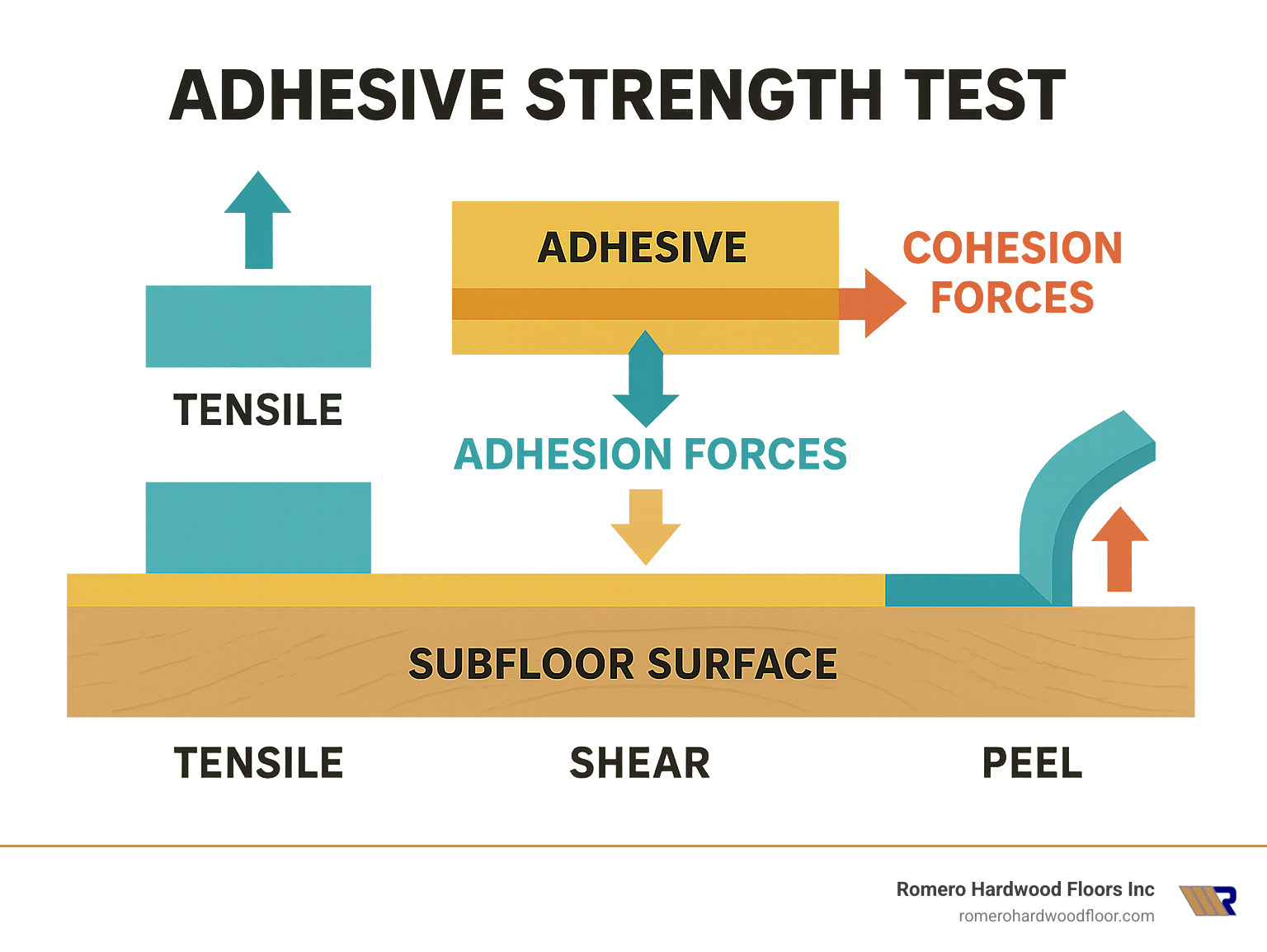
The three main adhesive strength tests are:
- Tensile Test – Measures resistance to pulling forces perpendicular to the surface (measured in psi)
- Shear Test – Measures resistance to sliding forces parallel to the surface (most critical for flooring)
- Peel Test – Measures force needed to separate bonded materials at an angle (measured in pounds per linear inch)
Nothing ruins a beautiful hardwood installation faster than bond failure. When adhesives fail, you get hollow spots, squeaky floors, and loose planks that shift underfoot. The difference between a floor that lasts 30 years and one that needs repairs in 3 years often comes down to choosing adhesives with proven strength test results.
Adhesion is the attraction between the adhesive and your subfloor surface, while cohesion is the internal strength holding the adhesive together. Both must be strong for a lasting bond – and that’s exactly what adhesive strength testing measures.
As Francisco Romero, owner of Romero Hardwood Floors Inc., I’ve seen how proper adhesive strength test data helps us select the right products for each project’s unique conditions. Over 15 years of installations have taught me that understanding these test results is crucial for delivering floors that stay beautiful and secure for decades.
The Science of Stick: Understanding Bond Strength Fundamentals
Think of a strong floor bond like a good friendship – it needs connection on both sides and strength from within. When we perform an adhesive strength test, we’re measuring two critical forces that work together to keep your beautiful hardwood floors rock-solid for decades.
Adhesion is all about attraction between your adhesive and the subfloor surface – this is called interfacial strength. It’s like how well two puzzle pieces fit together. Cohesion, on the other hand, measures the internal strength of the adhesive itself – its ability to hold together under pressure without falling apart.
Here’s where it gets interesting: your subfloor’s surface energy plays a huge role in how well adhesives work. High surface energy surfaces, like clean concrete or properly prepared plywood subfloors, allow adhesives to “wet out” beautifully – spreading smoothly and creating intimate contact for maximum bond strength.
Low surface energy surfaces are trickier. Think of trying to spread honey on a greasy pan versus a clean plate. The adhesive wants to bead up instead of spreading, which creates weak spots that can lead to those dreaded hollow sounds and creaky floors later.
This is exactly why proper surface preparation is absolutely critical in our hardwood floor installation process. Whether we’re working with plywood subfloors or concrete subfloors, removing contaminants, dust, and excess moisture creates the perfect foundation for strong molecular attraction and mechanical interlocking.
How Adhesion and Cohesion Create a Lasting Floor
When floors fail, they don’t all fail the same way. Understanding these failure patterns helps us choose better adhesives and installation techniques for high-traffic areas where your family lives and plays every day.
Adhesive failure happens when the bond between the adhesive and your subfloor breaks cleanly. You’ll see the adhesive pull away from the surface like a sticker that didn’t stick properly. This usually points to surface preparation issues or incompatible materials.
Cohesive failure occurs when the adhesive itself tears apart, leaving sticky residue on both the flooring and subfloor. It’s like when tape gets old and the adhesive becomes gooey – the internal strength just wasn’t enough for the job.
Substrate failure might sound bad, but it’s actually a sign of an incredibly strong bond! This happens when the adhesive bond is so strong that the wood or subfloor material breaks before the adhesive does. In testing, this tells us the adhesive is more than up to the task.
The magic happens in the bond line where molecular attraction creates chemical connections while mechanical interlocking allows the adhesive to flow into tiny pores and surface irregularities. Both forces work together to create the kind of lasting strength that keeps floors beautiful and secure through years of family life.
The Critical Role of Substrate Surface Energy
Your subfloor material’s surface energy is like its personality – some materials are naturally friendly to adhesives, while others need a little coaxing to form strong relationships.
High surface energy materials, like clean untreated wood and properly prepared concrete, welcome adhesives with open arms. The adhesive spreads easily, creating excellent wetting out and strong bonds. It’s like water spreading smoothly on clean glass.
Low surface energy surfaces can be challenging. Wood surface energy varies by species and preparation, while concrete porosity creates its own unique considerations. When moisture, curing compounds, or other contaminants are present, they effectively lower the surface energy and prevent proper adhesive contact.
Contaminants are the enemy of good bonds. Dust, oils, excessive moisture, or even residue from previous flooring can create invisible barriers that dramatically weaken adhesive performance. This is why our meticulous proper cleaning process is never optional – it’s the foundation of every successful installation.
Sometimes we use primers to modify surface energy or create moisture barriers, essentially giving difficult surfaces a more adhesive-friendly personality. These extra steps might seem small, but they make the difference between floors that last three years and floors that last thirty years.
From our base in Revere, MA, to projects throughout Chelsea, Peabody, Winchester, and beyond, this attention to surface preparation details ensures every floor we install has the strongest possible foundation for lasting beauty and performance.
The Main Events: Primary Methods for an Adhesive Strength Test
When we need to verify an adhesive’s performance, we turn to rigorous testing methods. Most of these are “destructive testing,” meaning we intentionally break the bond to measure exactly how much force it can withstand. This quantification of force gives us objective data to compare different adhesives and ensure they meet our high standards. Common units of measurement include pounds per square inch (psi) for tensile and shear strength, and pounds per linear inch (PLI) for peel strength.
To perform these tests, specialized equipment is used, often referred to as universal testing systems. These sophisticated machines are equipped with precision load cells to measure force and advanced data acquisition software to record the results. Portable instruments are also available for pull-off adhesion testing, capable of measuring a wide range of pressures. For example, some can measure up to 10000 psi (70 MPa) with smaller test dollies, while optional accessory kits allow for testing lower strengths, such as coatings on concrete, under 500 psi (3.5 MPa). The self-aligning feature of such testers, with a spherical articulating dolly head, is crucial for minimizing shear forces and ensuring consistent, reliable results.
Tensile, Shear, and Peel: A Closer Look at Adhesive Strength Test Methodologies
As mentioned, there are three primary ways we test adhesive strength, each mimicking different types of stress an adhesive bond might experience in real-world applications, especially on your hardwood floors.
| Test Type | Type of Force | Common Units | Typical Application Relevance (Flooring) |
|---|---|---|---|
| Tensile | Pulling apart perpendicularly | psi | Resistance to direct lifting forces (e.g., cupping) |
| Shear | Sliding forces parallel to surface | psi | Resistance to lateral movement, crucial for foot traffic, expansion/contraction |
| Peel | Peeling away at an angle | PLI | Resistance to localized stresses, edge lifting, delamination |
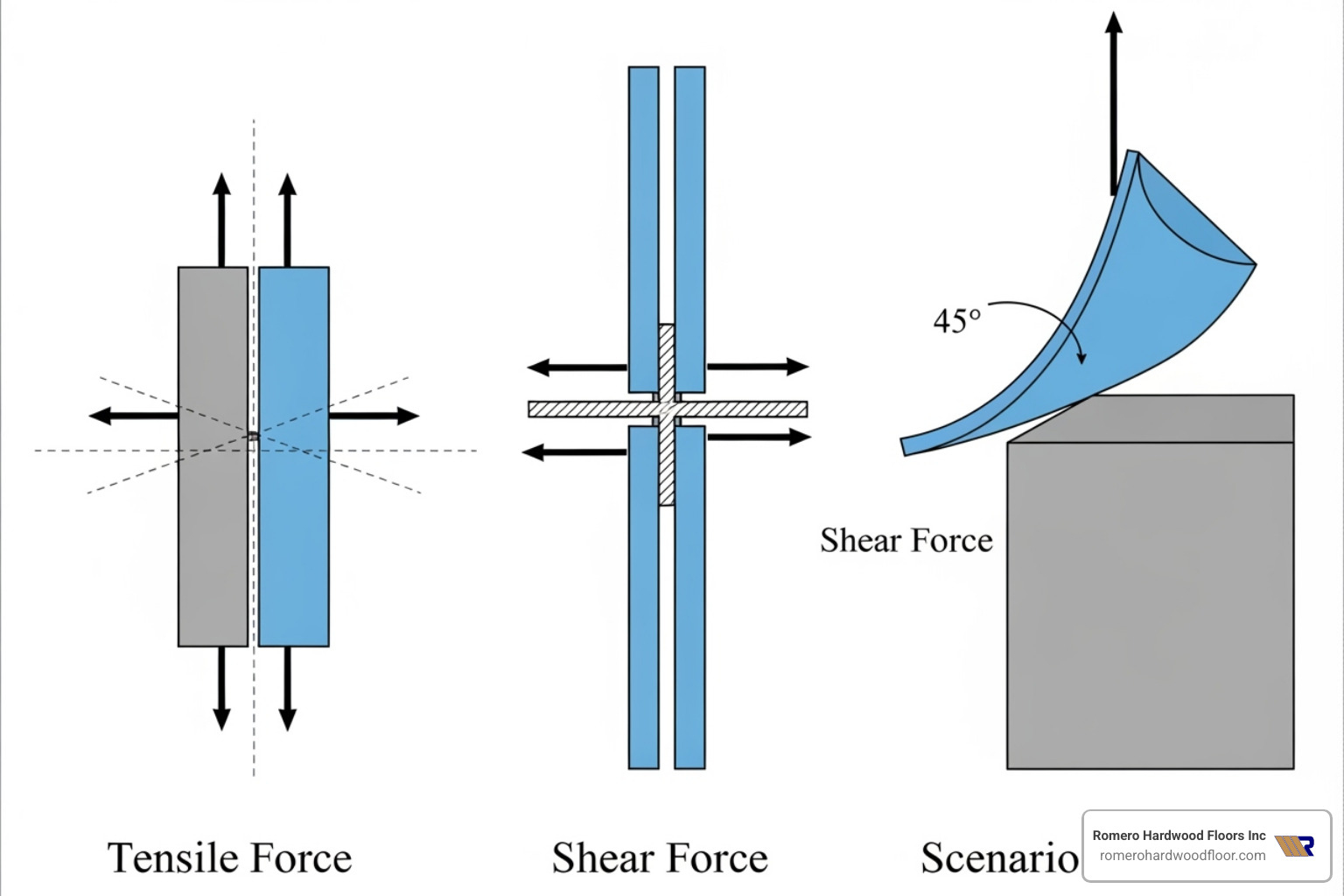
Tensile Strength: This test measures how much force an adhesive can withstand when pulled directly apart, perpendicular to the bonded surfaces. Imagine trying to pull a floorboard straight up off the subfloor. A sample is prepared, often with two small “dollies” bonded together, and then pulled by a testing machine until it breaks. The force at which it breaks, divided by the bonded area, gives us the tensile strength in psi.
Shear Strength: For flooring, shear strength is arguably the most critical test. This measures an adhesive’s ability to resist forces that try to slide one bonded surface parallel to the other. Think of the constant lateral forces your hardwood floor experiences from foot traffic, as well as the expansion and contraction of wood with changes in humidity. The “lap shear test” is common, where two overlapping strips of material are bonded and then pulled in opposite directions along their length. The maximum load before failure, divided by the bonded area, yields the shear strength in psi. A penetrating sealer, for example, once identified a 183% improvement in adhesion over an oxide seal, showcasing how crucial product selection can be.
Peel Strength: This test measures the force required to separate two bonded materials by peeling them apart at a specific angle (commonly 90-degree or 180-degree). This is particularly relevant for assessing an adhesive’s resistance to localized stresses, which can lead to edges lifting or delamination over time. The result is expressed in pounds per linear inch (PLI). The “T-peel test” is a variation where two flexible materials are bonded, and then pulled apart to form a “T” shape.
Common Industry Standards and Protocols
To ensure consistency and reliability in adhesive strength testing, various industry standards and protocols have been developed by organizations like ASTM International (formerly American Society for Testing and Materials) and ISO (International Organization for Standardization). These standards provide detailed procedures for sample preparation, testing conditions, and data analysis, making results comparable across different labs and manufacturers.
For example, when evaluating shear strength for our flooring adhesives, we often refer to standards like ASTM D1002 for lap shear strength. This standard outlines how to perform the lap shear test on metal-to-metal adhesive joints, providing a benchmark for structural adhesives. For peel adhesion, ASTM D903 is a widely used standard.
Other relevant ASTM standards include D4541 (pull-off strength of coatings) and D3330 (peel adhesion of pressure-sensitive tapes). ISO also provides comprehensive standards like ISO 4587 for lap shear and ISO 11339 for peel tests. There are even specific FINAT test methods used for pressure-sensitive labels and tapes. By adhering to these standardized procedures, we ensure that the adhesive data we rely on is accurate, repeatable, and directly applicable to the long-term performance of your hardwood floors.
Beyond the Bond: Critical Factors Influencing Adhesive Performance
Think of adhesive strength test results as just the starting point of your floor’s journey. While those initial numbers tell us how strong a bond is right after installation, the real test comes from living with your floors day after day, year after year. Your beautiful hardwood installation faces a constant barrage of challenges that can affect the adhesive underneath – environmental factors like humidity swings, the curing process that continues long after we leave your home, adhesive thickness variations, and even subtle differences in application technique.
Understanding these elements is what separates floors that look great for decades from those that start showing problems within a few years. It’s why we don’t just rely on lab test data – we consider how your specific home environment will interact with the adhesive over time to ensure long-term durability.
How Environment Affects Your Floor’s Adhesive
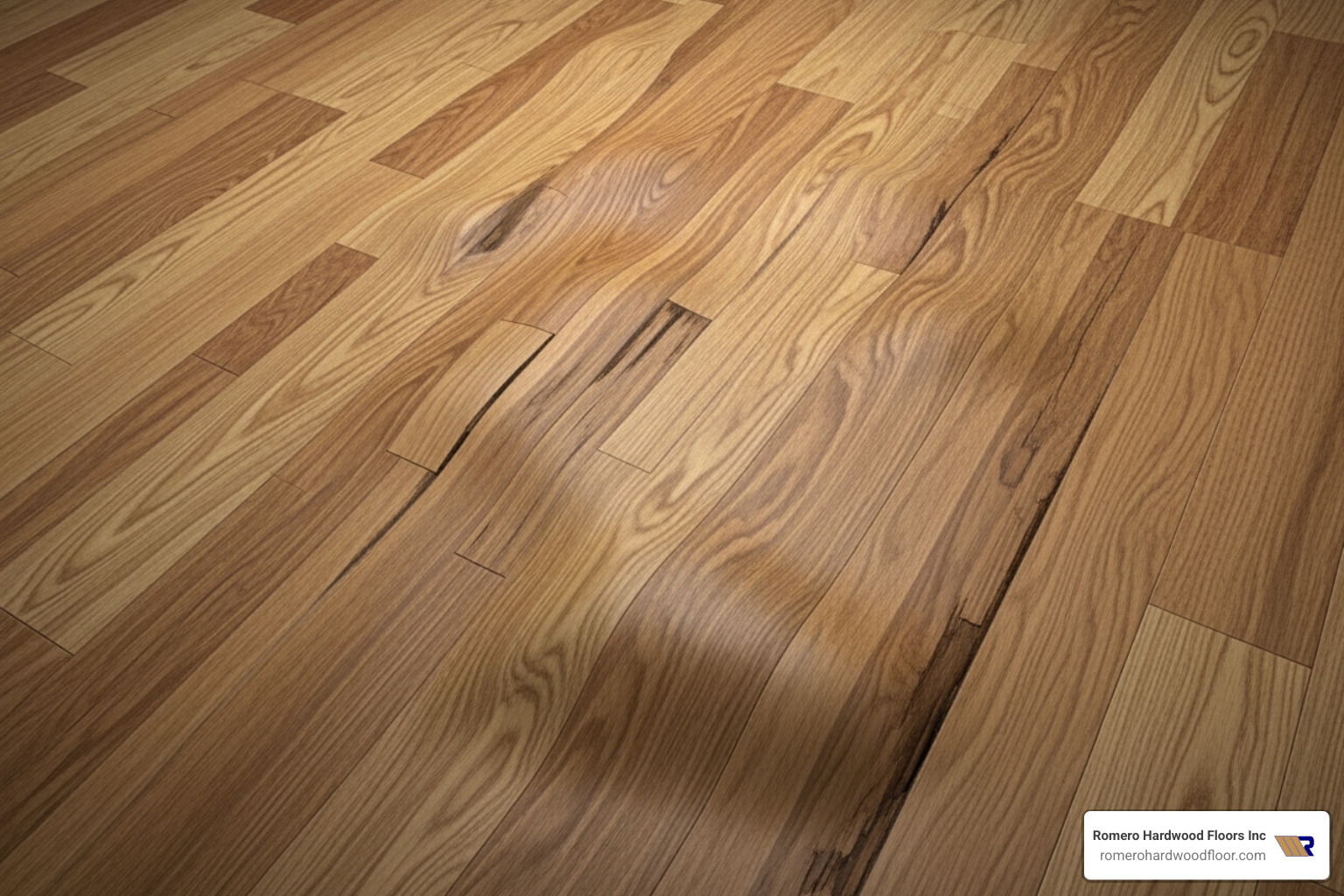
Your home’s environment is like a living, breathing entity that constantly tests your floor’s adhesive bond. Temperature fluctuations from season to season are one thing, but humidity changes are the real challenge. Wood is hygroscopic – it naturally absorbs and releases moisture from the air around it. When humidity rises in summer, your hardwood planks swell. When winter’s dry air arrives, they shrink back down.
This constant expansion and contraction puts tremendous stress on the adhesive beneath your floors. The moisture content of the wood is constantly shifting, and the adhesive has to flex and move with it without losing its grip. It’s like asking someone to hold hands while doing jumping jacks – the bond has to be both strong and flexible.
That’s why adhesive manufacturers put their products through accelerated aging tests in specialized environmental chambers. These chambers simulate decades of seasonal changes in just weeks, subjecting adhesive samples to extreme heat, cold, and humidity cycles. We’ve learned from experience that acclimatizing flooring and adhesives to your home’s specific conditions before installation makes all the difference.
When environmental factors do cause problems despite our best efforts, we’re here to help restore your floors. Sometimes refinishing can address damage caused by extreme environmental conditions: More info about floor refinishing to fix environmental damage.
Measuring the ‘Work of Adhesion’ and Why It Matters
Here’s where adhesive testing gets really interesting. Most people think about adhesive strength as a simple number – how much force does it take to break the bond? But there’s a more sophisticated way to look at it called the “work of adhesion” or separation energy.
Imagine two different adhesives. The first one is like a strong but brittle piece of glass – it can hold a lot of weight, but when it breaks, it snaps suddenly. The second is more like a tough piece of rubber – it might not hold quite as much weight at its peak, but it stretches and deforms, absorbing energy before it finally gives way.
When we look at force-displacement curves from testing, we’re not just interested in that peak force number. We want to see the whole story – how much total energy the bond absorbs before failure. This toughness of the bond tells us how well an adhesive will handle the real world, where forces aren’t always clean and predictable.
Research like the study on Quantifying Adhesive Strength of Tapes Through Precision TAA Method shows how measuring this work of adhesion gives us a much more complete picture than just peak force alone. This comprehensive approach to predicting real-world performance helps us choose adhesives that won’t just pass a lab test – they’ll keep your floors secure through everything life throws at them, from heavy furniture moves to kids running through the house with wet shoes.
The adhesive that can absorb more energy beyond peak force is often the one that will serve you better in the long run, even if its maximum strength number isn’t the highest on the spec sheet.
From Lab to Living Room: Applying Test Data for Quality and Success
Scientific data from an adhesive strength test isn’t just for labs. It serves one crucial purpose: ensuring your hardwood floors perform flawlessly for decades.
When we’re selecting adhesives for your project, we don’t just grab whatever’s on sale at the supply house. We dig deep into those data sheets and technical specifications, carefully matching each adhesive’s proven performance to your specific needs. Your flooring type, subfloor material, and expected foot traffic all play a role in this decision.
Think of it like matchmaking, but for building materials. A busy kitchen with kids and pets needs a different adhesive personality than a formal dining room that sees guests twice a year.
Choosing the Right Adhesive for Your Flooring Project
The world of flooring adhesives offers several distinct options, each with its own strengths and ideal applications. Structural adhesives create incredibly strong, rigid bonds that form a permanent marriage between your engineered wood and subfloor. These workhorses deliver exceptional shear and tensile strength, perfect for high-traffic areas.
Pressure-sensitive adhesives (PSAs) offer more flexibility and initial tack, allowing for repositioning during installation. While they’re fantastic for certain applications like vinyl tiles, they’re typically not our go-to choice for hardwood planks that need rock-solid stability.
Urethane adhesives have become our favorite for many hardwood projects. They strike that sweet spot between strength and flexibility that hardwood flooring demands. Many are moisture-cure formulations, meaning they actually use ambient moisture to cure and strengthen. This process can even help with moisture mitigation – a nice bonus for your subfloor’s health.
For hardwood installations, we prioritize adhesives with outstanding shear strength. Shear strength is what keeps your planks from sliding around under foot traffic and seasonal wood movement. While excellent peel strength helps prevent those annoying edge lifts, it’s the shear performance that really matters for day-to-day durability.
The balance between flexibility and rigidity requires careful consideration too. An adhesive that’s too rigid might crack as your wood naturally expands and contracts with humidity changes. Too flexible, and you lose the stability that keeps your floors feeling solid underfoot. Our years of experience installing floors throughout communities like Malden, Melrose, and Saugus have taught us exactly how to strike this balance.
Using an Adhesive Strength Test for Quality Control and Failure Analysis
Adhesive strength testing doesn’t end when manufacturers ship their products. We use these same testing principles for ongoing quality control and, when necessary, detective work.
Batch testing is one of our behind-the-scenes quality measures. Different production runs of the same adhesive can sometimes perform differently, so we test samples from various batches to ensure consistent performance. This helps us catch any potentially weak bonds before they end up under your beautiful hardwood floors.
When the rare problem does occur (and after 15+ years in business, we’ve seen just about everything), adhesive strength testing becomes our diagnostic tool. By carefully removing sections of flooring and testing the remaining bond, we can determine exactly what went wrong.
Was it cohesive failure, where the adhesive itself broke down? Adhesive failure, where the bond between surfaces failed? Or substrate failure, where the subfloor material couldn’t handle the stress? Each type of failure tells a different story and points to a different solution.
We sometimes use advanced techniques like microscopy to examine the bond line more closely, looking for issues like contamination or improper curing. This systematic approach helps us quickly diagnose problems and implement the right fix, preventing similar issues across all our projects from Beverly to Woburn.
This attention to detail and scientific approach to problem-solving is what sets professional installation apart. When you choose Romero Hardwood Floors Inc., you’re not just getting beautiful floors – you’re getting the peace of mind that comes from proven methods and guaranteed workmanship.
Frequently Asked Questions about Adhesive Strength
Over my 15+ years installing hardwood floors across the Boston area, I’ve heard these questions countless times from homeowners who want to understand what makes their floors stay put. Let me share what I’ve learned about adhesive strength testing and bond performance.
What is the difference between adhesion and cohesion?
Think of adhesion and cohesion as a team – they work together to keep your floors secure. Adhesion is like a handshake between the adhesive and your subfloor surface. It’s the force that makes the glue stick to the wood or concrete underneath your hardwood planks.
Cohesion, on the other hand, is the adhesive’s ability to hold itself together without falling apart. Imagine trying to pull apart a piece of taffy – that stretchy resistance you feel is cohesion at work.
Here’s the thing: you need both working properly for a floor that lasts. I’ve seen beautiful installations fail because the adhesive had great cohesion (it stayed together) but poor adhesion (it never really stuck to the subfloor). I’ve also seen the opposite – great adhesion but the adhesive itself was weak and crumbled over time.
Which strength test is most important for flooring adhesives?
Without a doubt, shear strength is the champion when it comes to flooring applications. This adhesive strength test measures how well the bond resists sliding forces – and trust me, your floors see plenty of those.
Every time someone walks across your hardwood, every time the wood expands in summer humidity or contracts in dry winter air, your adhesive is fighting shear forces. It’s like trying to slide two pieces of paper past each other when they’re glued together.
I always look for adhesives with proven shear strength data because I know they’ll handle the real-world stresses your floors will face. Tensile strength (pulling straight up) and peel strength (peeling at an angle) matter too, but shear strength is what keeps your planks from shifting and creating those annoying gaps.
How can I tell if my floor adhesive has failed?
Unfortunately, adhesive failure rarely stays hidden for long. Your floors will start telling you there’s a problem, and here’s what to listen for.
Hollow sounds when you tap or walk on certain areas are usually the first sign. When the bond fails, you get an air gap between the flooring and subfloor, creating that telltale hollow echo.
Squeaking and creaking noises are another dead giveaway. Without a solid adhesive bond, your planks start moving against each other and the subfloor with every step. What should be a quiet, solid floor becomes a symphony of annoying sounds.
You might also notice loose or shifting planks that move when you step on them, or visible gaps opening up between boards where there weren’t any before. Sometimes you’ll even see boards starting to cup or lift at the edges.
The good news? Catching these signs early means we can often address the problem before it spreads. I’ve rescued many floors by identifying failed adhesive bonds quickly and taking action. If you notice any of these warning signs, don’t wait – addressing adhesive failure early can save you from a much more expensive full replacement down the road.
Conclusion
When you’re investing in beautiful hardwood floors, understanding adhesive strength test methods isn’t just technical knowledge – it’s your assurance of quality that will last for decades. Throughout this guide, we’ve explored how tensile tests measure pulling forces, shear tests evaluate the sliding resistance that’s so crucial for foot traffic, and peel tests assess an adhesive’s ability to resist localized stresses that could cause edge lifting.
The science behind these tests reveals why proper testing matters so much. Environmental factors like our New England humidity swings and temperature changes constantly challenge your floor’s bond. That’s why we pay close attention to the “work of adhesion” – it tells us not just how strong a bond is at its peak, but how tough and resilient it will be under real-world conditions.
At Romero Hardwood Floors Inc., this expert knowledge drives every decision we make. When we’re selecting adhesives for homes in Chelsea, Winchester, or any of the communities we serve, we’re not just looking at marketing claims. We’re analyzing actual test data, understanding failure modes, and choosing products that have proven their performance in rigorous laboratory conditions.
Quality materials paired with our meticulous installation processes mean your floors won’t just look stunning on day one – they’ll stay that way for years to come. We’ve seen too many beautiful installations compromised by poor adhesive choices or shortcuts in the bonding process. That’s why we never compromise on proper testing and selection.
The investment in understanding adhesive strength test results pays dividends by avoiding costly repairs down the road. Whether it’s preventing those telltale hollow sounds when you walk across your floor or ensuring your planks stay perfectly aligned through seasonal changes, the right adhesive choice makes all the difference.
Ready to experience the difference that expert knowledge and quality materials can make? Let our team help you create floors that combine beauty with lasting performance.
Find the perfect engineered wood floor adhesive for your project
