
Best wood for floors: Top 3 Stunning Picks in 2025
Finding the Perfect Wood for Your Floors
Best wood for floors depends on your specific needs, lifestyle, and aesthetic preferences. Here’s a quick comparison of the top options:
| Wood Type | Hardness (Janka) | Best For | Appearance |
|---|---|---|---|
| Hickory | 1,820 lbf | High-traffic, homes with kids/pets | Distinctive grain, rustic character |
| White Oak | 1,360 lbf | Versatility, moisture resistance | Classic look, varies from light to medium brown |
| Hard Maple | 1,450 lbf | Durability, clean aesthetic | Uniform, fine grain with light color |
| Red Oak | 1,220 lbf | Affordability, wide availability | Warm tones with prominent grain patterns |
When it comes to changing your home, the best wood for floors offers a perfect blend of beauty, durability, and value. Hardwood flooring stands as one of the most timeless investments you can make in your property, with the potential to last for generations with proper care.
Whether you’re renovating a century-old colonial in New England or building a modern open-concept home, the species of wood you select will significantly impact both the aesthetic appeal and performance of your floors.
Hardwood floors aren’t just beautiful—they’re practical too. They’re easier to clean than carpet, don’t trap allergens, and can be refinished multiple times over their lifespan, which can exceed 100 years for quality installations. The right wood species makes all the difference in how your floors will stand up to your family’s lifestyle.
I’m Francisco Romero, owner of Romero Hardwood Floors Inc., and with over 15 years of experience installing the best wood for floors throughout Massachusetts, I’ve helped countless homeowners steer the important decision of selecting the perfect hardwood for their unique needs.
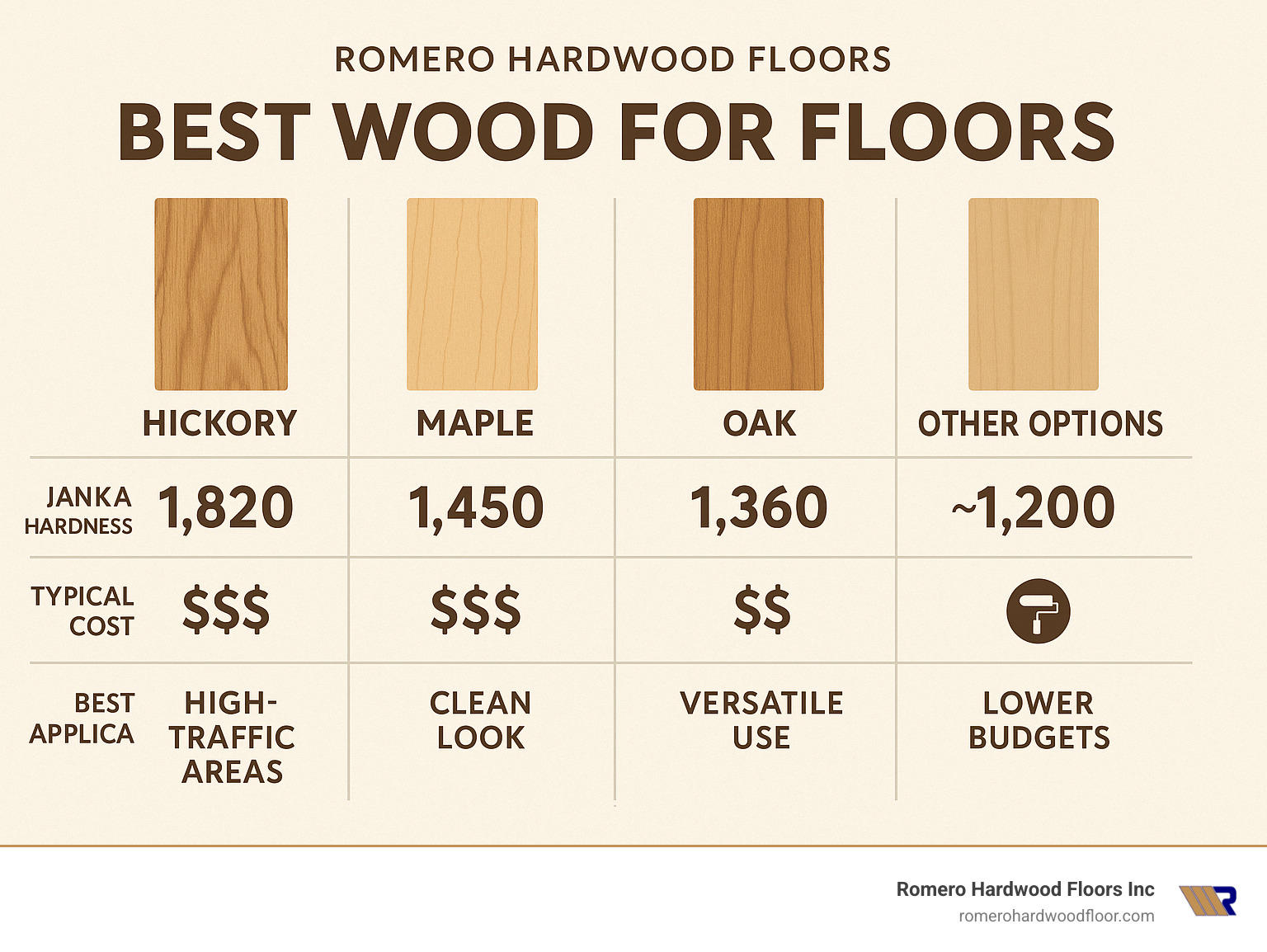
Must-know Best wood for floors terms:
– Engineered hardwood benefits
– Choosing hardwood floor color
– Best hardwood for pets
The Hardwood Basics: Solid, Engineered & Grades
Before we dive into specific wood species, let’s talk about the foundation of what makes the best wood for floors work for your home. It’s not just about picking oak or maple – it’s understanding how that wood is prepared and constructed.
Solid vs. Engineered Hardwood
When you walk into a home with gorgeous hardwood floors, you can’t immediately tell if they’re solid or engineered – but the difference matters tremendously for performance and longevity.
Solid hardwood is exactly what it sounds like – each plank comes from a single piece of timber, typically 3/4″ thick. This traditional choice can be refinished numerous times (up to 10 times for quality boards), giving you a floor that could genuinely last a century or more with proper care.
Engineered hardwood, meanwhile, is like nature’s sandwich – a real hardwood veneer on top (the pretty face you see) with layers of plywood or high-density fiberboard underneath, arranged in opposing directions for improved stability.
“Many of our Massachusetts clients are genuinely surprised when they can’t tell the difference between solid and engineered floors once they’re installed,” I often tell homeowners during consultations. “The real difference shows up in where and how they perform over time.”
Engineered hardwood brings several advantages to the table: it handles humidity changes better, works beautifully over concrete slabs, plays nice with radiant heating systems, and typically costs less than its solid counterpart. The trade-off? You can usually only refinish it once or twice because of that thinner top layer, giving it a still-impressive 40-80 year lifespan versus solid wood’s century-plus potential.
Why Grades Matter for Look & Budget
Wood isn’t perfect – and that’s what makes it beautiful. But how much “character” you want in your floors affects both appearance and what you’ll pay.
Prime Grade (AB-Grade) floors provide that clean, uniform look with minimal knots or color variation – perfect for formal spaces and modern designs, but at a premium price. Select Grade offers a balanced middle ground with some small knots and subtle color shifts while maintaining a relatively consistent appearance.
For homes that accept a more lived-in feel, Character/Rustic Grade welcomes wood’s natural quirks – more pronounced knots, color variations, and mineral streaks – while being gentler on your budget. Cabin Grade takes this even further, showcasing wood’s full personality with significant character marks at the most affordable price point.
“For Revere families with active households, we often suggest character grade flooring in living spaces,” I like to point out during home visits. “Those natural variations not only add warmth but also help hide the inevitable scratches from daily life. Save the prime grade for your formal dining room if that’s your style.”
Engineered Anatomy 101
Understanding what’s inside your engineered hardwood helps you make smarter choices:
The wear layer is the actual hardwood veneer on top, ranging from whisper-thin 0.6mm up to substantial 4.5mm. This thickness directly impacts how many times you can refinish the floor – thicker is better for longevity.
Beneath that pretty face lies the core layers – multiple sheets of plywood or fiberboard arranged in a cross-grain pattern that resists the expansion and contraction that can warp solid wood. The more layers and better materials used here, the more stable your floor.
A quality backing layer rounds out the construction, providing additional structural support and moisture resistance.
“For Massachusetts basements and other below-grade spaces, we typically recommend engineered hardwood with a plywood core,” I tell homeowners concerned about moisture issues. “The layered construction handles the humidity fluctuations that would cause solid hardwood to cup or crown.”
When evaluating engineered options, focus on veneer thickness (thicker means more refinishing potential), core quality (plywood generally outperforms HDF), and overall construction (more layers usually means better stability).
Best Wood for Floors: Hickory vs Maple vs Oak Head-to-Head
When it comes to finding the best wood for floors, three domestic champions consistently rise to the top of every conversation: hickory, maple, and oak. Each brings its own personality and performance benefits to your home.
Ever wonder how we actually measure wood hardness? The Janka hardness test is the industry’s gold standard – it measures the force needed to embed a small steel ball halfway into a wood sample. The higher the number (measured in pounds-force or lbf), the more resistant your floor will be to dents from dropped pans, pet claws, or furniture legs. Learn more about the Janka hardness test and how it helps determine the best flooring for your needs.
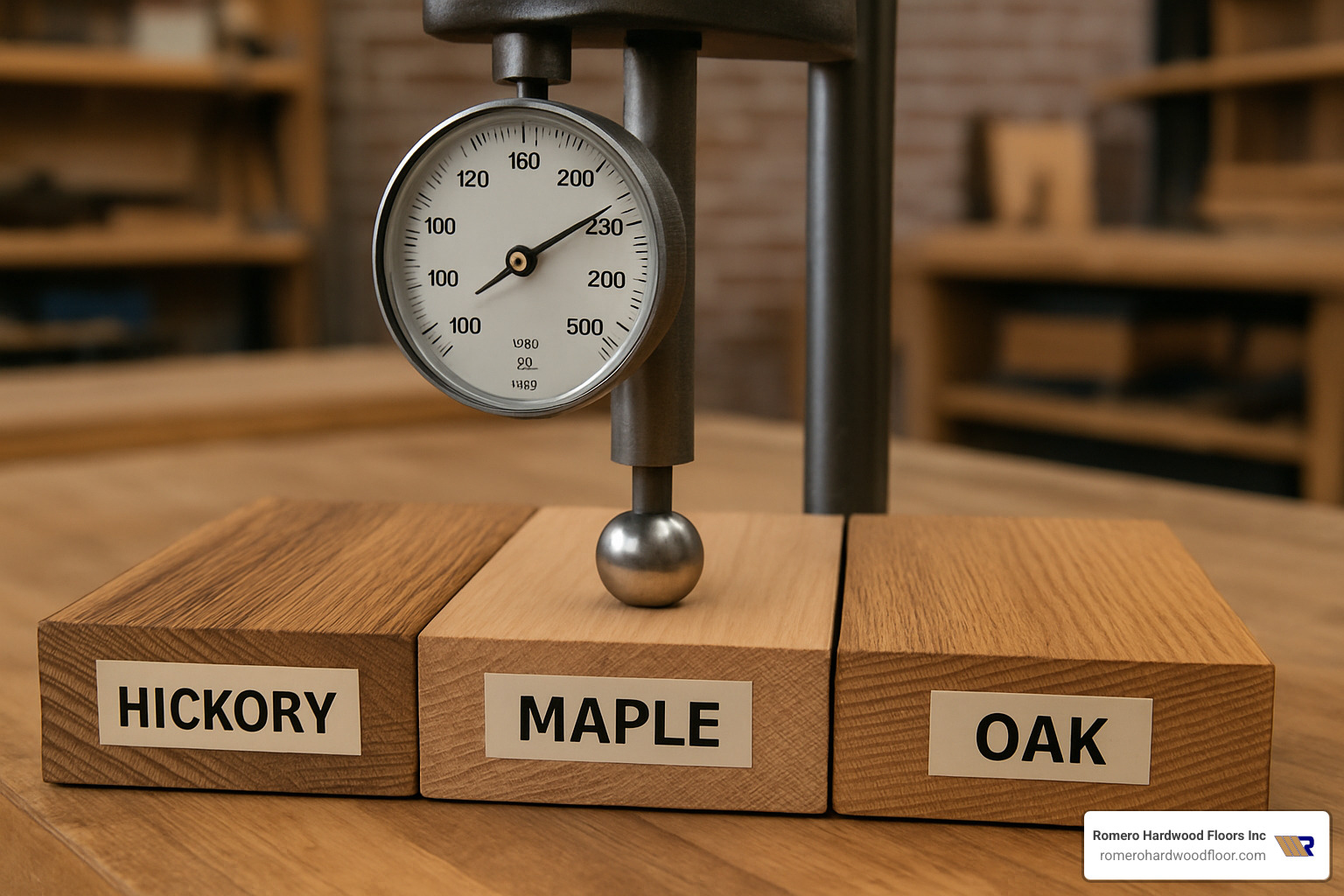
Let’s compare these top contenders side by side:
| Feature | Hickory | Hard Maple | White Oak | Red Oak |
|---|---|---|---|---|
| Janka Hardness | 1,820 lbf | 1,450 lbf | 1,360 lbf | 1,220 lbf |
| Color Range | Light cream to dark brown | Pale cream to light reddish-brown | Light tan to medium brown | Pale pink to reddish-brown |
| Grain Pattern | Dramatic, distinctive | Subtle, fine | Medium, with rays (quartersawn) | Medium, with prominent rays |
| Stain Acceptance | Variable | Moderate | Excellent | Excellent |
| Cost Range | $6-$15/sq ft | $6-$14/sq ft | $5-$14/sq ft | $4-$11/sq ft |
| Best For | High-traffic, rustic styles | Modern, clean aesthetics | Versatile, traditional to contemporary | Warm, traditional spaces |
Is Hickory the Best Wood for Floors?
With a mighty Janka rating of 1,820 lbf, hickory stands as the undisputed heavyweight champion among domestic hardwoods commonly used for flooring. This exceptional hardness makes hickory the best wood for floors in homes where life happens at full volume – active children racing down hallways, enthusiastic dogs skidding around corners, or busy entryways that see constant traffic.
“Hickory has become the go-to recommendation for our clients in Beverly and Danvers with busy family homes,” shares our design team at Romero Hardwood Floors Inc. “They love that they don’t have to tiptoe around their beautiful new floors.”
Beyond its impressive durability, hickory floors tell a story through their striking character. The dramatic grain patterns create natural artwork beneath your feet, with colors that can range from creamy white to rich chocolate brown – often within the same plank! This natural variation creates a built-in rustic charm that looks particularly stunning in wider planks (5″ and up) where the character has room to shine.
Historically used for tool handles because of its shock absorption properties, hickory brings that same resilience to your floors. However, this dramatic beauty comes with one consideration – its pronounced color variation means hickory can be somewhat challenging to stain evenly. If you’re seeking a specific uniform color tone, you might find other species provide more consistent results.
Is Maple the Best Wood for Floors?
Hard maple brings an impressive 1,450 lbf Janka rating to the table, making it the second-hardest common domestic flooring option. While slightly less dent-resistant than hickory, maple offers exceptional durability with a completely different aesthetic appeal – making it the best wood for floors in spaces where a clean, contemporary look is desired.
“We’ve installed maple floors throughout Medford and Winchester in homes where owners want that bright, clean aesthetic without sacrificing durability,” notes our installation team. “It’s like having a bowling alley’s toughness with a modern home’s elegance.”
That bowling alley reference isn’t random – maple’s outstanding durability has made it the traditional choice for both bowling alleys and basketball courts where it withstands incredible abuse while maintaining its beauty. In your home, this translates to floors that stand up to daily life while providing a bright, airy foundation for your design vision.
Maple’s naturally light blonde color and subtle, fine grain create a sophisticated backdrop that works beautifully in contemporary and minimalist spaces. The tight grain pattern offers a more uniform appearance than oak or hickory, though it does tend to show dirt more readily than darker woods and will gradually develop a subtle amber tone with age and sun exposure.
One important consideration with maple is its somewhat limited staining potential. The dense grain structure doesn’t always accept stain evenly, especially darker colors. Many homeowners choose to accept maple’s natural light beauty rather than altering it with stain.
Is Oak Still the Best Wood for Floors?
There’s a reason oak remains America’s most popular hardwood flooring, accounting for roughly two-thirds of all installations nationwide. This enduring popularity stems from oak’s remarkable versatility, reasonable price point, and proven performance over generations.
“Oak continues to be our most requested species, particularly in communities like Salem and Marblehead with their historic homes,” explains our design consultant at Romero Hardwood Floors Inc. “White oak has gained tremendous popularity for modern renovations, while red oak remains perfect for classic New England homes.”
Red Oak brings a Janka hardness of 1,220 lbf along with warm, reddish undertones that create an inherently welcoming atmosphere. Its prominent grain patterns add natural texture and interest to any room, while its excellent stain absorption makes it incredibly versatile for achieving your desired color. As the most affordable of the premium hardwoods, red oak delivers exceptional value without compromising quality.
White Oak steps up the durability factor with a Janka rating of 1,360 lbf and offers more neutral tan to brown tones that work beautifully in contemporary designs. Its tighter grain pattern creates a slightly more refined look than red oak, and its closed cell structure provides superior moisture resistance – making it an excellent choice for kitchens or coastal homes in communities like Manchester-by-the-Sea and Gloucester.
Oak’s widespread availability translates to more grade options, width choices, and competitive pricing. Its excellent staining properties also make it the most versatile choice for achieving virtually any desired color, from the lightest whitewash to the deepest ebony.
Cost, Availability & Sustainability Considerations
Let’s talk dollars and sense when it comes to finding the best wood for floors. Your beautiful new hardwood floor is definitely an investment, but one that typically pays you back in home value and lasting enjoyment for decades to come.
If you’re budgeting for new hardwood floors, here’s what you can generally expect to spend:
– Materials only: $4-$15 per square foot
– Total installed cost: $6-$25 per square foot
Note: These are average costs based on internet data and not actual costs for Romero Hardwood Floors Inc. Actual prices can swing significantly depending on your specific choices and installation needs.
“When we help homeowners in Revere plan their flooring projects, we always suggest adding a 5-10% buffer to your calculated square footage,” says our estimating team. “This extra material accounts for cuts, the occasional mistake, and gives you matching wood for future repairs if needed.”
Several key factors will influence what you’ll actually pay for your new floors. Wood species makes a big difference – those gorgeous exotic hardwoods will generally hit your wallet harder than domestic options. The grade you select matters too, with those clean, knot-free prime grades commanding premium prices over more rustic character grades with natural variations.
Your choice between solid and engineered construction affects pricing, as does plank width (those trendy wide planks typically cost more per square foot). Even your finish choices and installation pattern play a role – a complex herringbone pattern requires more labor and material than a straight lay installation.
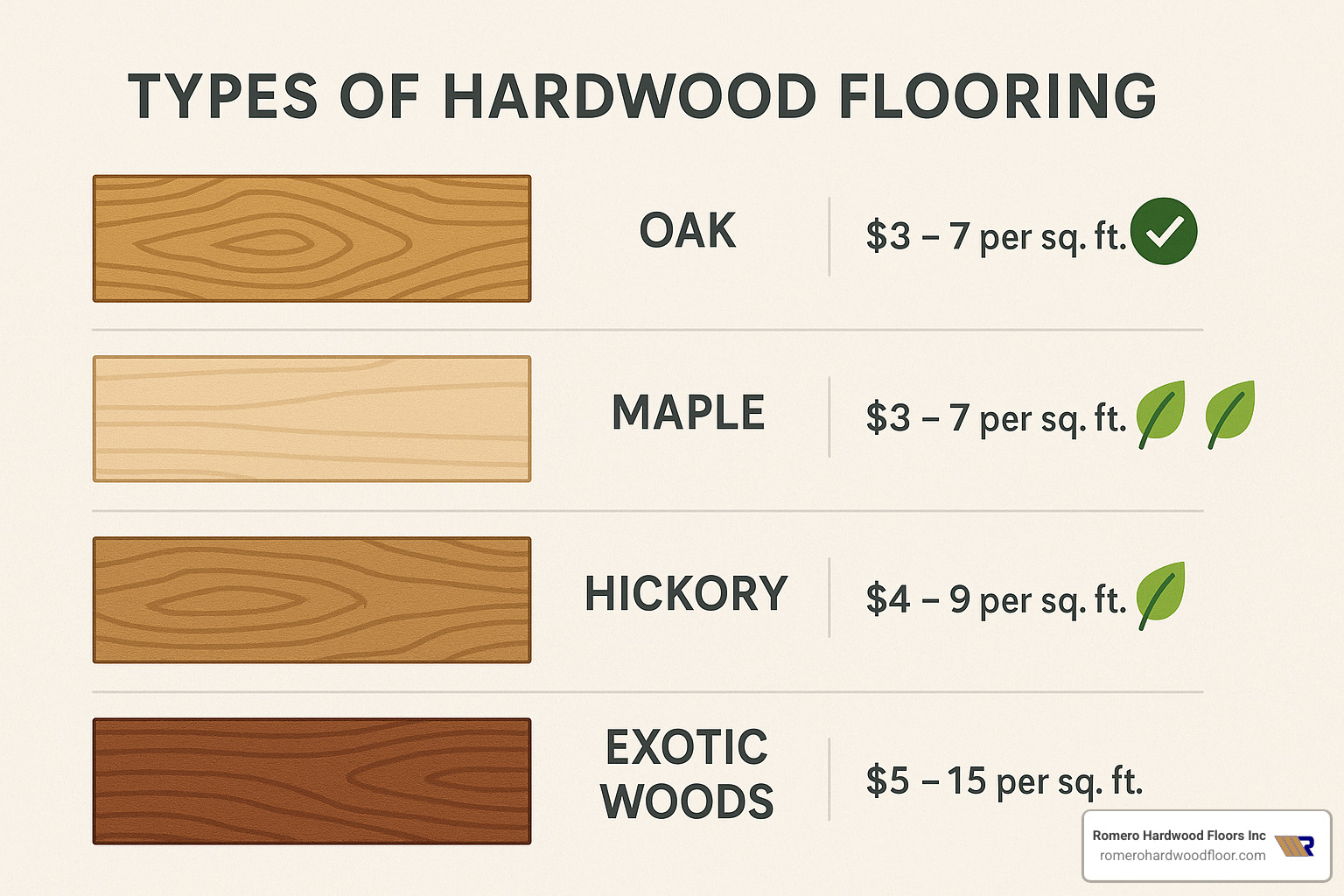
Domestic vs Exotic Price Gaps
While we’ve focused on American-grown hickory, maple and oak in this guide, it’s worth noting the significant price difference between these hometown heroes and their exotic counterparts:
Our domestic favorites typically range from $4-$15 per square foot for materials alone. Red oak often represents the most budget-friendly option starting around $4, while specialty cuts of hickory might reach $15 at the high end.
By comparison, exotic imports like Brazilian cherry, tigerwood, Brazilian walnut (ipe), and teak can command anywhere from $8-$30 per square foot. These exotic beauties offer stunning colors and often exceptional hardness ratings (many exceed 2,500 on the Janka scale), but they come with premium pricing due to import costs, tariffs, and limited availability.
“When clients in Malden or Melrose are considering exotic species, we make sure they understand the potential for longer lead times and fewer grade options,” explains our sourcing specialist at Romero Hardwood Floors Inc. “While these woods are undeniably beautiful, the supply chain complexities can affect both timeline and budget.”
Eco-Friendly Choices & Certifications
Today’s homeowners increasingly want floors that look good and do good for the planet. If environmental impact matters to you when selecting the best wood for floors, here are some helpful guideposts:
FSC Certification from the Forest Stewardship Council ensures your wood comes from responsibly managed forests that provide environmental, social, and economic benefits. This independent certification is the gold standard for sustainable wood sourcing – look for the FSC logo when shopping.
For engineered products, CARB Compliance (California Air Resources Board) certification guarantees that your flooring meets strict formaldehyde emission standards, contributing to healthier indoor air quality. This is especially important for families with young children or those with respiratory sensitivities.
Low-VOC finishes minimize harmful volatile organic compounds that can off-gas into your home. Water-based polyurethanes and natural oil finishes generally offer better environmental and health profiles than traditional solvent-based options.
“For our environmentally conscious clients in Cambridge and Somerville, we often discuss both certified new wood and reclaimed options,” notes our sustainability advisor. “Reclaimed wood salvaged from old barns and factories offers incredible character while giving new life to existing materials.”
Bamboo provides another interesting alternative. Though technically a grass, it offers hardwood-like performance with impressive sustainability credentials – bamboo reaches harvest maturity in just 3-5 years compared to decades for traditional hardwoods.
If you’re serious about minimizing environmental impact, you might also consider cork flooring, harvested from the bark of cork oak trees without harming the tree itself. It creates a comfortable, resilient surface that’s naturally antimicrobial and sound-absorbing.
Most Eco-Friendly Wood Flooring
When we help Massachusetts homeowners steer these choices at Romero Hardwood Floors Inc., we find that balancing budget, aesthetics, and environmental considerations leads to the most satisfying long-term results. The good news? Today’s market offers beautiful, durable options at virtually every price point and environmental standard.
Installation Scenarios & Maintenance Tips
The best wood for floors isn’t a one-size-fits-all solution – it truly depends on where in your home you’re installing it. Each area presents unique challenges that can make certain species and constructions perform better than others.
When we work with homeowners across Massachusetts, we often discuss how different rooms have different needs. Kitchens, for instance, are prone to occasional spills and humidity fluctuations. While no hardwood is truly waterproof (despite what some may claim!), white oak has naturally superior moisture resistance compared to other domestic species. Many of our clients in coastal towns like Gloucester appreciate this extra protection.
“I always tell homeowners to think about the room’s purpose first,” says our lead installer at Romero Hardwood Floors Inc. “A busy entryway needs different considerations than a rarely-used guest bedroom.”
For basements and other below-grade spaces, solid hardwood is simply not recommended due to moisture concerns. Engineered hardwood with a quality plywood core is the way to go here, with white oak or maple veneers offering excellent performance without the worry of warping or buckling.
Those high-traffic zones – entryways, hallways, and busy family rooms – benefit tremendously from hickory’s exceptional hardness. We’ve seen hickory floors in busy households with multiple dogs hold up beautifully year after year. Hard maple and white oak are strong alternatives if hickory’s distinctive look isn’t your style.
Your living and dining rooms often serve as your home’s showcase spaces. These formal areas typically see less abuse than family zones, allowing you to prioritize appearance. The classic look of oak or the clean appearance of maple works beautifully here, offering the perfect balance of durability and style.
Bedrooms offer the most flexibility since they see less traffic and fewer spills. This is where you can really let your personal style shine through in your flooring choice without worrying quite as much about maximum durability.
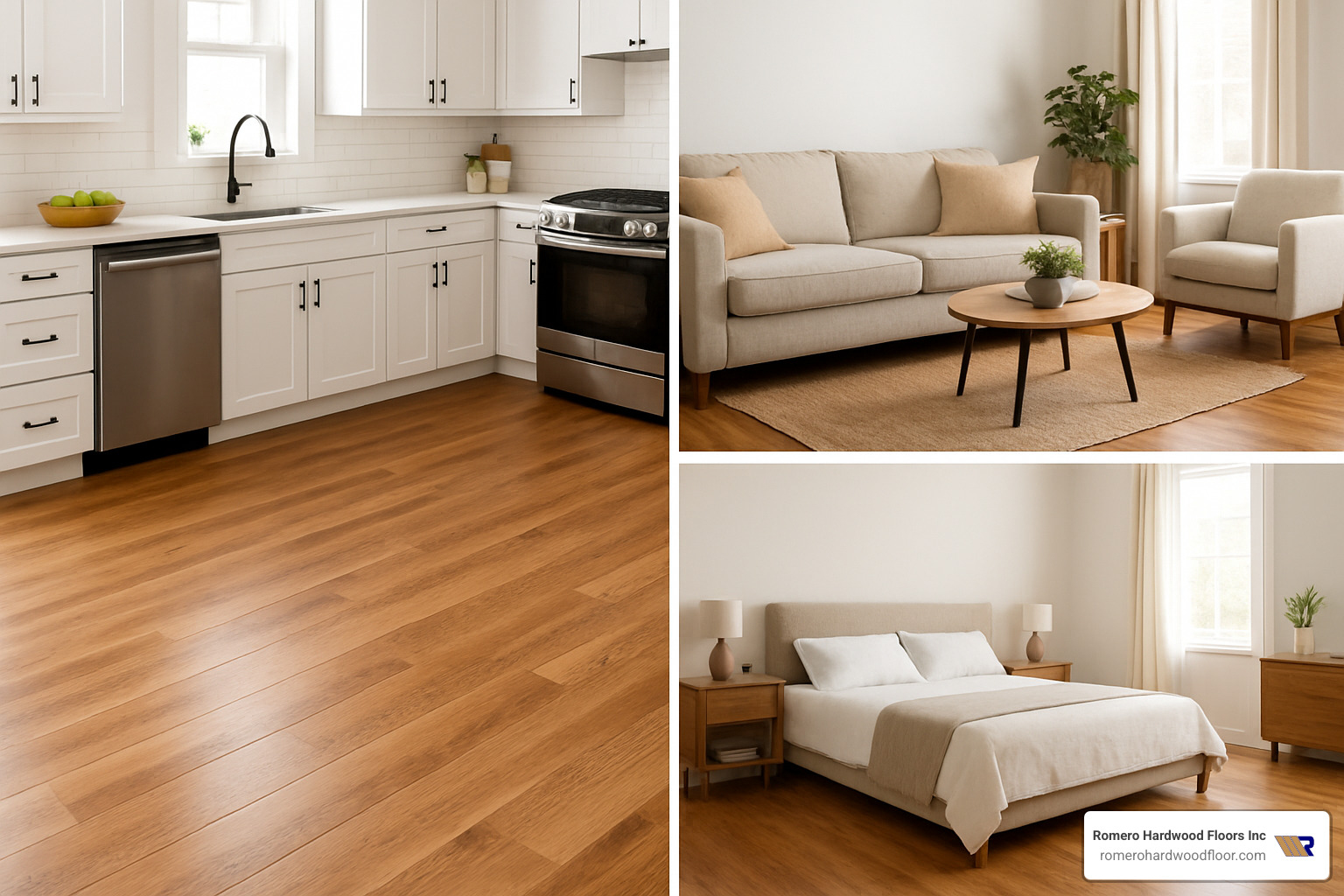
Over Concrete & Radiant Heat
Installing hardwood over concrete slabs or radiant heating systems requires some special know-how – something we’ve perfected over our years serving Massachusetts homes.
Concrete slabs present a unique challenge for hardwood. The moisture that naturally migrates through concrete can wreak havoc on solid hardwood, causing cupping, crowning, or worse. This is why engineered hardwood is almost always the appropriate choice for these installations.
“Many of our clients in newer developments around Revere and Lynn have concrete subfloors and still want the warmth of hardwood,” notes our installation team. “We carefully test for moisture content and install proper vapor barriers before laying any engineered product.”
For concrete installations, we typically recommend a glue-down application rather than floating methods. This provides superior long-term stability and that solid feel underfoot that homeowners love.
Radiant heating systems have become increasingly popular in Massachusetts homes, especially during our cold winters! If you’re considering this cozy option, engineered hardwood is generally more stable over radiant heat than solid. Quarter-sawn white oak deserves special mention here – its unique cut makes it exceptionally stable with temperature fluctuations.
We’ve found that narrower boards (2¼” or 3¼”) typically perform better than wide planks with radiant heat. The proper acclimation period is absolutely critical before installation – rushing this step can lead to problems down the road.
Caring for Hickory, Maple & Oak Floors
The best wood for floors will only stay beautiful with proper care. While maintenance routines are similar across species, there are some interesting differences worth knowing.
All hardwoods benefit from regular sweeping or dust-mopping to remove tiny abrasive particles that can scratch the finish over time. Use only manufacturer-approved hardwood cleaners – we’ve seen too many beautiful floors damaged by well-intentioned homeowners using the wrong products!
Spills happen (especially in homes with kids and pets), but prompt cleanup is essential. Despite what some might think, no traditional hardwood is waterproof. Maintaining indoor humidity between 35-55% helps prevent seasonal gapping and cupping – a particular concern in our New England climate with dry winters and humid summers.
Each species has its own personality when it comes to showing wear:
Hickory’s extreme hardness makes it remarkably dent-resistant, though it can still be scratched. The good news? Its dramatic color variations naturally camouflage minor scratches and wear patterns. Many of our clients with active households in Danvers and Beverly choose hickory for this very reason.
Maple’s light, uniform appearance means it may show dirt more readily than darker woods, requiring slightly more frequent cleaning. The tight grain pattern does offer some resistance to dirt infiltration, though scratches tend to be more visible against its clean canvas.
Oak floors have that wonderful prominent grain pattern that helps disguise minor scratches and dents – one reason they’ve remained popular for generations. White oak’s closed cell structure provides better protection against occasional spills, making it a practical choice for busy family homes.
“We recommend refinishing solid hardwood floors every 7-10 years in busy households,” shares our maintenance specialist. “Homes with fewer people and pets can often go 10-15 years between refinishing. Engineered floors typically need refinishing less frequently, but remember they have fewer total refinishing cycles available over their lifetime.”
Frequently Asked Questions about Best Wood for Floors
How does the Janka rating influence real-world durability?
The Janka hardness test gives us a scientific measurement, but what does it really mean when your toddler drops a toy truck or your retriever skids across the floor?
Best wood for floors choices all have different hardness ratings, but the practical differences might surprise you. While hickory (1,820 lbf) significantly outranks red oak (1,220 lbf) on paper, both will serve you beautifully in most homes. The difference becomes more noticeable in what I call “high-chaos environments” – homes with large dogs racing down hallways, children who treat the living room like a playground, or households that entertain frequently.
“In our experience installing floors throughout Massachusetts communities, we find that any domestic hardwood with a Janka rating above 1,000 will provide good performance in normal residential use,” explains our technical advisor at Romero Hardwood Floors Inc. “The higher ratings become more important in specific high-wear scenarios.”
Hardness isn’t the whole durability story. The quality of the finish, how well you maintain your floors, and keeping consistent humidity levels often matter more for longevity than the wood’s natural hardness. Even the hardest hickory floor will show wear if it’s poorly maintained!
Can engineered hickory, maple or oak be refinished?
Yes, you can definitely refinish engineered versions of these popular woods—but there’s a catch that solid hardwood doesn’t have.
The refinishing potential boils down to one critical factor: how thick is that top layer of real wood? Think of it as your floor’s “refinishing budget” that you can spend over its lifetime:
- Thin veneer (0.6-1.5mm): This gives you enough for light buffing and recoating, but not deep sanding
- Medium veneer (2-3mm): You’ll get about 1-2 refinishing cycles—perfect for most homeowners
- Thick veneer (3mm+): Premium engineered floors with this thickness allow for 2-3 refinishing cycles
“When we install premium engineered hardwood with a thick wear layer, we inform our clients in communities like Lynnfield and Reading that they can expect to refinish their floors at least once or twice over the floor’s lifetime,” notes our installation team.
For comparison, traditional 3/4″ solid hardwood typically allows for 5-10 refinishing cycles throughout its life, with each sanding removing about 1/32″ of wood. That’s why solid hardwood can sometimes last a century or more in historic New England homes!
Which species handles kids, pets and high heels best?
When your home hosts the trifecta of floor challenges—children, pets, and high-heel traffic—durability becomes your primary concern when selecting the best wood for floors.
For homes buzzing with children’s activities, all three species perform admirably, though hickory offers the best defense against dropped toys and impromptu wrestling matches. Consider character or rustic grades that naturally hide minor dents and scratches—they tell the story of your family’s life without looking damaged.
Pet owners face different challenges depending on their furry friends:
– Large dogs with clicking nails? Hickory wins handily, with hard maple following closely
– Medium-sized pets? Any of these three species will serve you well with proper care
– Cats? Focus more on scratch-resistant finishes than the specific wood species
As for those stiletto heels that concentrate remarkable force into tiny contact points—hickory provides the best natural resistance, but even it can dent under the pointed pressure of high heels. The most practical solution? A gentle house rule about removing shoes or using protective pads in areas where heels are common.
“We often recommend aluminum oxide factory-finished flooring for homes with pets, as this provides superior scratch resistance regardless of the wood species,” advises our product specialist at Romero Hardwood Floors Inc.
Here’s a practical tip from our years of experience: lower-gloss finishes (matte or satin) show scratches and dents far less obviously than shiny high-gloss finishes. This simple choice makes a remarkable difference in how forgiving your floors appear in active households, regardless of which wood species you select as the best wood for floors for your family.
Conclusion
When it comes to finding the best wood for floors, there’s truly no one perfect answer for everyone. Each premium domestic hardwood we’ve explored brings something special to your home.
Hickory shines with its remarkable hardness (1,820 lbf) and eye-catching character. If your home bustles with active kids, playful pets, or constant foot traffic, hickory’s exceptional durability makes it a standout choice. Those distinctive grain patterns create a statement floor that becomes a conversation piece in any room.
Hard maple delivers that perfect balance of strength and style. With its fine, uniform grain and bright, clean appearance, maple fits beautifully into modern and minimalist spaces. It’s the perfect canvas when you want your furniture and décor—not your flooring—to take center stage.
Oak continues its reign as America’s favorite hardwood for good reason. Both red and white oak varieties offer that sweet spot of durability, value, and versatility that homeowners love. White oak deserves special mention for homes near the coast or in kitchens, where its natural moisture resistance provides extra peace of mind.
At Romero Hardwood Floors Inc., we’ve been changing homes throughout Revere and surrounding Massachusetts communities since 2006. Our experienced team walks with you through every step—from selecting the perfect species to professional installation and long-term maintenance guidance. We’re committed to creating floors that your family will enjoy for generations.
We understand that choosing new hardwood flooring represents a significant investment in your home. That’s why we pride ourselves on offering competitive pricing without compromising on quality or service. Whether you’re restoring a historic Guide Hill brownstone or building a contemporary suburban home, our punctual service and guaranteed workmanship ensure your project runs smoothly from start to finish.
The best wood for floors ultimately depends on your unique lifestyle, design preferences, and budget considerations. By weighing the distinctive characteristics of each species against your family’s needs, you’ll find the perfect hardwood to improve both your home’s beauty and its value for decades to come.
Best Hardwood Floor Brands for your next project
