
Can You Refinish Prefinished Hardwood Floors? 7 Powerful Reasons 2025
Yes, You Can Refinish Prefinished Hardwood Floors
Can you refinish prefinished hardwood floors? Absolutely. Even with a rock-hard factory aluminum-oxide coating, the wood underneath can be sanded and finished again.
Quick Answer:
– Solid prefinished hardwood: 2–5 complete refinishes over its life
– Engineered prefinished hardwood: Usually 1–2, depending on veneer thickness
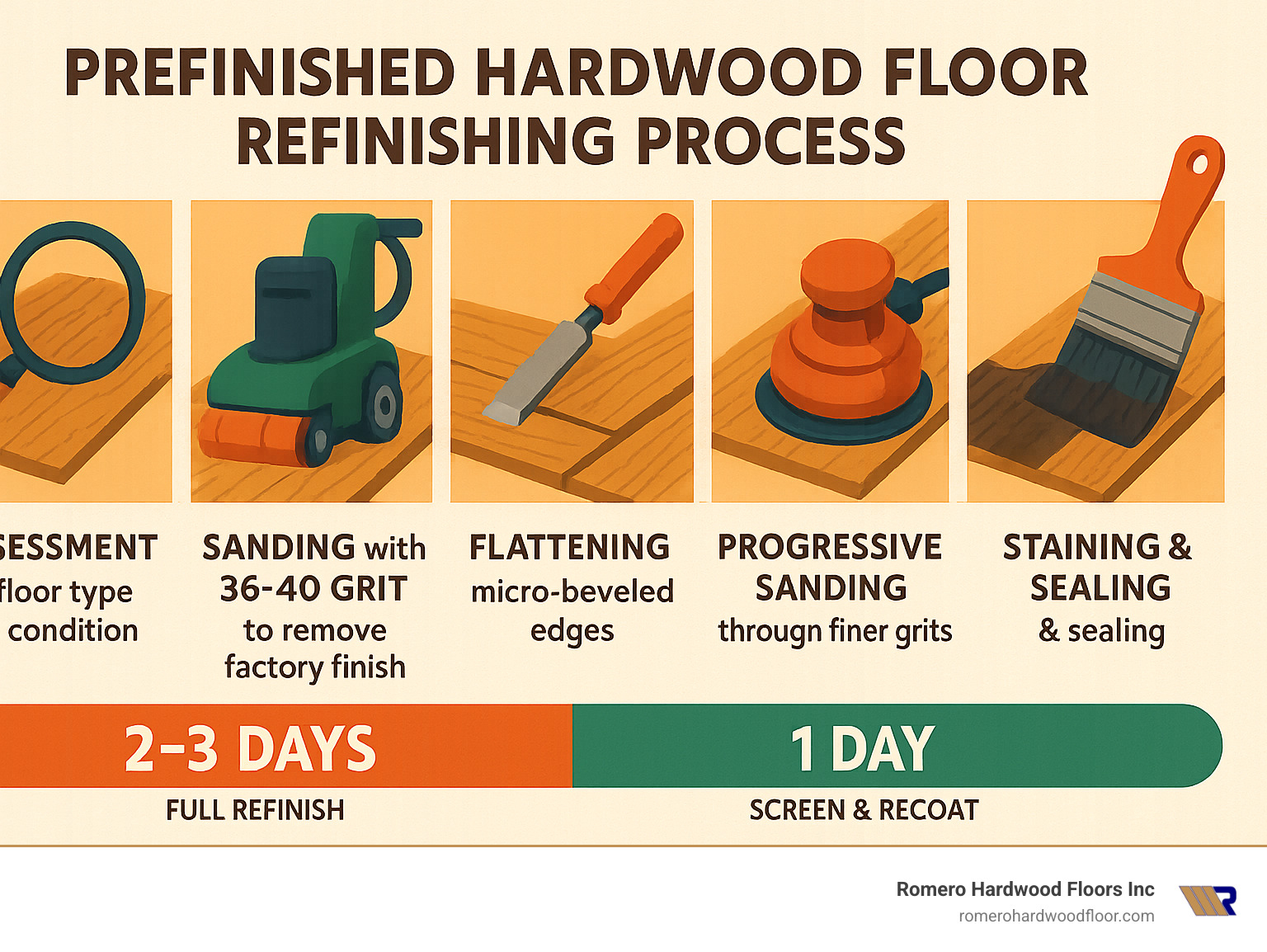
– Removing factory finish: Start with aggressive 36–40-grit sanding
– Micro-beveled edges: Decide whether to sand them flat or leave them
– Screen & recoat: Ideal for light surface wear—no full sanding needed
Once the factory finish is removed, the rest of the job mirrors any other hardwood project. The keys are strong dust containment and a careful eye on wear-layer thickness with engineered floors.
I’m Francisco Romero, owner of Romero Hardwood Floors Inc. in Revere, MA, and I’ve refinished hundreds of prefinished floors across Greater Boston since 2006.
What Makes Prefinished Hardwood Different
Prefinished hardwood floors are built completely differently than floors that get finished on-site. When you’re asking can you refinish prefinished hardwood floors, you need to understand what you’re working with first.
These boards arrive at your home already sanded, stained, and sealed with multiple protective layers. The factory does all the finishing work in controlled conditions with industrial equipment. This creates some unique challenges when it comes time to refinish.
The biggest differences that affect refinishing are the aluminum oxide finish that’s baked on like armor, those micro-beveled edges between planks, and whether you’re dealing with solid or engineered construction.
Solid prefinished floors with their full 3/4″ thickness can handle multiple refinishes over their lifetime. But engineered versions might only give you one or two chances because that top veneer layer can be as thin as 1/8″.
We’ve refinished prefinished floors from every major manufacturer over the years, and the approach varies significantly based on these factory-applied features. For more details on our Prefinished Hardwood Flooring Refinishing services, we handle both solid and engineered prefinished floors throughout our service areas.
Factory-Applied Aluminum-Oxide Finish
This is the real game-changer when it comes to refinishing prefinished floors. That factory finish isn’t just tough – it’s incredibly tough. We’re talking about 5-7 layers of UV-cured polyurethane that gets baked in industrial ovens with aluminum oxide particles mixed right in.
Aluminum oxide is the same abrasive material used to make sandpaper. So essentially, your floor’s finish contains the stuff we use to sand floors. No wonder it’s so scratch-resistant!
This creates a finish that can last up to 25 years before needing refinishing, but it also means we need to bring out the big guns to remove it. While we might start with 60-80 grit sandpaper on regular site-finished floors, prefinished floors require 36-40 grit sandpaper to cut through that aluminum oxide coating.
The process is more aggressive, but once you get through that factory armor, you’re working with quality hardwood underneath. The aluminum oxide coating was designed to protect the wood, not make refinishing impossible.
According to scientific research on aluminum-oxide durability, this factory process creates a finish that’s significantly harder than anything applied on-site.
Micro-Beveled Edge Profiles
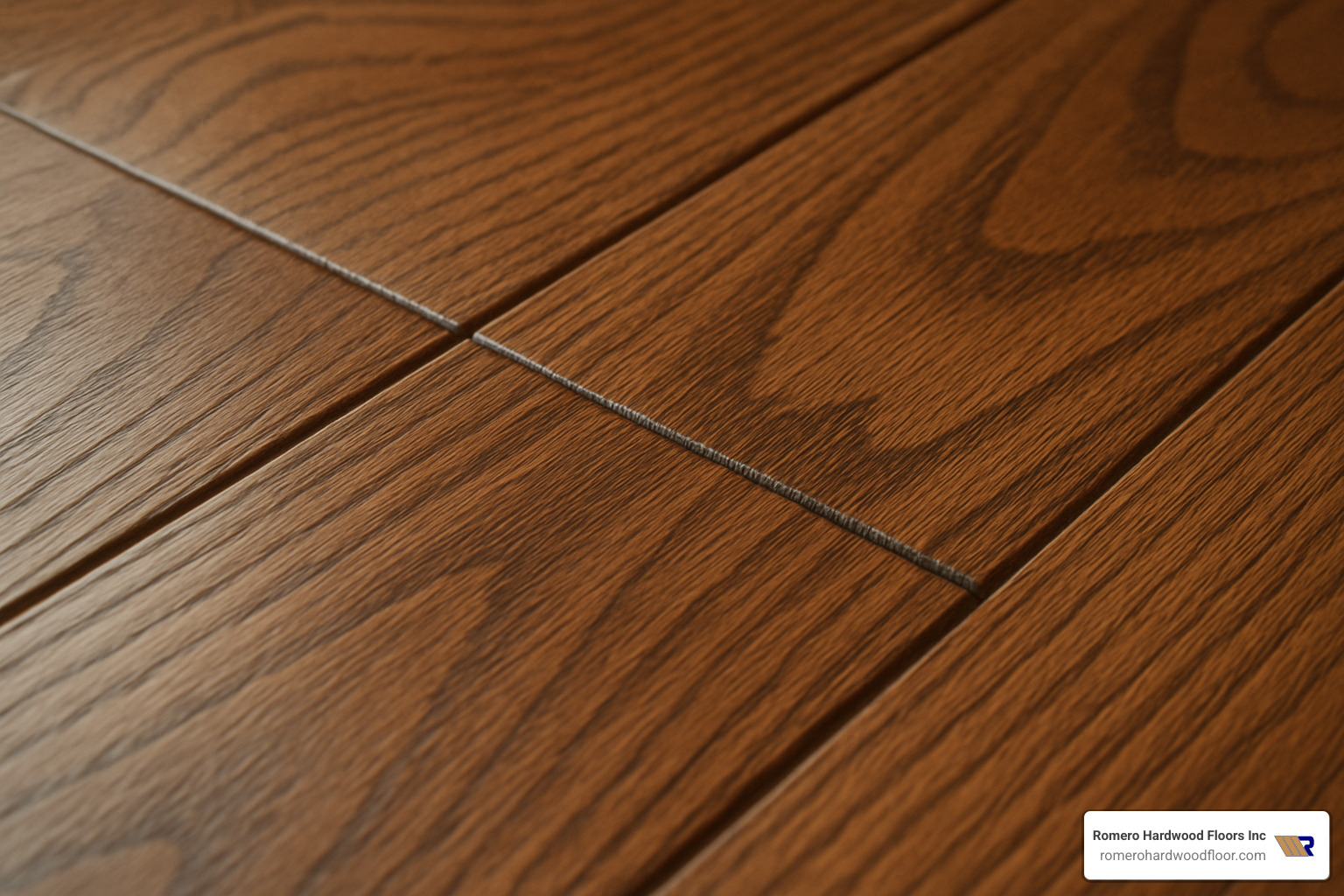
Those small grooves running between each plank are micro-beveled edges that serve a real purpose during installation. The bevels help hide minor subfloor imperfections and make the installation process more forgiving for contractors.
Over time, these little grooves can trap dirt and debris, which is why some homeowners want them completely sanded flat when we refinish their floors.
Getting rid of the bevels requires careful edge work with specialized sanders or sometimes hand-scraping tools. Some contractors will suggest filling these bevels with wood putty, but we don’t recommend that approach – the filler typically cracks and peels over time.
When we’re planning a refinish job, we always discuss with homeowners whether to keep the bevels or sand them flat. Keeping them preserves more wood thickness for future refinishes, while flattening them creates a smoother surface that’s easier to clean and maintain.
Can You Refinish Prefinished Hardwood Floors?
Here’s the straight answer: can you refinish prefinished hardwood floors? Absolutely, yes! Don’t let anyone tell you those factory-finished floors are impossible to refinish. I’ve been doing it successfully for over 15 years, and while it’s more challenging than regular hardwood, it’s definitely doable.
Solid prefinished hardwood floors can typically handle 2-5 refinishing cycles during their lifetime, which gives you plenty of opportunities to refresh your floors. Those tough factory finishes that seem so permanent? They actually protect the wood underneath, keeping it in great shape for refinishing.
Most prefinished floors will go 25 years or more before needing their first refinish, thanks to that super-durable aluminum oxide coating. When the time comes, you’ve got two main options: a full sand-and-refinish job, or a lighter screen and recoat method if your floors just have surface wear.
The key difference is knowing whether you have solid or engineered prefinished flooring. Solid floors give you much more flexibility for multiple refinishes, while engineered floors with thin wear layers are more limited.
For engineered floors specifically, the process requires extra care and expertise. Check out our Engineered Hardwood Floor Refinishing services to see how we handle these more delicate floors.
Main Challenges of “Can You Refinish Prefinished Hardwood Floors”
When homeowners ask can you refinish prefinished hardwood floors, they’re usually thinking it’ll be just like refinishing regular hardwood. Not quite! That aluminum oxide finish is incredibly tough – we’re talking about the same material used to make sandpaper. Removing it requires aggressive sanding with coarse grits that can overwhelm typical DIY equipment.
Bevel leveling is where things get really tricky. Those micro-beveled edges between planks need special attention. You can either work around them carefully or sand them completely flat – both approaches require specialized tools and techniques.
Veneer thickness on engineered floors is the make-or-break factor. Sand too aggressively and you’ll cut right through that thin hardwood layer to the plywood underneath. We use precision gauges to measure exactly how much material we can safely remove.
Dust control becomes even more critical with prefinished floors. The aggressive sanding needed creates significantly more dust than typical refinishing. Without proper HEPA filtration, you’ll have aluminum oxide particles settling throughout your home for weeks.
How Many Times Can You Refinish Prefinished Hardwood Floors
The answer to how many times can you refinish prefinished hardwood floors depends entirely on what’s under your feet. Solid prefinished floors with their full 3/4″ thickness can theoretically be refinished 5-10 times over their lifetime. In the real world, most homeowners refinish 2-4 times before replacement.
Engineered prefinished floors are a different story entirely. With wear layers often just 1/8″ thick or even less, you might only get 1-2 refinishes before hitting the plywood core. Some cheaper engineered floors have veneers so thin they can’t be refinished at all.
We always do a moisture content check and verify the subfloor attachment before starting any refinishing project. Floating floors that aren’t nailed or glued down can’t be refinished safely – the sanding process will cause them to shift and separate.
The wear layer gauge is our most important diagnostic tool. We need at least 1/32″ of solid wood above the tongue and groove connection to safely refinish. Each refinishing cycle removes approximately 1/32″ to 1/16″ of material, depending on the floor’s condition.
Step-By-Step Guide: From Sanding to Topcoat
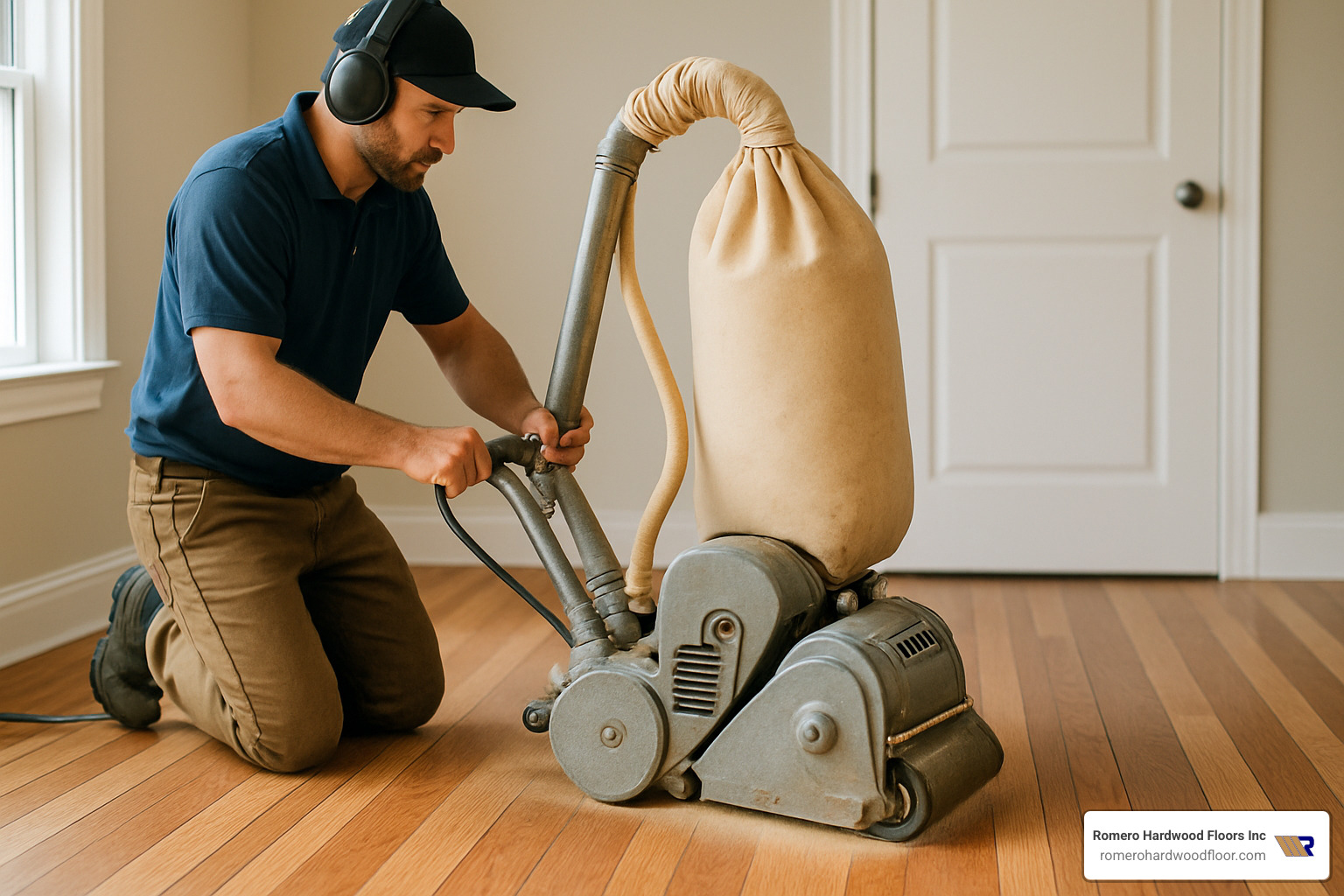
When homeowners ask can you refinish prefinished hardwood floors, they’re often surprised to learn it follows a proven process we’ve perfected over 15 years. The key is understanding that the factory finish requires a more aggressive approach than typical site-finished floors.
The prep work starts before any sander touches the floor. We remove all furniture and rugs first, then give the floors a thorough cleaning. Any loose boards get secured with finish nails because the vibration from drum sanders can make squeaks worse.
Dust containment is crucial – we seal off the work area with plastic sheeting and use HEPA vacuums throughout the process. The aluminum oxide particles create more dust than regular refinishing.
The grit sequence for prefinished floors is more aggressive than most DIY guides suggest. We start with 36-40 grit sandpaper to cut through that tough factory finish – anything finer just glazes over the surface. From there, we progress through 60 grit for smoothing, 80 grit for preparation, and finish with 100-120 grit for that final smooth surface.
Edge sanding around the perimeter requires specialized equipment since drum sanders can’t reach tight spaces. Those micro-beveled edges need special attention – either careful preservation or complete removal depending on your preference.
The stain choice comes after all sanding is complete. We always test stain colors in an inconspicuous area first. Wood conditioner helps ensure even stain penetration, especially on maple or birch floors.
Sealer application creates the foundation for your topcoats, followed by a light sanding with 180-220 grit. Then we apply 2-3 finish coats with proper cure times between each application.
For more detailed sanding techniques, check out our How to Sand Hardwood Floors guide.
Should You Keep or Flatten the Micro-Bevels?
This decision stumps a lot of homeowners, and there’s no wrong answer. We’ve done both approaches hundreds of times, and each has its place depending on your lifestyle and preferences.
Keeping the bevels preserves more wood thickness for future refinishes – something that matters if you plan to stay in your home long-term. The bevels also maintain that original factory look. The downside? Those grooves can still trap dirt and pet hair.
Flattening the bevels creates a completely smooth surface that’s much easier to clean and maintain. No more debris getting stuck in the cracks, and stain coverage is more uniform. The trade-off is removing more wood material, which limits future refinishing options.
We follow NWFA guidance and discuss both options during our initial consultation. In kitchens and high-traffic areas, most clients choose to flatten the bevels for easier maintenance. In formal dining rooms or bedrooms, keeping the bevels often makes more sense.
Screen & Recoat (Buff & Coat) Method
Sometimes the answer to can you refinish prefinished hardwood floors is “yes, but you don’t need full refinishing.” The screen and recoat method works great for floors with light wear that just need refreshing.
This light abrasion approach involves scuffing up the existing finish just enough for new polyurethane to bond properly. We use 120-150 grit screens attached to buffer machines – much gentler than the aggressive sanding required for full refinishing.
When it’s appropriate depends on your floor’s condition. Surface scratches from pets or furniture? Perfect candidate. Finish looks dull but you can’t feel scratches with your fingernail? Screen and recoat will bring back that showroom shine. Deep gouges or water damage? You’ll need full refinishing.
The best part about this method is the one-day process. We can typically complete screen and recoat in a single day, and you can walk on your floors after just 24 hours cure time. Compare that to 3-5 days for full refinishing.
Our Hardwood Floor Refinishing Contractors team can assess whether your prefinished floors are good candidates for this lighter approach during a free consultation.
Costs, Equipment & Safety
Wondering what it will cost? Whether you tackle the job yourself or hire a pro, the numbers mainly depend on square footage and how much sanding is required.
Professional pricing around Greater Boston averages $3.50–$6.50 per sq ft for a screen-and-recoat and $4–$8 per sq ft for a full sand-and-refinish. Complex layouts or serious repairs can reach $15 per sq ft. (All figures are averages pulled from public internet sources—not Romero Hardwood Floors’ actual rates.)
DIY looks cheaper—about $2.50 per sq ft in rental and material costs—but that excludes your time and the risk of costly mistakes. We’ve replaced plenty of floors after a weekend sanding experiment went wrong.
| Method | Scope | Typical Time | Avg. Cost/Sq Ft* | Pros | Cons |
|---|---|---|---|---|---|
| DIY Full Refinish | Strip to bare wood, stain, 2–3 coats | 3–5 days | $2.50–$7.50 | Lowest cash outlay | Steep learning curve, no warranty |
| Screen & Recoat | Light abrasion, 1 new coat | 1 day | $3.50–$10.00 | Fast, little dust | Works only on minor wear |
| Pro Full Refinish | Complete restoration | 2–3 days | $4.00–$15.00 | Guaranteed results, pro gear | Higher upfront cost |
*Average costs from internet data; not a quote from Romero Hardwood Floors Inc.
Essential equipment includes a heavy 220-volt drum sander (to handle 36-grit paper), an edge sander, a buffer, multiple sandpaper grits, and a HEPA-filtered vacuum. Safety must come first: an N95 or P100 respirator, eye and ear protection, and knee pads. Aluminum-oxide dust is abrasive—keep it out of your lungs.
Need help? Check our Hardwood Floor Refinishing Near Me page to see if we service your town.

Refinish, Replace, or Paint? Deciding Factors
Refinishing is ideal when the wood itself is sound but the finish looks tired—think scratches, dullness, or sun-fade. Floors with severe water damage, rot, or engineered veneers thinner than 1/32″ often need replacement instead.
Red Flags That Mean Replacement
- Rot, decay, or mold in the boards
- Engineered layers separating (delamination)
- Veneer thickness below 1/32″
- Floating floors that aren’t glued or nailed down
- Deep gouges that reach the plywood core
- Persistent pet-odor penetration
Can You Paint Prefinished Hardwood Floors?
Technically you can, but paint rarely bonds well to the slick aluminum-oxide surface. Even with a bonding primer, chipping usually begins within a couple of years, so we typically recommend proper refinishing or new flooring for better long-term value.
Frequently Asked Questions about Prefinished Floor Refinishing
Will sanding remove all scratches and dents?
Almost all surface scratches disappear. Deep gouges that cut through the wear layer may need filler or board replacement.
How long before I can move furniture back?
Water-based polyurethane: light foot traffic after 24 hours, furniture after 72 hours. Oil-based finishes: 48 hours and roughly one week. Either product reaches full hardness in 7–14 days.
What maintenance is required after refinishing?
Dust-mop or vacuum weekly, clean monthly with a pH-neutral hardwood cleaner, use felt pads under furniture, and wipe spills immediately. Skip steam mops. With these habits, a fresh finish should last 10–15 years.
Conclusion
Can you refinish prefinished hardwood floors? The answer is a resounding yes, and I hope this guide has given you the confidence to move forward with your project. While refinishing prefinished floors requires more skill and patience than working with site-finished wood, the results are absolutely worth it.
After nearly two decades of bringing prefinished floors back to life throughout Greater Boston, I can tell you that homeowners are always amazed at the change. Those dull, scratched surfaces that seemed beyond hope become stunning focal points that add real value to your home.
The benefits of refinishing over replacement speak for themselves. You’ll save 40-60% compared to full replacement costs while keeping the character and quality of your existing hardwood. Most projects wrap up in just 2-3 days, creating far less disruption than tearing out and installing new floors.
At Romero Hardwood Floors Inc, we’ve successfully restored prefinished hardwood throughout Revere, Beverly, Chelsea, Danvers, East Boston, Gloucester, Lynnfield, Malden, Manchester by the Sea, Marblehead, Medford, Melrose, Nahant, Peabody, Reading, Rockport, Salem, Saugus, Somerville, Stoneham, Swampscott, Wakefield, Winchester, Winthrop, and Woburn since 2006.
Whether you’re considering a DIY approach, a simple screen and recoat, or full professional refinishing depends on your floor’s condition and your comfort level with the process. The aluminum oxide finish and micro-beveled edges don’t have to intimidate you – they just require the right approach and realistic expectations.
Don’t let anyone convince you that your prefinished floors are destined for the landfill. With proper assessment and technique, these floors can serve your family beautifully for decades to come.
For comprehensive information about our refinishing services and to see examples of our work, visit our More info about full refinishing services page. We’re always happy to provide honest assessments and free estimates, backed by our guarantee of competitive pricing, punctuality, and quality workmanship that improves your property value.
The real question isn’t whether you can refinish those prefinished floors – it’s when you’re ready to fall in love with your hardwood all over again.
