
Step Up Your Game with Our Commercial Floor Install Cost Guide
Commercial Floor Install: 7 Powerful Cost Secrets for 2025
What Is Commercial Floor Install? Fast Answers for Business Owners & Facility Managers
Commercial Floor Install is the process of selecting, preparing, and fitting special flooring in business spaces—like offices, retail stores, schools, and hospitals—designed to handle heavy foot traffic, rolling carts, and frequent cleaning.
Quick Cost Overview: Commercial Floor Install
| Flooring Type | Average Install Cost per 1,000 sq ft* | Best For | Typical Lifespan |
|---|---|---|---|
| Hardwood | $7,000–$23,000 | Offices, upscale lobbies | 10–20+ years |
| Vinyl | $3,000–$7,000 | Retail, healthcare | 10–20 years |
| Laminate | $3,000–$10,000 | Budget projects, offices | 8–15 years |
| Ceramic Tile | $6,000–$20,000 | Restrooms, kitchens | 15–30 years |
*These are average costs from public internet sources—not actual quotes from Romero Hardwood Floors. Final prices can change based on site conditions, materials, and project size.
In short:
– Commercial Floor Install is NOT the same as residential floor install.
– Costs and materials vary widely.
– Key factors include your space’s use, style, safety, and how much downtime you can allow.
If you want clear, reliable numbers for your Commercial Floor Install, or tips to avoid hidden costs, you’re in the right place.
“Clients derive no satisfaction from their material purchase until it is properly installed.”
My name is Francisco Romero, and I’ve specialized in Commercial Floor Install since 2006 as the owner of Romero Hardwood Floors Inc. With over 15 years of experience serving businesses in Massachusetts, I’m passionate about helping you get durable, beautiful floors with honest guidance every step of the way.
Commercial Floor Install terminology:
– commercial kitchen flooring contractor
– independent flooring contractors
– contract flooring
Commercial Floor Install Cost Breakdown
When you start planning a Commercial Floor Install, it’s easy to think it’s just about materials—pick a floor, pay for labor, and done, right? But your total investment is made up of several moving parts, and knowing what goes into your budget can save you from sticker shock later.
Average Commercial Floor Install Costs by Material
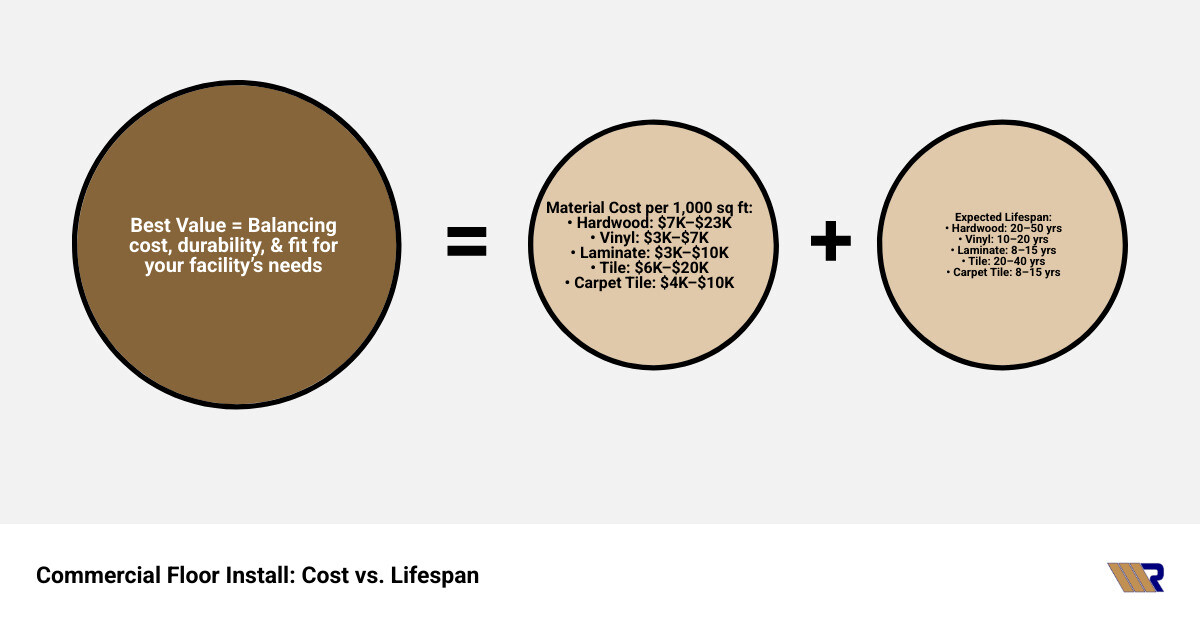
Let’s break down what you might expect to pay, based on average costs found online (remember, these are not official quotes from Romero Hardwood Floors Inc.):
- Hardwood flooring typically runs between $7,000 and $23,000 per 1,000 sq ft. It’s timeless, durable, and a favorite for upscale offices or striking lobbies. Keep in mind: expert installation and careful subfloor prep are a must.
- Vinyl (including LVT, VCT, and sheet vinyl) costs about $3,000 to $7,000 per 1,000 sq ft. Its water resistance and versatility make it a go-to for healthcare spaces, retail, and schools.
- Laminate is a budget-friendly option, ranging from $3,000 to $10,000 per 1,000 sq ft. It’s a good fit for offices or locations where moisture isn’t a constant issue.
- Ceramic or Porcelain Tile comes in at $6,000 to $20,000 per 1,000 sq ft. Tile shines in places like restrooms and kitchens, but installation takes skill and a super-flat subfloor.
- Carpet Tile typically sits in the $4,000 to $10,000 per 1,000 sq ft ballpark. It’s similar in price to vinyl and wins points for how easily damaged sections can be swapped out.
It’s also important to remember that labor costs usually make up 30–50% of your overall budget. The exact split depends on the floor’s complexity, what shape your subfloor is in, and whether the job needs to be done in phases. Materials, of course, make up the rest.
Substrate Preparation and Removal Fees can sneak up on you—think $1–$4 per sq ft for leveling, moisture testing, or removing old flooring. If there’s asbestos hiding out in older buildings, safely removing it will add both cost and time.
Keep in mind: Some projects run far above average if your building needs extra prep or specialty materials. It’s not unusual for costs to jump up to 3x the low end, so averages are just a starting point.
Hidden Expenses in a Commercial Floor Install Budget
Even the best-planned budgets can get tripped up by expenses that only pop up after the project’s started. Some key things to watch for:
Moisture testing is required for most warranties—especially with concrete subfloors. If you skip it, you risk problems down the road and may void your warranty.
Asbestos abatement is a must in older spaces if there’s any suspicion of hazardous materials.
If you need the job done after-hours or on weekends to avoid interrupting daily business, overnight or weekend shifts bring higher labor rates.
Furniture moving and storage can add time and cost. Installers often need spaces cleared before they start, and moving desks or fixtures isn’t always as simple as it sounds.
Waste disposal for hauling away old flooring and packaging can tack on $0.50–$3.00 per sq ft, especially if there’s anything hazardous.
And don’t forget about permit fees—some towns require them for bigger commercial flooring projects.
Knowing all these pieces up front helps you budget confidently and avoid unwanted surprises. For more expert advice or help planning your next Commercial Floor Install, you can always reach out to Romero Hardwood Floors Inc. —transparency is what we’re all about.
Factors That Influence Pricing & Material Selection
Every Commercial Floor Install is unique—there’s no one-size-fits-all answer when it comes to cost or the “best” flooring type. The right choice for your space depends on several real-world factors, from how your facility is used to what’s hiding under your old floors.
First, think about foot traffic and load. Busy lobbies and hallways see a lot more shoe miles—and rolling carts—than a quiet office. Surfaces here need to be tough, easy to clean, and resilient enough not to wear out before their time.
Next up is aesthetics. Flooring sets the stage for your brand’s personality, whether you want the warmth of wood, bold geometric patterns, or a calming, natural vibe. Your choice speaks volumes to clients and staff before you even say hello.
Today, sustainability is a must-have for many businesses. Products with recycled content, low-VOC finishes, and access to reclamation programs are gaining traction. It’s smart to ask suppliers about green certifications before making a final pick.
Don’t overlook your substrate condition. If the subfloor isn’t flat, dry, or stable, even the finest flooring won’t last long. Prepping the base can take time (and money), but it’s crucial for a successful, long-lasting install.
Scheduling and downtime can also have a big impact. Can you pause business for the install, or do you need work done in phases or overnight? Special scheduling like this may cost more, but it minimizes disruption.
Safety and compliance are non-negotiable. Your new floor must meet ADA rules, fire codes, and offer slip resistance to keep everyone safe and your business up to code.
Finally, always insist on manufacturer-certified procedures. Quality assurance isn’t just a fancy term—it protects your warranty and makes sure your new floor performs as promised.
Matching Flooring Types to Facility Needs
Picking a floor is more than just picking a color swatch. Think about your space’s daily life. Vinyl plank and tile (LVT/VCT) are champions for healthcare and retail—they’re water-resistant, easy on budgets, and built tough. If you’re worried about noise in offices or schools, carpet tile is a great option—it absorbs sound, is simple to replace, and feels cozy.
For spaces that demand heavy-duty performance, like labs, kitchens, or warehouses, epoxy and resinous flooring offer seamless, chemical-resistant surfaces. Want to make a real statement? Porcelain slabs give lobbies a luxurious, durable look that lasts.
There’s also a growing trend for biophilic and patterned flooring, bringing natural elements or striking custom layouts straight to your workspace. Check out some Best Commercial Flooring Options for inspiration. And if noise is a concern, don’t forget about acoustic needs—some products have special backing to help keep things peaceful.
Planning Around Substrate & Environment
Even the best floor will fail if the prep isn’t right. Concrete moisture is a common culprit—always test before installation. Too much moisture can ruin flooring and void warranties. Likewise, commercial floors need to meet strict flatness tolerances. Floors that aren’t level can lead to gaps, lifting, or premature wear.
HVAC conditioning matters, too. Stable temperature and humidity help the flooring and adhesives perform as they should, both during and after the install. That’s why most materials require acclimation—a period to get used to your building’s conditions before installation. Skip this step, and you might end up with warping or gaps.
When you plan your Commercial Floor Install with these factors in mind, you set yourself up for a smoother process, fewer surprises, and a finished floor that stands up to the real world. And if you ever feel stuck, just reach out—we’re always happy to walk you through your options.
Step-by-Step Installation & Best Practices
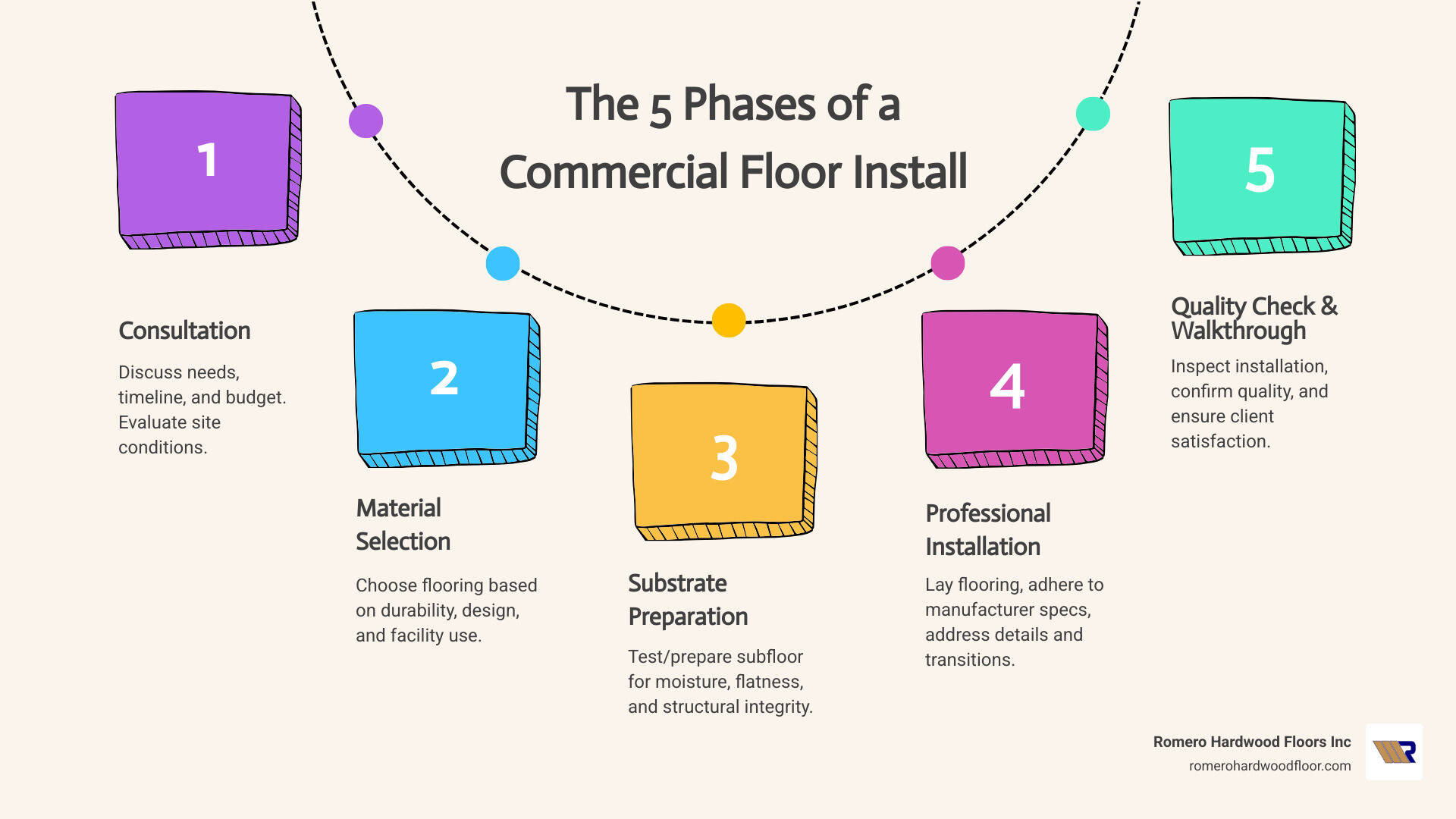
A smooth Commercial Floor Install is never a fluke—it’s the result of careful planning, skilled hands, and proven best practices. Here’s how we bring your vision to life, from the first handshake to the final walkthrough.
It all starts with a consultation and needs analysis. We’ll meet you on-site, get to know your business goals, and measure every corner of your space. No guesswork here—just a friendly chat and a lot of tape measures.
Next comes the specification review. We help you pick the right flooring materials, colors, and layout options, all custom to your budget and needs. Whether you’re dreaming of a modern lobby or a hard-working healthcare space, this is where your design ideas take shape.
Substrate preparation is the unsung hero of the process. We carefully remove any old flooring and level out the subfloor. This is also when we run all the important moisture and vapor tests. Think of it as prepping the canvas before you paint—skip this step, and nothing lasts.
With a clean, ready surface, we do a dry-fit layout. This is our puzzle phase, planning the perfect placement for every tile, plank, or pattern. We adjust for room shape, patterns, and doorways, making sure there’s as little waste as possible.
Once everything fits just right, it’s time for adhesive set and installation. Our crews use only manufacturer-certified adhesives and follow all guidelines by the book—no shortcuts, ever. This ensures you keep your warranty protection and your floors stand the test of time.
After installation, we use heavy rollers to bond and cure the flooring, and restrict traffic for 24–72 hours depending on the material. This step is crucial, even if your team is itching to move the furniture back in.
Every project wraps up with quality checks and a punch list. We comb through every inch, fix any tiny flaws, and make sure you’re delighted. You’ll get a final tour, plus a quick lesson on cleaning and warranty care—because we want your new floor to look fabulous for years to come.
For an even deeper dive on the process, check out Commercial Flooring Installation Companies.
Pre-Install Site Preparation Checklist
Before we unbox the first plank, we tackle a few essential to-dos. For older buildings, an asbestos test is a must for everyone’s safety. We also perform a vapor emission test to make sure your subfloor is dry enough for adhesives—this is non-negotiable for warranty protection.
Material acclimation comes next. Your new flooring gets stored on-site for a while to match the building’s temperature and humidity, helping prevent future warping or gaps. We set up safety barriers and signage to keep your staff and visitors out of the work zone and double-check that all materials and conditions are exactly right before installation begins.
On-Site Commercial Floor Install Execution
When it’s time to roll up our sleeves, we work in carefully sequenced phases so your business can keep running as smoothly as possible. If you need us to work at night or over the weekend, we’re happy to accommodate—just know that after-hours work can come at a premium.
Our crews are meticulous about following manufacturer guidelines every step of the way, and we keep the site clean and safe with regular progress updates. You’ll always know exactly what’s happening and when.
Want to visualize the journey? Check out the infographic below showing our 5-phase timeline—from consultation to prep, install, cure, and final punch list.
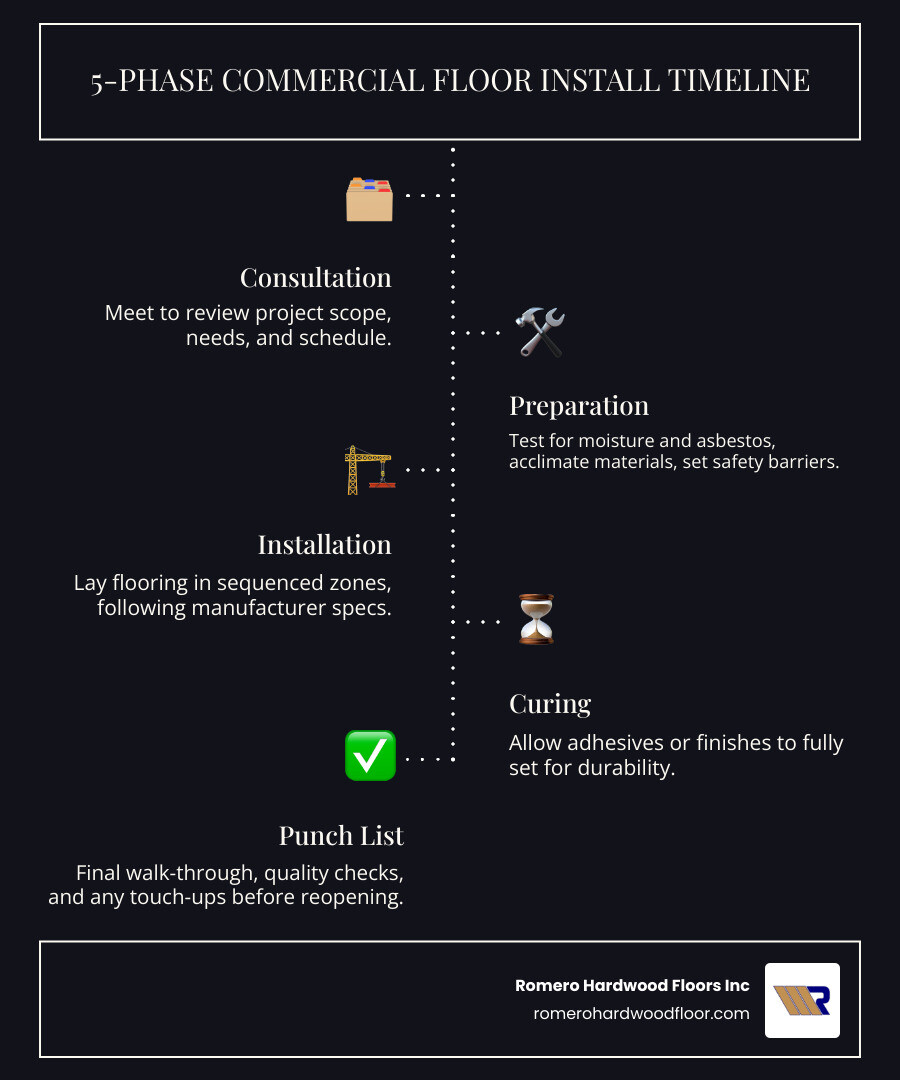
A great Commercial Floor Install is more than just laying boards or tiles—it’s a detailed process built for your peace of mind and long-lasting results.
Maintenance, Warranties & Lifecycle ROI
A smart Commercial Floor Install is an investment—protect it!
- Cleaning Protocols:
Regular sweeping, mopping, and prompt spill cleanup extend floor life. - Protective Mats:
Entry mats and furniture pads prevent premature wear. - Periodic Inspections:
Catch issues early before they become costly. - Finish Re-Coats & Repairs:
Schedule re-coats or replace damaged tiles for long-term value. - Warranty Compliance:
Only use approved cleaning products and follow maintenance schedules. - Sustainability & Reclamation:
Many products can be recycled—ask us about green options. - See more about the design vision behind patterned commercial floors.
Frequently Asked Questions about Commercial Floor Installation Costs
How do I estimate my total Commercial Floor Install budget?
Estimating your Commercial Floor Install budget takes a little bit of homework and a dash of patience. The simplest place to start is with your space’s square footage. Multiply that number by the average installed cost for your chosen flooring material (check out the chart above for reference). Just remember, these prices are wide ranges gathered from public internet sources and not actual quotes from Romero Hardwood Floors Inc.
But don’t stop at just the material! Be sure to factor in extra costs like subfloor prep (which can add $1–$4 per square foot), removal and disposal of old flooring, and required moisture or asbestos testing. If your project needs after-hours work or has tricky site conditions, you’ll want to include those costs too.
Every building is different, so these averages are just a starting point. For a clear, custom estimate custom to your facility, it’s best to contact us. We’ll help you avoid surprises.
What certifications should my installer carry?
Choosing the right installer makes a huge difference in the success of your Commercial Floor Install. Always ask about certifications! At minimum, your crew should have manufacturer installation training (which keeps your warranty valid), a state contractor’s license, and up-to-date liability and workers’ comp insurance.
Safety is non-negotiable, so OSHA safety certifications are a must. If you’re installing hardwood, extra credentials—like being a BONA Certified Craftsman—show your installer is serious about quality and the latest techniques.
How long before heavy equipment can roll over new floors?
Patience pays off when it comes to protecting your new floors! For most vinyl or resilient flooring, keep foot traffic light for 24 hours, but wait at least 72 hours before moving in the big stuff. For tile floors, let things set undisturbed for about 72 hours before rolling over with heavy equipment or furniture.
Hardwood floors need a little more TLC—the finish typically takes 3 to 7 days to fully cure to maximum hardness. Always rely on the manufacturer’s instructions for your particular product; a few extra days of patience can mean years of extra life for your investment.
If you still have questions about your Commercial Floor Install, or want clear numbers for your project, reach out anytime. We’re here to help you make confident, informed decisions for your business spaces.
Conclusion
At Romero Hardwood Floors Inc., we know that a successful Commercial Floor Install is about more than just “putting down new floors.” It’s about clarity, trust, and making sure you get the best value for your investment—without surprises. Whether you’re refreshing a classroom, modernizing a hospital wing, or upgrading your company’s lobby, we’re here as your one-stop partner for commercial flooring across Massachusetts.
Since 2006, our team has helped business owners and facility managers in cities like Beverly, Chelsea, Danvers, East Boston, Gloucester, Lynnfield, Malden, Manchester by the Sea, Marblehead, Medford, Melrose, Nahant, Peabody, Reading, Revere, Rockport, Salem, Saugus, Somerville, Stoneham, Swampscott, Wakefield, Winchester, Winthrop, Woburn, and the surrounding areas. We believe in transparency, expert guidance, and standing behind our work with a full guarantee.
We also believe in making your experience easy and stress-free. From your first call to final walk-through, you’ll get honest answers and clear communication. Want to know what’s involved or how to avoid those pesky hidden costs? We’re happy to walk you through all your options—no jargon, no pressure.
If you’re ready to take the next step, or just want a straightforward, detailed quote, get more info about hardwood floor installation or reach out for a free, no-obligation consultation. Let’s make your project simple—so you get beautiful, long-lasting floors, and more peace of mind.
Related Resources:
– Best Commercial Flooring Options
– Commercial Flooring Installation Companies
– More info about hardwood floor installation
Note: All cost figures referenced here are based on average internet data, not exact Romero Hardwood Floors prices. For a custom quote custom to your space, please contact our team directly.