
Cost of Installing Flooring: 10 Powerful Ways to Save in 2025
Understanding the True Cost of Installing Flooring
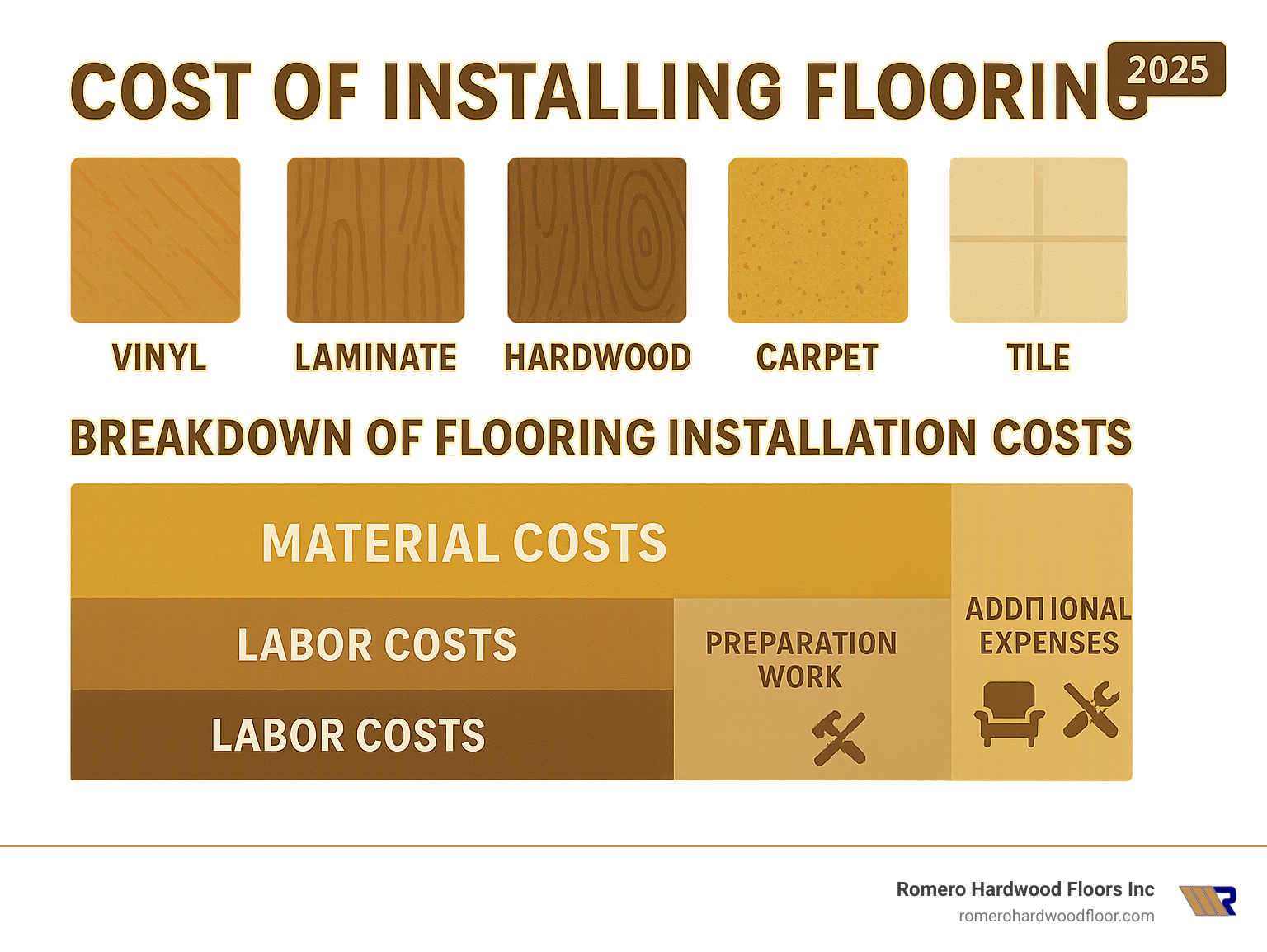
The cost of installing flooring ranges from $4 to $15 per square foot, with most homeowners spending between $2,000 and $7,500 for a 500-square-foot project. Here’s what you need to know:
Quick Cost Reference:
– Vinyl flooring: $2-$7 per sq ft installed
– Laminate: $2.50-$8 per sq ft installed
– Hardwood: $10-$18 per sq ft installed
– Carpet: $2-$8 per sq ft installed
– Tile: $10-$50 per sq ft installed
Total Project Costs (500 sq ft):
– Budget option: $2,000-$3,000
– Mid-range: $3,000-$5,000
– Premium: $5,000-$7,500+
Whether you’re planning a single room makeover or a whole-house renovation, understanding flooring costs helps you budget smart and avoid surprises. Labor typically accounts for 25-40% of your total project cost, while materials make up the rest.
The biggest cost drivers? Room size, material choice, subfloor condition, and your location. Small projects often cost more per square foot due to contractor minimums, while larger jobs can qualify for bulk discounts.
I’m Francisco Romero, owner of Romero Hardwood Floors Inc., and I’ve helped homeowners steer the cost of installing flooring for over 15 years in the Greater Boston area. My experience with hundreds of installations has taught me that informed customers make better decisions and get better results.
Easy cost of installing flooring glossary:
– Cost of hardwood floors
– Hardwood Flooring Cost
The Real Cost of Installing Flooring: Key Factors
Here’s the truth about flooring costs that most contractors won’t tell you upfront: the cost of installing flooring can easily double once you factor in all the “extras.” I’ve watched too many homeowners start with a $3,000 budget only to face a $6,000 reality check.
The biggest shock? Labor and preparation work often cost more than the actual flooring materials. After 15+ years installing floors throughout Beverly, Salem, Peabody, and the Greater Boston area, I’ve seen this pattern repeat hundreds of times.
Inflation has hit our industry hard – material prices jumped 15-25% since 2022, and they’re not coming back down anytime soon. Meanwhile, skilled installers are harder to find, which means labor rates have climbed right alongside material costs.
Your material grade choice can make or break your budget. That “budget-friendly” laminate at $2 per square foot looks great until you see the premium options at $6-8 per square foot. The high-end stuff can easily cost three times more than builder-grade materials.
But here’s where homeowners get blindsided: subfloor preparation. In our experience serving the Boston area, subfloor work adds $1-4 per square foot to most projects. Got squeaky spots? Uneven areas? Water damage? Each issue costs extra to fix properly.
Moving furniture might seem simple, but professional movers charge $60-120 per hour. Regional pricing in our Boston market runs 10-20% higher than national averages – that’s just the reality of working in a high-cost area.
Don’t forget the waste factor – always budget an extra 10-15% for cuts, mistakes, and future repairs. Stairs get expensive fast at $10-45 per step, depending on your flooring choice. And if we find hazardous materials like asbestos or mold during demo, remediation can add $4-30 per square foot.
Finally, most flooring types need proper underlayment, which runs $0.50-3.50 per square foot. It’s not optional – it’s what keeps your floors looking and feeling great for years.
Average Labor Charges Per Sq Ft
Labor costs typically range from $2-8 per square foot for most flooring installations, but this wide range reflects the complexity differences between materials. Based on internet data (not our actual pricing), here’s what you can expect in our market.
Simple installations like vinyl sheet or laminate floating floors usually run $1.50-4 per square foot for labor. These materials install quickly with minimal subfloor prep required.
Complex installations tell a different story. Hardwood nail-down installations typically cost $3-6 per square foot for labor, while tile work ranges from $4-15 per square foot. Natural stone can push labor costs to $8-20 per square foot due to the precision required.
Most contractors have minimum project fees between $500-1,500, which can make small jobs expensive per square foot. That 100-square-foot bathroom might cost $15 per square foot installed, while a 1,000-square-foot main floor averages closer to $8 per square foot.
Primary Influencers on the Cost of Installing Flooring
Room size is probably the biggest factor affecting your per-square-foot costs. Projects under 200 square feet often cost 20-50% more per square foot due to contractor minimums and setup time. Medium projects from 200-500 square feet hit the sweet spot for standard pricing. Larger projects over 500 square feet can qualify for bulk discounts of 5-15%.
Layout complexity significantly impacts the cost of installing flooring. Square rooms with straight runs install fastest and cheapest. Add multiple angles, cuts around cabinets, or tricky transitions, and labor time increases 10-25%.
Acclimation time affects your timeline and costs, especially with hardwood that needs 3-5 days to adjust to your home’s humidity. Prefinished materials save money compared to site-finished options by eliminating sanding and finishing time.
Moisture barriers become essential in basements and over concrete slabs, adding to material costs but protecting your investment long-term. Timing matters too – winter installations often cost 10-15% less due to lower demand.
Price Breakdown by Material, Room & Region
Let’s break down real-world costs by material type. These are average ranges based on internet research and industry data, not our specific pricing at Romero Hardwood Floors Inc.
Hardwood Flooring remains the premium choice, with solid hardwood ranging from $4-$13 per square foot for materials, plus $2.50-$6 installation costs. Engineered hardwood offers similar aesthetics at $3-$11 per square foot material cost.
Laminate Flooring provides the wood look at budget prices: $1-$5 per square foot for materials, with installation adding $2-$4 per square foot. It’s DIY-friendly but difficult to repair if damaged.
Luxury Vinyl Plank (LVP) has exploded in popularity, costing $2-$7 per square foot installed. It’s waterproof, durable, and comes in incredibly realistic wood and stone patterns.
Carpet Installation ranges from $2-$8 per square foot total, including padding. Higher-end carpets with premium padding can reach $15-$25 per square foot.
Tile Installation varies wildly: ceramic starts around $2.50-$8.50 per square foot for materials, with installation adding $8-$32 per square foot. Natural stone tiles can cost $1-$50 per square foot for materials alone.

Material Price Ranges and the Cost of Installing Flooring Per Square Foot
Here’s our comprehensive breakdown of material costs, remembering that high-end options can cost three times the average (our standard pricing rule for accuracy):
Budget-Friendly Options:
– Vinyl sheet: $1-$6 per sq ft (high-end: $15-$25 per sq ft)
– Basic laminate: $1-$3 per sq ft (premium: $8-$15 per sq ft)
– Builder-grade carpet: $2-$5 per sq ft (luxury: $12-$35 per sq ft)
Mid-Range Choices:
– Engineered hardwood: $3-$8 per sq ft (exotic species: $15-$30 per sq ft)
– Luxury vinyl plank: $3-$7 per sq ft (commercial grade: $8-$25 per sq ft)
– Ceramic tile: $2-$8 per sq ft (designer/imported: $15-$50 per sq ft)
Premium Materials:
– Solid hardwood: $4-$12 per sq ft (exotic/wide plank: $15-$40 per sq ft)
– Natural stone: $5-$15 per sq ft (rare marble/granite: $25-$75 per sq ft)
– High-end carpet: $8-$15 per sq ft (custom wool: $25-$80 per sq ft)
Always Add 10-15% Waste Allowance to your material calculations. Complex layouts with lots of cuts can require up to 20% extra material.
Regional Variations significantly impact costs:
– Greater Boston area: 10-20% above national average
– Rural Massachusetts: 5-10% below Boston pricing
– Compared to Ontario, Canada: Similar pricing for materials, 15-25% higher labor
– National averages: Use as baseline, adjust for local market
According to scientific research on property value boost, new flooring delivers impressive returns on investment, with hardwood floors showing up to 118% ROI in some markets.
Room-Size Snapshots: 200 sf, 500 sf, 1,000 sf
Let’s look at real-world project costs for common room sizes. These examples use average internet pricing data, not Romero Hardwood Floors’ actual rates:
200 Square Foot Bedroom:
– Carpet: $800-$2,400 total
– Laminate: $1,000-$2,800 total
– Engineered hardwood: $1,800-$4,200 total
– Luxury vinyl: $1,200-$3,000 total
500 Square Foot Kitchen/Living Area:
– Vinyl flooring: $1,000-$3,500 total
– Laminate: $1,250-$4,000 total
– Tile: $5,000-$25,000 total (wide range due to material variety)
– Hardwood: $5,000-$9,000 total
1,000 Square Foot Main Floor:
– Carpet: $2,000-$8,000 total
– Laminate: $2,500-$8,000 total
– Engineered hardwood: $7,000-$20,000 total
– Luxury vinyl: $2,000-$7,000 total
Stairs Surcharge: Add $10-$45 per step for any material. A typical 13-step staircase adds $130-$585 to your project cost.
Basement Considerations: Moisture concerns often require special underlayment or moisture barriers, adding $1-$3 per square foot. Concrete subfloors may need leveling compound at $1.50-$4 per square foot.
DIY vs Professional Installation: Which Saves More?
The age-old question: should you tackle flooring installation yourself or hire a pro? After watching hundreds of projects over the years, I can tell you it’s not just about the cost of installing flooring—it’s about what you value most: time, peace of mind, or immediate savings.
Let’s be honest: DIY can save you serious money. You’ll pocket the $2-$8 per square foot that would otherwise go to labor costs. On a 500-square-foot project, that’s $1,000-$4,000 staying in your wallet. Tool rental runs $50-$200 for most projects.
But here’s where it gets tricky. DIY projects almost always take longer than expected—usually 3-5 times longer than professional installation. That weekend project becomes a month-long ordeal, especially if you hit unexpected issues like uneven subfloors or tricky cuts around doorways.
The hidden costs can bite you. Quality tools cost $200-$800 to buy or rent. DIYers typically waste 15-25% of their materials compared to our 10% waste factor. Disposal fees for old flooring run $200-$500. And if you make a major mistake? You might spend 50-100% of your original material cost fixing it.
The biggest risk? Many flooring manufacturers void their warranties if you don’t use professional installation. That beautiful hardwood with a 25-year warranty suddenly becomes a gamble if something goes wrong.

Professional installation brings warranty protection, insurance coverage, and expertise that’s hard to match. We complete most projects in 1-3 days, handle subfloor surprises without breaking stride, and carry liability insurance if anything goes sideways.
Pros & Cons of DIY for the Cost of Installing Flooring
DIY makes the most sense when you’re working with simple rectangular rooms and floating floor systems like laminate or luxury vinyl. These snap together without nails or glue, making mistakes less catastrophic. You can remove old flooring yourself and save $1-$3.50 per square foot on demo work.
The sweat equity factor is real—your time investment builds home value, and you control every detail of material selection without contractor markup.
But DIY gets complicated fast with hardwood nail-down installations, tile work requiring perfect waterproofing, or any project involving stairs. The physical demands are intense—hours of kneeling, lifting, and precision cutting that can leave you sore for days.
Hidden costs pile up quickly. Beyond tool rental and disposal fees, you’re looking at potential re-work if measurements go wrong or cuts don’t fit properly. We’ve rescued several DIY projects where homeowners got halfway through and realized they were in over their heads.
The warranty issue deserves serious consideration. Most manufacturers require professional installation to honor their guarantees. That premium flooring investment loses protection if you install it yourself and problems develop later.
Hiring a Pro: What the Labor Fee Includes
When you hire professional installers, you’re not just paying for someone to lay flooring. The labor fee covers a comprehensive service that starts before we arrive and continues after we leave.
Before installation day, we conduct site inspections and verify measurements, assess subfloor conditions and handle minor repairs, perform crucial moisture testing (especially important for hardwood and tile), and coordinate furniture moving logistics.
During installation, we bring professional-grade tools and materials, handle real-time problem solving when surprises pop up, ensure proper underlayment and moisture barriers, and maintain clean, organized work areas that minimize disruption to your daily routine.
After installation wraps up, we install trim and transitions for a finished look, complete thorough cleanup and debris removal, conduct final inspections and touch-ups, provide care and maintenance guidance, and handle warranty registration with manufacturers.
For specific material breakdowns, our Affordable Laminate Flooring Installation Cost Breakdown and Savings Tips dives deeper into what affects pricing.
Professional guarantees include workmanship warranties (typically 1-2 years), insurance coverage protecting your property during installation, manufacturer warranty protection that DIY installation might void, and callback service for minor adjustments that sometimes become necessary after floors settle.
How to Calculate Your Flooring Project Budget
Creating an accurate budget for your flooring project prevents surprises and helps you make informed decisions. Here’s our step-by-step approach developed over hundreds of installations in the Greater Boston area.
Step 1: Measure Accurately
– Length × Width = Square footage
– Measure each room separately
– Account for closets and alcoves
– Subtract permanent fixtures (islands, built-ins)
Step 2: Add Waste Factor
– Standard rooms: Add 10% waste
– Complex layouts: Add 15% waste
– Diagonal installations: Add 20% waste
– First-time DIY: Add 25% waste
Step 3: Choose Your Material Tier
– Budget: Focus on function over form
– Mid-range: Balance of quality and cost
– Premium: Investment in long-term value
Step 4: Add Labor Costs
– Research local installer rates
– Get multiple quotes for comparison
– Factor in your room’s complexity
Step 5: Include Extras
– Underlayment: $0.50-$3.50 per sq ft
– Transition strips: $3-$15 per linear foot
– Baseboards: $2-$8 per linear foot
– Furniture moving: $60-$120 per hour
Step 6: Build in Contingency
– Add 15% for unexpected issues
– Subfloor problems are common surprises
– Permits may be required in some areas
For accurate estimates custom to your specific project, use our Hardwood Floor Cost Estimator.
Step-by-Step Budget Worksheet
Here’s a practical worksheet to calculate your total project cost:
Room Measurements:
1. Room 1: _ sq ft
2. Room 2: sq ft
3. Room 3: __ sq ft
4. Total square footage: _____ sq ft
Material Costs:
– Base material cost per sq ft: $_
– Total material cost: sq ft × $__ = $_
– Waste factor (10-15%): $___
– Total material cost: $_____
Labor Costs:
– Installation rate per sq ft: $_
– Total installation: sq ft × $__ = $_____
– Total labor cost: $_____
Additional Costs:
– Underlayment: _ sq ft × $ = $
– Old flooring removal: _ sq ft × $ = $
– Furniture moving: _ hours × $ = $__
– Transitions and trim: $_____
– Total additional costs: $_____
Project Total:
– Materials: $_
– Labor: $
– Additional: $__
– Subtotal: $_____
– Contingency (15%): $_____
– Final Budget: $_____
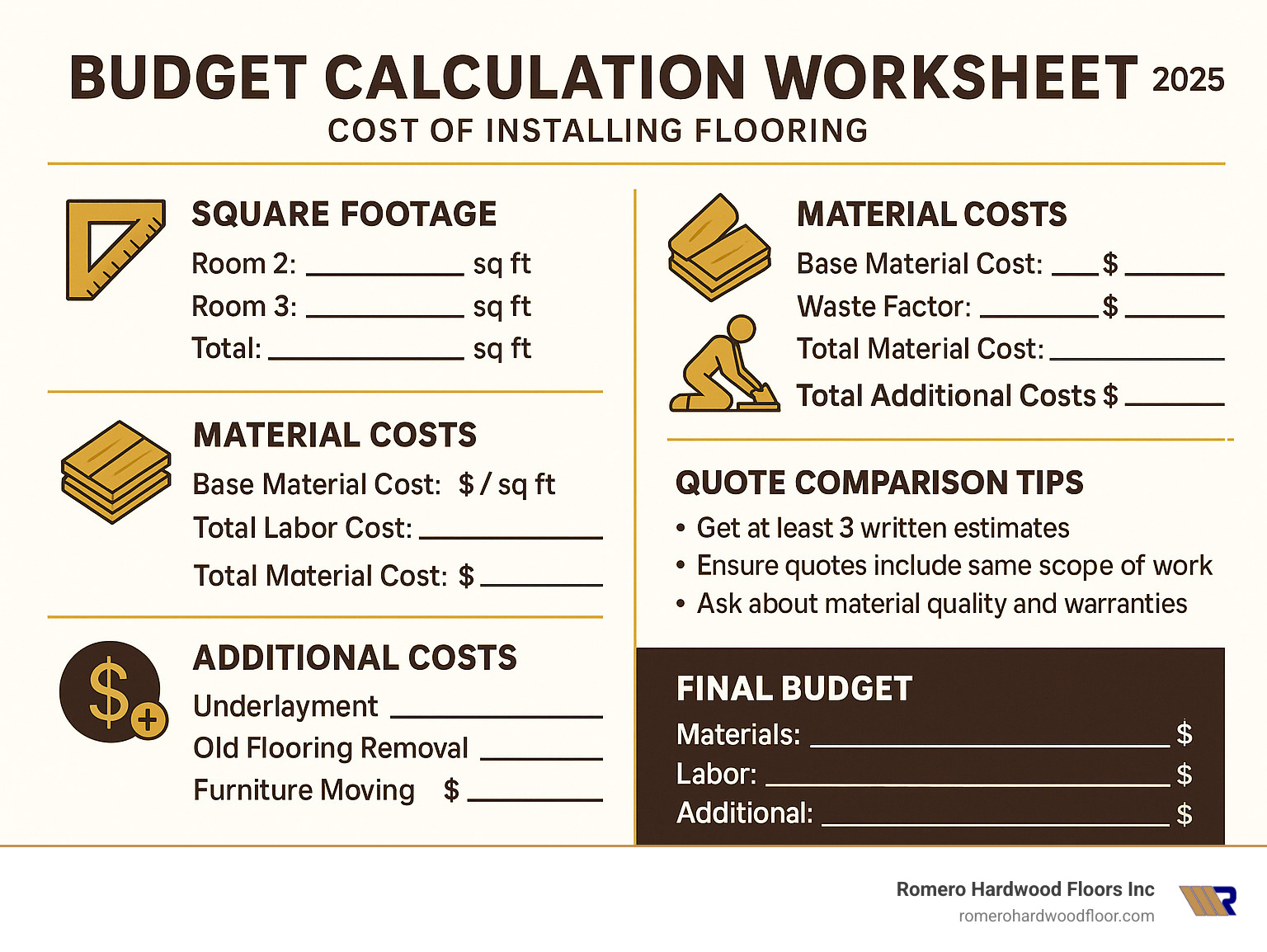
Quote Comparison Tips:
– Get at least 3 written estimates
– Ensure quotes include same scope of work
– Ask about material quality and warranties
– Verify licensing and insurance
– Check references and online reviews
Financing Options:
Many flooring projects qualify for home improvement financing with rates as low as 3-7% APR. Consider:
– Personal loans for smaller projects
– Home equity lines of credit
– Contractor financing programs
– Credit cards with promotional rates
Frequently Asked Questions about the Cost of Installing Flooring
After helping hundreds of homeowners with flooring projects since 2006, I’ve noticed that people ask the same questions over and over. The cost of installing flooring can feel overwhelming when you’re just starting to research your project, so let me answer the big questions that keep homeowners up at night.
What is the Cheapest Type of Flooring to Install?
Vinyl sheet flooring wins the budget championship, with total installed costs typically running $2-$4 per square foot based on internet averages. It’s fast to install, forgiving on imperfect subfloors, and today’s patterns look surprisingly good.
But here’s the thing about “cheap” flooring – it’s not always the best value. I’ve seen homeowners spend $2,000 on budget vinyl only to replace it three years later when it starts peeling or looking tired.
Peel-and-stick vinyl tiles offer the absolute lowest entry point at $1-$3 per square foot if you install them yourself. They’re perfect for rental properties or temporary solutions, but don’t expect them to last a decade.
Basic carpet with padding runs $2-$5 per square foot installed, though premium options can reach $15-$35 per square foot. Carpet remnants from big box stores can save you 50-70% off regular pricing if you can find the right size.
Laminate flooring sits in the sweet spot at $2.50-$6 per square foot installed (premium versions can hit $15-$20 per square foot). It’s DIY-friendly, looks like real wood, and holds up well to kids and pets.
The smartest money-saving strategies I’ve seen? Shop during winter when demand drops, do your own demolition work, and buy materials during spring sales for fall installation. But watch out for hidden costs that can double your budget – subfloor repairs at $2-$6 per square foot, moisture barriers at $0.50-$2 per square foot, and those transition strips that seem cheap until you need twelve of them.
How Much Value Does New Flooring Add to a Home?
New flooring consistently ranks as one of the smartest home improvements you can make. The National Association of Realtors reports that hardwood flooring delivers 70-118% return on investment, which means you often get back more than you spend.
Here’s what really happens when you upgrade your floors: buyers notice immediately. We’ve had real estate agents tell us that homes with beautiful hardwood floors sell faster and for higher prices than comparable homes with tired carpet or outdated vinyl.
Luxury vinyl plank delivers 60-80% ROI based on industry data, while carpet replacement typically returns 50-70% of your investment. Tile flooring shows strong returns at 70-90% ROI, especially in bathrooms and kitchens where buyers expect quality materials.
Laminate flooring offers more modest returns at 40-60% ROI, but it’s still a smart investment if you’re planning to stay in your home for several years.
The cost of installing flooring becomes an investment when you choose quality materials and professional installation. I’ve seen $8,000 hardwood projects add $15,000 to home values in competitive markets.
But the real value goes beyond dollars. New flooring transforms how your home feels every single day. No more embarrassment when guests arrive, no more worrying about stains or worn spots.
Quality matters enormously for returns. Builder-grade materials might check the “new flooring” box, but premium materials create the “wow factor” that buyers remember and pay for.
How Long Does Flooring Installation Take?
Most homeowners are shocked by how quickly professional installation happens. Carpet installation typically takes just 4-8 hours for an average bedroom, while luxury vinyl plank usually takes 1-2 days for most homes.
Laminate floating floors install quickly too – expect 1-2 days for typical projects. The planks click together without glue or nails, so there’s no drying time.
Engineered hardwood needs 2-3 days plus acclimation time. That acclimation period is crucial – the wood needs to adjust to your home’s humidity for 3-5 days before installation. Skipping this step causes problems later.
Ceramic tile takes 2-4 days including grout curing time. You can’t walk on freshly grouted tile, so plan accordingly.
Solid hardwood with site finishing represents the longest timeline at 5-7 days. We install the raw wood, then sand and finish it in your home. It’s beautiful but disruptive.
The biggest timeline killer? Subfloor problems. When we pull up old flooring and find damage, squeaks, or uneven areas, repairs can add 1-3 days to your project. This is why honest contractors always warn about potential delays.
Material acclimation can’t be rushed. Hardwood that doesn’t acclimate properly will gap, cup, or buckle later. We’ve learned this lesson the hard way over our years in business.
My advice? Plan for the estimated timeline plus two extra days. That way you’re pleasantly surprised when we finish early instead of frustrated by delays. And remember, the cost of installing flooring includes getting it done right, not just getting it done fast.
Conclusion
Planning your flooring project doesn’t have to feel overwhelming. Understanding the cost of installing flooring puts you in control, whether you’re dreaming of rich hardwood, practical vinyl, or cozy carpet. The key is knowing what to expect and choosing partners who’ll deliver quality results without surprises.
Here at Romero Hardwood Floors Inc., we’ve been turning flooring dreams into reality since 2006. From our home base in Revere, we’ve helped hundreds of families throughout Greater Boston create beautiful spaces they love coming home to. Our commitment to competitive pricing, showing up when we say we will, and standing behind every job has built relationships that last for years.
Every project teaches us something new, but some truths never change. Budget that extra 15% for the unexpected — trust me, subfloors have a way of surprising everyone. Your material choice shapes both your upfront investment and your daily experience for years to come. Professional installation protects your investment and keeps those warranties valid when you need them most.
We’ve seen too many “bargain” installations that cost twice as much to fix later. The cheapest option rarely delivers the best value. Quality materials installed by experienced professionals create floors that improve your daily life while adding real value to your home.
Ready to see what’s possible for your space? We provide free estimates throughout Beverly, Salem, Peabody, Medford, Winchester, Chelsea, Danvers, Gloucester, Lynnfield, Malden, Marblehead, Melrose, Nahant, Reading, Rockport, Saugus, Somerville, Stoneham, Swampscott, Wakefield, Winthrop, and Woburn. No pressure, no surprises — just honest answers about what your project will take.
For project-specific cost estimates and detailed planning help, visit our Hardwood Floor Installation Cost page. With over 15 years of experience and countless satisfied customers, we’ll help you steer the cost of installing flooring and create the beautiful, lasting floors your home deserves.
Your floors should make you smile every time you walk through the door. Let’s make that happen together.
