
Fake Timber Flooring: Ultimate 3 Perfect Picks
Why Fake Timber Flooring Offers the Best of Both Worlds
Fake Timber Flooring refers to wood-look flooring materials that mimic natural hardwood but are made from synthetic or engineered materials like laminate, luxury vinyl plank (LVP), or engineered wood.
Quick Answer: What You Need to Know About Fake Timber Flooring
- Main Types: Laminate ($1-$5/sq ft), Luxury Vinyl Plank ($2-$8/sq ft), Engineered Wood ($3-$10/sq ft)
- Key Benefits: Lower cost, better water resistance, easier maintenance, DIY-friendly installation
- Lifespan: 15-40 years depending on type (laminate: 15-25 years, LVP: 15-30 years, engineered wood: 20-40 years)
- Best For: Homes with kids and pets, moisture-prone areas like kitchens and bathrooms, budget-conscious renovations
- Main Drawback: Most types cannot be refinished like solid hardwood
Few things lift a room like new wood floors. But what if your budget, lifestyle, or a moisture-prone area makes real hardwood impractical? That’s where fake timber flooring comes in.
Modern wood-look alternatives have revolutionized the industry. Today’s laminate, luxury vinyl plank, and engineered wood can be visually indistinguishable from real hardwood, while often outperforming it in durability, water resistance, and ease of care. Advanced technology like high-definition printing and embossed textures creates a stunningly realistic look and feel.
As Francisco Romero, owner of Romero Hardwood Floors Inc. with over 15 years of experience, I’ve seen how these alternatives deliver exceptional value. This guide will walk you through everything you need to know to choose the right fake timber flooring for your home.
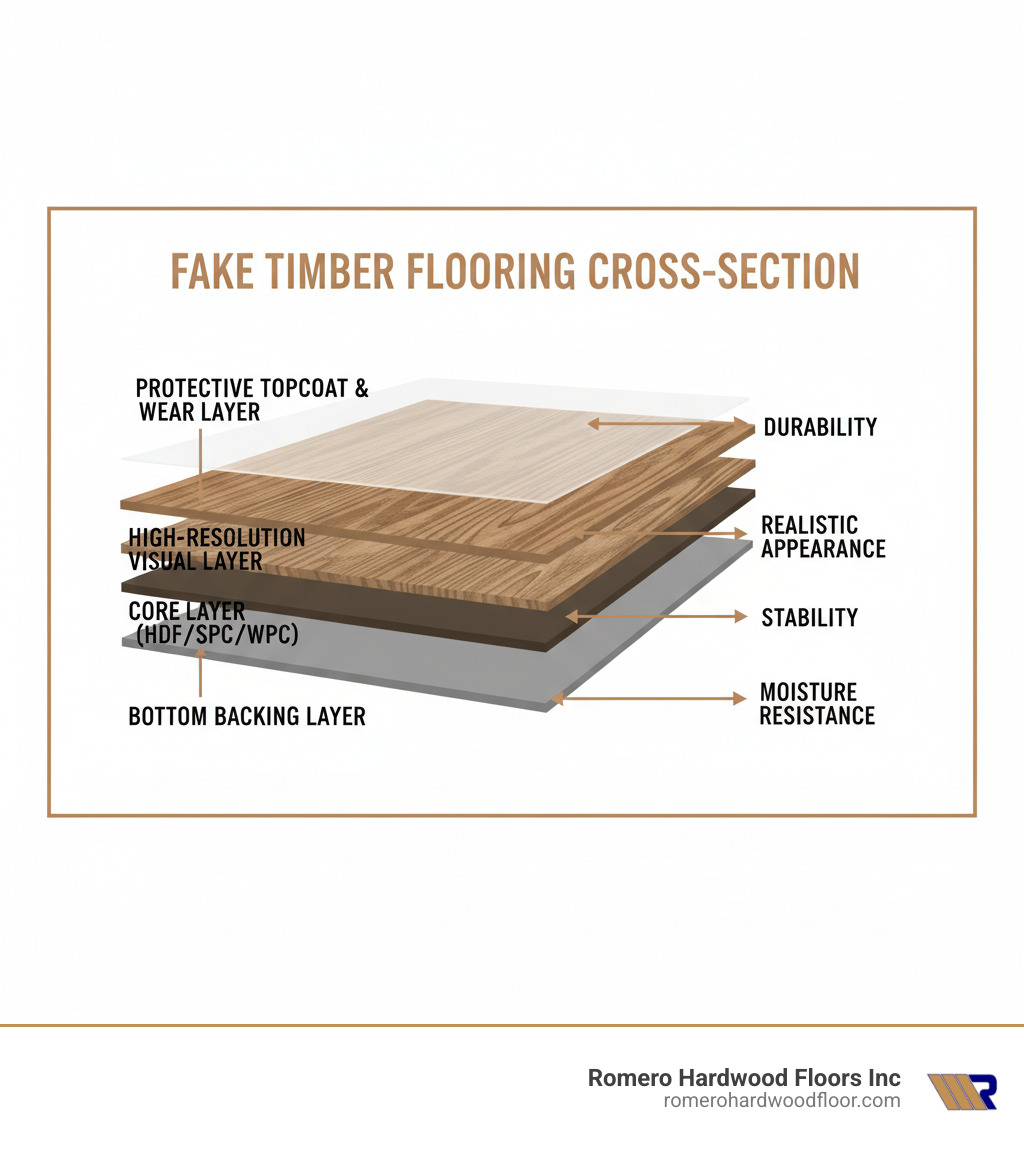
What is Fake Timber Flooring?
Today’s fake timber flooring—also known as faux wood or wood-look flooring—is so convincing that it often requires a second glance to distinguish from the real thing. These materials are engineered to capture the beauty of hardwood without being made from a solid piece of wood.
Their secret is a layered construction. A bottom backing layer provides stability and moisture resistance. The core layer—High-Density Fiberboard (HDF) in laminate or a Stone/Wood Polymer Composite (SPC/WPC) in vinyl—forms the plank’s backbone. The magic happens in the visual layer, where a high-resolution photograph of real wood grain is printed. Finally, a tough, clear protective wear layer shields the floor from scratches, stains, and daily wear.
The Pros and Cons of Fake Timber Flooring
After installing hundreds of these floors, I’ve seen what makes homeowners love them—and where they fall short.
Pros:
- Cost-Effective: Significantly cheaper than solid hardwood, saving thousands on a typical project.
- Highly Durable: Quality laminate (AC4/AC5 rated) and LVP (20+ mil wear layer) resist scratches, dents, and heavy traffic.
- Water-Resistant/Waterproof: Many laminate options handle moisture well, while LVP is often 100% waterproof, making it perfect for kitchens, bathrooms, and basements.
- Easy Maintenance: Requires only simple sweeping and occasional damp mopping. No special cleaners or refinishing needed.
- DIY-Friendly: Most laminate and LVP feature click-lock systems that are easy for handy homeowners to install.
- Variety: Available in countless styles, colors, and textures, mimicking everything from common oak to exotic hardwoods.
Cons:
- Cannot Be Refinished: Unlike solid hardwood, most laminate and LVP cannot be sanded down. Damaged planks must be replaced.
- Resale Value: While beautiful, it typically doesn’t increase a home’s resale value as much as genuine hardwood.
- Pattern Repetition: Budget options may have noticeable repeating patterns, though premium products minimize this.
- Feel and Sound: Some laminates can feel harder or sound hollower underfoot without a quality underlayment.
The Latest Innovations and Trends
The industry is constantly evolving with impressive new technologies:
- Embossed in Register (EIR): This technology aligns the plank’s physical texture with the printed wood grain image, so you can feel the knots and lines you see. It’s a game-changer for realism.
- Waterproof Cores: SPC (Stone Polymer Composite) and WPC (Wood Polymer Composite) cores have made 100% waterproof LVP a reality. SPC is rigid and ultra-durable, while WPC is softer and warmer underfoot.
- Wide Plank Formats: Wider and longer planks are on-trend, creating a spacious, modern look that makes rooms feel larger.
- Eco-Friendly Materials: Many products now include recycled content and carry low-VOC certifications like FloorScore® for better indoor air quality. Alternatives like bamboo, cork, and even hemp flooring offer sustainable choices.
- Matte Finishes: These subtle, low-sheen finishes have replaced the glossy look of older products, adding to the authentic appearance.
For budget-friendly options, see our guide to Cheap Fake Wood Flooring.
The 3 Main Types of Fake Timber Flooring Offered by Romero Hardwood Floors
We recommend three main categories of fake timber flooring to our clients. Each has unique strengths, and we’ve learned which product is best for each situation.
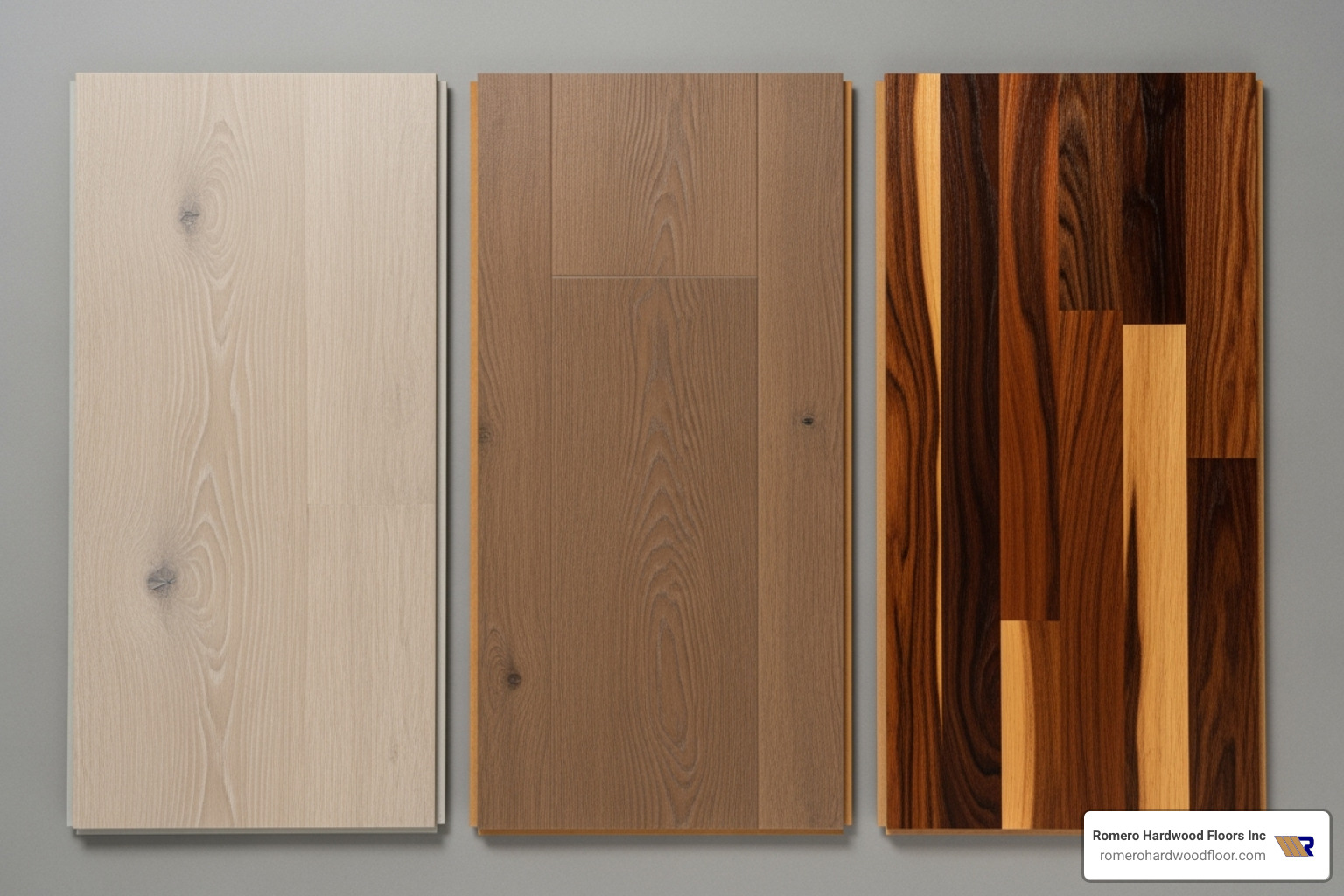
Laminate Flooring
Laminate was the original wood-look game-changer and remains a popular, budget-friendly choice. It’s built on a High-Density Fiberboard (HDF) core with a photographic wood-grain layer on top, all protected by a tough wear layer. The AC rating system (AC1-AC5) indicates its durability, with AC3 being great for bedrooms and AC4 or AC5 ideal for high-traffic areas.
Laminate typically lasts 15-25 years. Material costs generally range from $1-$5 per square foot, though premium options can reach $15 per square foot. These are average costs based on internet data, not actual pricing for Romero Hardwood Floors. It’s significantly cheaper than hardwood and its click-lock system is very DIY-friendly.
Learn more on our Laminate Flooring page or find budget options in our guide to Cheap Laminate Wood Flooring.
Luxury Vinyl Plank (LVP) Flooring
LVP is the current rockstar of the flooring world. Its core is either a rigid Stone Polymer Composite (SPC) for maximum durability or a softer Wood Polymer Composite (WPC) for more comfort underfoot. The key feature for many homeowners is that LVP is often 100% waterproof, making it perfect for kitchens, bathrooms, and basements.
The protective wear layer’s thickness, measured in “mil,” is crucial for durability. We recommend 12-22 mil for busy homes. LVP has a lifespan of 15-30 years, with material costs from $2-$8 per square foot for standard products and up to $24 per square foot for premium versions. These are average costs based on internet data, not actual pricing for Romero Hardwood Floors. For families with kids and pets, LVP is often our top recommendation.
Engineered Wood Flooring
For those who want the best of both worlds, engineered wood offers an authentic real wood experience. It features a thin veneer of real hardwood (like oak or maple) on top of a stable, multi-layered core of plywood or HDF. This construction makes it far more resistant to humidity and temperature changes than solid hardwood, allowing it to be installed in basements or over radiant heat.
A key advantage is that engineered wood can often be refinished 1-3 times if the veneer is 3mm or thicker. It has a long lifespan of 20-40 years. Material costs range from $3-$10 per square foot, with high-end exotic species reaching $30 per square foot. These are average costs based on internet data, not actual pricing for Romero Hardwood Floors.
See how it compares to laminate in our Engineered Hardwood vs Laminate guide.
Comparison: Fake Timber vs. Real Hardwood
How does fake timber flooring stack up against traditional hardwood? Modern alternatives have closed the gap in many ways and even surpassed solid wood in key performance areas.
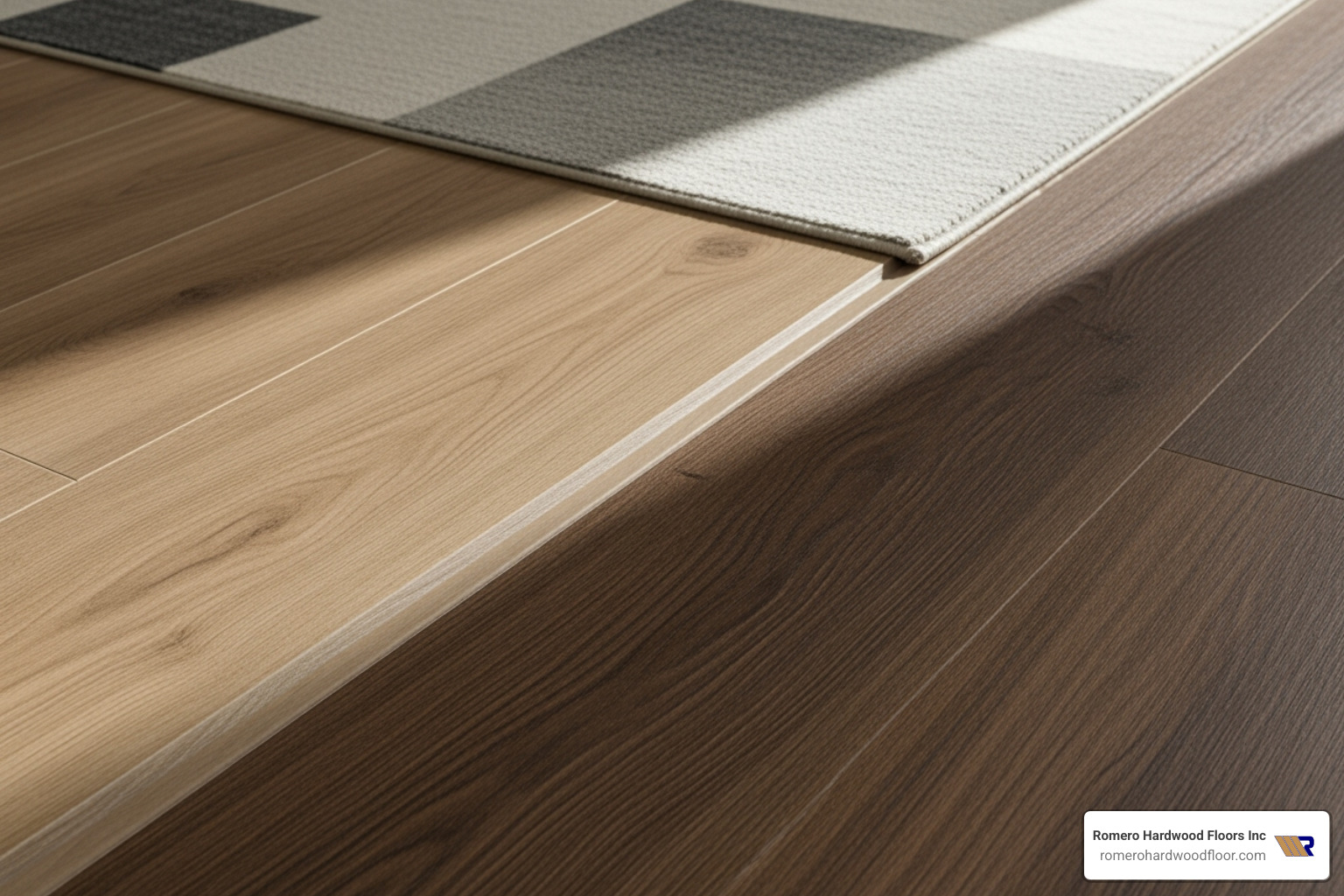
| Feature | Laminate | LVP (Luxury Vinyl Plank) | Engineered Wood | Solid Hardwood |
|---|---|---|---|---|
| Cost (Material) | $1-$15/sq ft | $2-$24/sq ft | $3-$30/sq ft | $5-$45/sq ft |
| Lifespan | 15-25 years | 15-30 years | 20-40 years | 50+ years |
| Water Resistance | Good (some water-resistant options) | Excellent (many 100% waterproof) | Good (more stable than solid, but not waterproof) | Poor (susceptible to moisture damage) |
| Durability | Good (AC rating, scratch-resistant) | Excellent (wear layer, dent/scratch-resistant) | Good (real wood veneer, dent/scratch-resistant) | Good (can dent, but can be refinished) |
| Maintenance | Easy (sweep, damp mop, no special products) | Very Easy (sweep, damp mop, no special products) | Moderate (sweep, damp mop, specific cleaners) | High (sweep, specific cleaners, refinishing) |
| Refinishing | No | No | Yes (1-3 times depending on veneer) | Yes (multiple times) |
| DIY-Friendliness | High (click-lock floating) | High (click-lock floating) | Moderate (floating, glue-down, nail-down) | Low (professional installation recommended) |
| Realism | High (HD printing, EIR texture) | Very High (HD printing, EIR texture, matte finish) | Excellent (real wood veneer) | Excellent (authentic wood) |
For a deeper dive, check out our article on Hardwood Floor vs Laminate.
Cost Analysis: Faux Wood vs. Real Hardwood
Cost is a major driver for choosing fake timber flooring. It typically wins on both material and installation costs.
Please note: The following cost ranges are average estimates based on internet data and are not actual costs for Romero Hardwood Floors. Please request an estimate for accurate project pricing.
- Laminate: $1-$15/sq ft
- LVP: $2-$24/sq ft
- Engineered Wood: $3-$30/sq ft
- Solid Hardwood: $5-$45/sq ft
Installation costs add to the total. Floating floors (laminate, click-lock LVP) are the most affordable to install and are DIY-friendly. Glue-down or nail-down installations (some LVP, engineered wood) require more skill and are more expensive. Professional installation ensures proper technique and protects your warranty. For budget-friendly tips, see our guide on Cheap But Good Laminate Flooring.
Durability, Water Resistance, and Maintenance
This is where fake timber flooring often outperforms real wood in busy households.
- Durability: LVP with a 20+ mil wear layer is exceptionally resistant to scratches and dents. Laminate with an AC4 or AC5 rating is built for heavy traffic. Engineered wood is as durable as its real wood veneer, while wood-look tile is nearly indestructible.
- Water Resistance: This is a key advantage. LVP is often 100% waterproof, making it ideal for bathrooms and basements. Modern laminate is highly water-resistant. Engineered wood is more stable than solid wood in humidity but is not waterproof.
- Maintenance: All fake timber options are easy to clean. Regular sweeping and occasional damp mopping are all that’s needed. Avoid steam mops and harsh chemicals. Use felt pads under furniture and mats at entryways to protect your investment.
Sustainability and Eco-Friendly Options
Many fake timber flooring options are environmentally conscious.
- Recycled Content: Many laminate and composite cores use recycled wood materials.
- Low VOCs: Look for FloorScore® or GREENGUARD Gold certifications, which ensure the product meets strict indoor air quality standards.
- Renewable Alternatives: Consider rapidly renewable materials like bamboo (matures in 3-5 years), cork (harvested from tree bark), and hemp (harvested in 120 days). For engineered wood, look for FSC certification to ensure responsible forestry. Learn more about hemp’s benefits in this scientific research on hemp sustainability.
How to Choose and Install Your Flooring
Choosing the right fake timber flooring is about matching the product to your life. With a clear approach, you can find the perfect floor for your home.
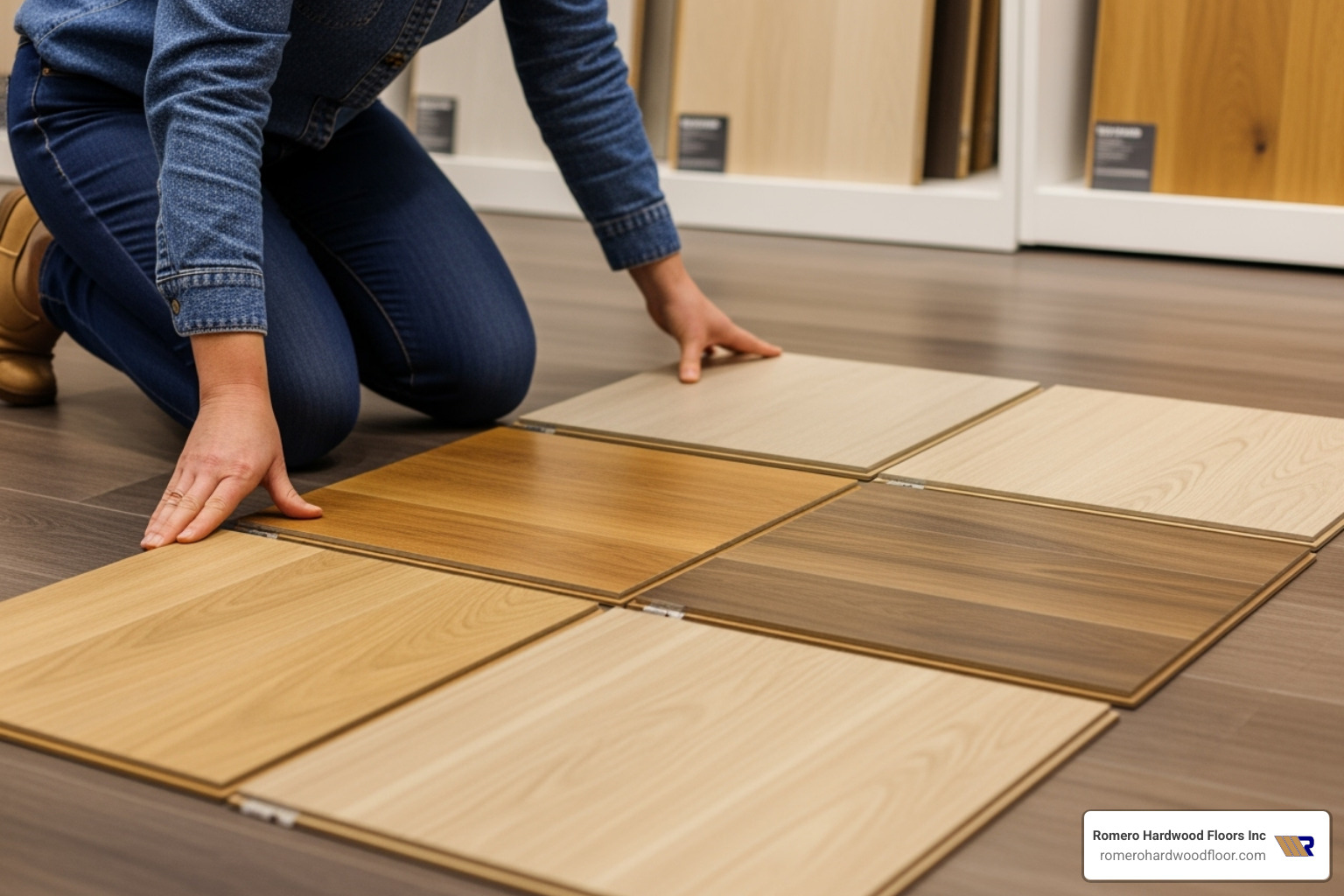
Choosing the Right Type of Fake Timber Flooring
Ask yourself these key questions to narrow down your options:
- What is your lifestyle? For homes with kids and pets, prioritize durability. LVP with a 20+ mil wear layer or laminate with an AC4/AC5 rating are excellent choices.
- Which room is it for? For moisture-prone kitchens, bathrooms, and basements, choose a 100% waterproof option like LVP or wood-look tile. For bedrooms and offices, you have more flexibility with laminate or engineered wood.
- What is your budget? Material costs range from under $2/sq ft for laminate to over $30/sq ft for premium engineered wood. Factor in installation costs to get a complete picture.
- What is your style? Wide planks create a modern, spacious feel, while narrower planks are more traditional. Matte finishes look more authentic. You can find colors and textures to match any decor, from gray-toned modern to warm, classic oak. Explore our guide on Laminate Flooring Color Choices for inspiration.
Installation: DIY vs. Professional
Once you’ve chosen your floor, you need to decide on installation.
DIY installation is a great option for handy homeowners, especially with floating floors like click-lock laminate and LVP. You can save significantly on labor costs if you are patient and follow instructions carefully.
Professional installation is recommended for more complex methods like glue-down or nail-down floors, and it’s essential for wood-look tile. A pro ensures the job is done right, protects your warranty, and handles any subfloor issues.
Regardless of who does the work, these steps are critical:
- Subfloor Preparation: The subfloor must be clean, dry, and level. Any imperfections will show through the new flooring.
- Acclimation: Allow the flooring materials to sit in the room for 24-72 hours to adjust to the temperature and humidity. This prevents future gapping or buckling.
- Underlayment: A quality underlayment provides sound absorption, insulation, and a moisture barrier. Don’t skip this step.
For a detailed walkthrough, see our guide on Laminate Flooring Installation.
Frequently Asked Questions about Fake Timber Floors
We get these questions all the time from homeowners exploring fake timber flooring. Here are the answers that matter most.
Which fake timber flooring looks the most realistic?
Engineered hardwood is the clear winner because its top layer is real wood. You’re seeing genuine grain and character, making it nearly indistinguishable from solid hardwood once installed.
Premium Luxury Vinyl Plank (LVP) is a very close second. Products with Embossed in Register (EIR) technology, where the texture matches the visual grain, are incredibly convincing. Look for matte finishes and a high number of unique plank patterns to avoid a repetitive look.
High-definition laminate has also made huge strides in realism, with advanced texturing and printing that can fool the eye from a standing position.
What is the most durable fake wood flooring for pets and kids?
For active households, durability is non-negotiable. Here’s what holds up best:
- Luxury Vinyl Plank (LVP): This is our top recommendation. Choose a product with a thick wear layer of 20 mil or higher to resist scratches from pet claws and dents from dropped toys. Its waterproof nature is also a huge plus for handling spills and accidents.
- Laminate with a high AC rating: Look for a rating of AC4 (heavy residential) or AC5 (commercial). These floors are specifically designed to withstand high traffic, abrasion, and impact.
- Wood-look tile: This option is practically indestructible. It’s impervious to scratches, water, and stains, making it the ultimate worry-free floor for extreme durability.
Can you install fake timber flooring over an existing floor?
Yes, in many cases you can install floating floors like laminate and click-lock LVP directly over an existing hard surface floor. This can save significant time and money.
However, this is only possible if the existing floor is:
- Level and Flat: The subfloor must be flat within 1/8 inch over a 6-foot span. Dips or bumps will cause problems later.
- Clean and Dry: Any moisture or debris must be addressed first.
- Structurally Sound: The old flooring cannot be loose, damaged, or cushioned.
Also, consider the added height, which will affect doors and transitions to other rooms. While it can be a DIY job, we recommend a professional assessment to ensure your existing floor is a suitable base for your new one.
Conclusion: The Perfect Alternative for Your Home
Modern fake timber flooring has revolutionized home design, offering the perfect blend of style, durability, and affordability. You no longer have to choose between a beautiful floor and one that can handle the reality of a busy home—from muddy paws to spilled drinks.
These wood-look alternatives provide the timeless character of hardwood without the high cost and demanding upkeep. Whether you need the 100% waterproof peace of mind of LVP, the budget-friendly versatility of laminate, or the authentic touch of engineered wood, there is a smart solution for your home.
As Francisco Romero, owner of Romero Hardwood Floors, I’ve spent over 15 years installing these floors across the greater Boston area, from Beverly to East Boston and beyond. I’m more excited than ever about the value and performance these products offer. They aren’t a compromise; they’re a superior choice for modern living.
Ready to find the perfect floor for your space and lifestyle? We’d love to help.
Request an estimate for your flooring project today and let’s create something beautiful together!
