
Hardwood Flooring Cost 2025: 10 Powerful Ways to Save Big
Why Understanding Hardwood Flooring Cost Matters for Your Investment
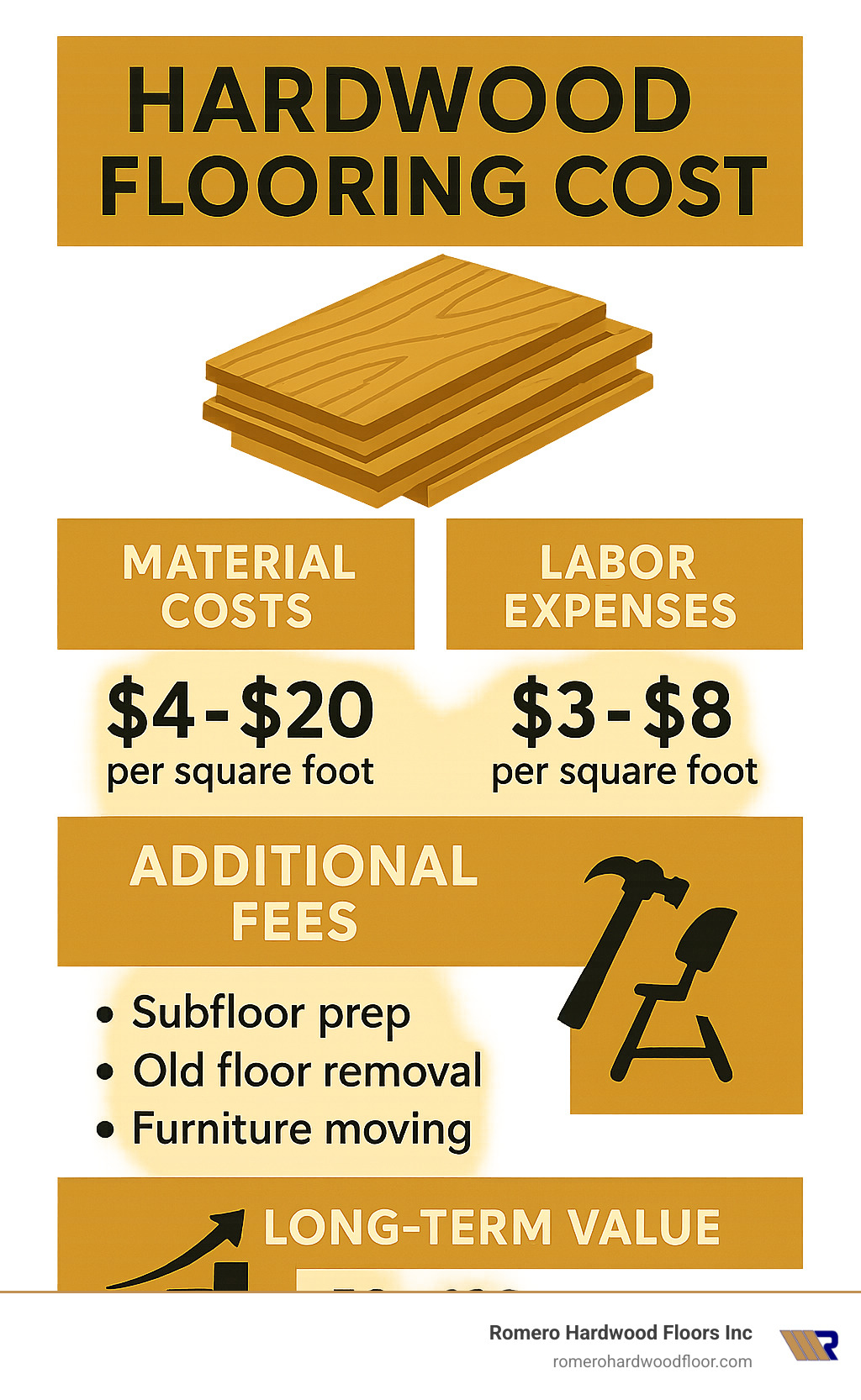
Hardwood Flooring Cost can make or break your renovation budget, but knowing what to expect helps you plan smart. The numbers tell a clear story: homeowners typically spend $6-$25 per square foot for materials and installation, with premium projects reaching up to $45 per square foot.
Quick Cost Overview:
– Average total cost: $2,500-$7,500 for a 340 sq ft living room
– Materials only: $4-$20 per square foot
– Installation labor: $3-$8 per square foot
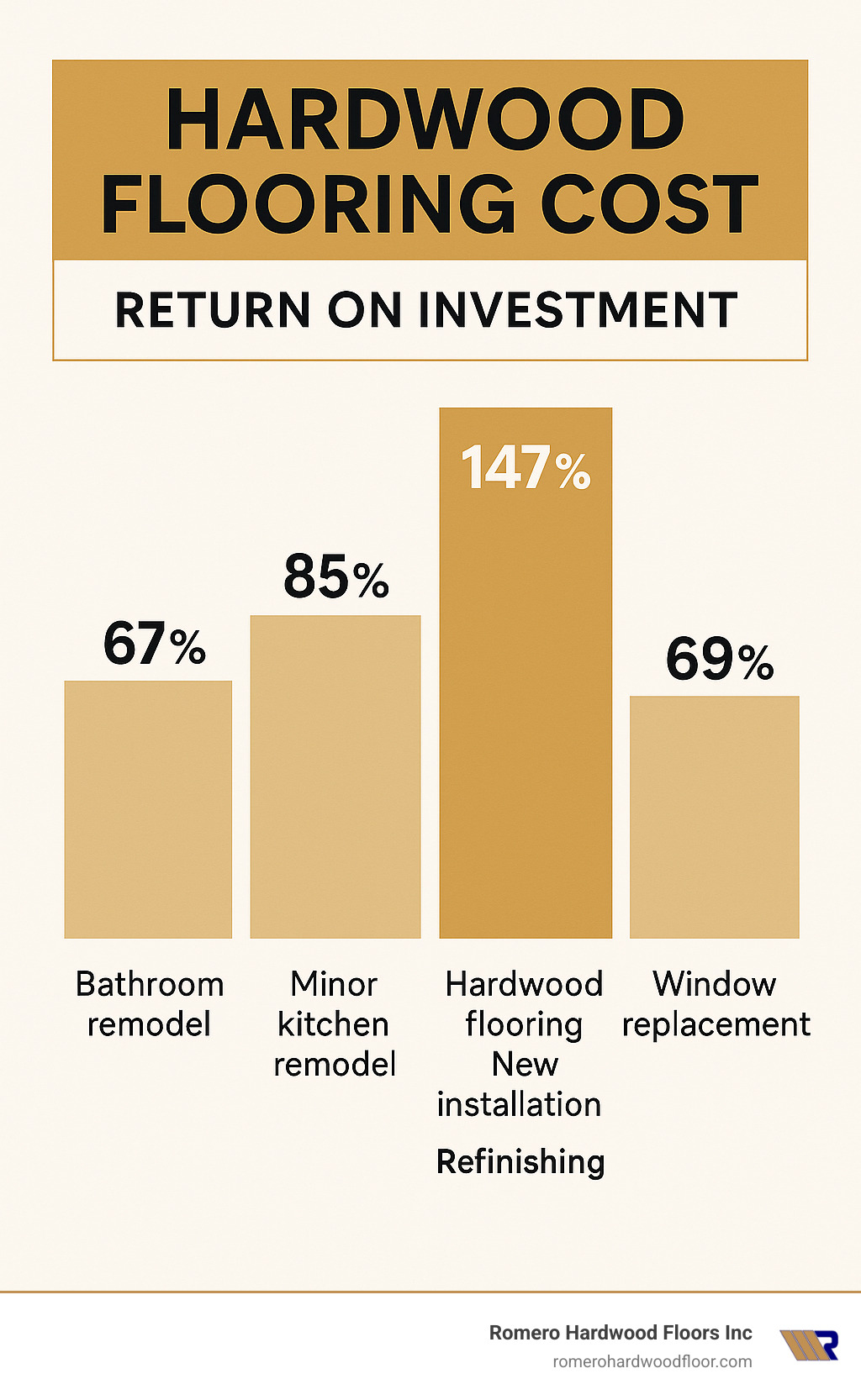
– Return on investment: 118% for new floors, 147% for refinishing
– Lifespan: 50-100+ years with proper care
Here’s what drives these costs: labor makes up 50-70% of your total budget, while material choice creates the biggest price swings. Domestic oak starts around $6 per square foot installed, while exotic Brazilian walnut can hit $25 or more. The good news? Even basic hardwood delivers serious value—most homeowners recoup over 100% of their investment when selling.
Hidden costs often surprise first-time buyers. You’ll need 10% extra material for waste, plus potential charges for subfloor prep ($1-$5 per square foot), old floor removal ($3-$5 per square foot), and furniture moving. Pattern complexity like herringbone can double your labor costs.
I’m Francisco Romero, owner of Romero Hardwood Floors Inc., and I’ve been helping Greater Boston homeowners steer Hardwood Flooring Cost decisions since 2006. My 15+ years of hands-on experience has taught me that understanding these cost factors upfront prevents budget surprises and helps you make choices that maximize both beauty and value.
Similar topics to Hardwood Flooring Cost:
– Cost of hardwood floors
Hardwood Flooring Cost at a Glance
When you’re planning a hardwood floor project, the Hardwood Flooring Cost typically falls between $6-$25 per square foot installed nationwide. This wide range might seem confusing at first, but it makes perfect sense once you understand what drives the pricing.
Here’s the reality: labor eats up about 50% of your total budget. That’s right—half of what you spend goes to the skilled craftspeople who transform raw planks into beautiful floors. The other half covers materials, and that’s where you’ll see the biggest price swings depending on your choices.
Don’t forget to budget for 10% extra material beyond your room measurements. This covers cutting waste (every room has corners and odd angles) plus gives you backup planks for future repairs. Trust me, you’ll thank yourself later when you need to replace a damaged board and have matching wood ready to go.
| Budget Level | Cost Per Sq Ft | 500 Sq Ft Room | What You Get |
|---|---|---|---|
| Basic | $6-$10 | $3,000-$5,000 | Domestic oak/maple, prefinished, standard installation |
| Mid-Range | $11-$18 | $5,500-$9,000 | Premium domestic species, wider planks, site-finished options |
| High-End | $19-$45 | $9,500-$22,500 | Exotic woods, custom patterns, complex installations |
Note: These are average costs based on internet data and not actual costs for Romero Hardwood Floors Inc.
The jump from basic to high-end isn’t just about showing off—it reflects real differences in materials and craftsmanship. Basic projects use domestic woods like red oak with factory finishes, while premium installations might feature hand-selected exotic species with custom staining and intricate patterns.
Hardwood Flooring Cost per Square Foot
The $6 starting point gets you genuine hardwood—usually red oak or maple with a prefinished surface and straightforward installation. At the $45 premium end, you’re looking at exotic species like Brazilian walnut, custom patterns such as herringbone, or challenging installation conditions that require extra skill and time.
Let me put this in real-world terms with actual room sizes. A 150 square foot bedroom runs $900-$6,750 total, while a 340 square foot living room costs $2,040-$15,300. For bigger spaces, a 500 square foot great room ranges from $3,000-$22,500, and a full 1,000 square foot main floor can hit $6,000-$45,000.
These ranges aren’t arbitrary—they reflect genuine choices you’ll make. Standard red oak in 3-inch planks hits the low end, while hand-scraped exotic wood in complex patterns reaches the top tier. The good news? Every option gives you real hardwood that lasts decades.
For detailed breakdowns specific to your project size, check out our Hardwood Floor Cost Per Square Foot guide.
Hardwood Flooring Cost vs Alternatives
Hardwood Flooring Cost looks steep compared to carpet or laminate upfront. But here’s what changes the math: hardwood floors last 50-100+ years while most alternatives need replacement every 10-25 years.
Laminate costs $7-$11 per square foot installed but typically lasts 15-25 years. Vinyl plank runs $8-$15 per square foot with a 10-20 year lifespan. Bamboo falls between $7-$19 per square foot and gives you 25-30 years. Carpet seems like a bargain at $3-$8 per square foot until you realize you’ll replace it every 5-15 years.
According to Angi’s flooring cost analysis, hardwood’s longevity makes it surprisingly economical. You might replace carpet 4-6 times over a hardwood floor’s lifetime. Plus, hardwood typically adds 3-5% to your home’s value, while other options rarely boost resale prices.
The math gets even better when you consider that hardwood can be refinished multiple times, essentially giving you a “new” floor for a fraction of replacement cost.
Price Breakdown by Material & Construction
Material selection drives the biggest Hardwood Flooring Cost variations. Domestic species like oak and maple offer excellent value, while exotic imports command premium prices. Construction type—solid versus engineered—affects both upfront costs and long-term maintenance expenses.

Wood hardness, measured on the Janka scale, influences both price and durability. Harder woods like hickory (1,820 Janka) cost more than softer species like pine (380 Janka) but resist dents and scratches better. Plank width also affects pricing—wider boards typically cost 15-30% more than standard 2.25-inch strips.
Domestic Species Roundup
Red Oak remains the gold standard for Hardwood Flooring Cost value, ranging from $4-$12 per square foot for materials. Its consistent grain pattern and excellent finishing properties make it ideal for first-time hardwood buyers. We’ve installed thousands of square feet of red oak across Beverly, Salem, and Peabody—it’s reliable, beautiful, and budget-friendly.
White Oak costs slightly more at $5-$14 per square foot but offers superior moisture resistance. This makes it perfect for kitchens and entryways where spills happen. The tighter grain structure also creates stunning visual appeal when site-finished with custom stains.
Maple falls in the $4-$15 per square foot range and delivers exceptional hardness (1,450 Janka rating). Its light, consistent color takes stain beautifully, though some homeowners prefer its natural blonde appearance. Character-grade maple with knots and mineral streaks costs less but adds rustic charm.
Hickory commands $7-$14 per square foot due to its extreme hardness (1,820 Janka) and dramatic grain patterns. This species works well in high-traffic areas and homes with pets or children. The natural color variation means each plank looks unique—some homeowners love this character, others prefer more uniform species.
Exotic & Reclaimed Standouts
Brazilian Walnut (Ipe) represents the premium end of Hardwood Flooring Cost at $9-$25 per square foot. With a Janka rating over 3,600, it’s nearly indestructible but requires specialized installation techniques. We’ve installed Brazilian walnut in luxury homes throughout Winchester and Manchester by the Sea—the results are stunning but definitely an investment.
Teak ranges from $12-$30 per square foot and brings natural water resistance that’s perfect for bathrooms or coastal homes. Its golden color and straight grain create an neat, yacht-like appearance that never goes out of style.
Reclaimed Oak costs $15-$18 per square foot but offers unique character impossible to replicate with new wood. Each plank tells a story, with nail holes, saw marks, and patina that add instant warmth. The environmental benefits appeal to eco-conscious homeowners, though limited availability can extend project timelines.
Engineered vs Solid: Hardwood Flooring Cost Factors
Engineered hardwood typically costs $7-$20 per square foot installed, making it more budget-friendly than solid wood’s $11-$25 range. The multi-layer construction with plywood or fiberboard cores provides dimensional stability that works well over concrete slabs or in moisture-prone areas.
Veneer thickness determines refinishing potential—thicker veneers (4-6mm) can be sanded 2-3 times, while thin veneers (1-2mm) allow only light screening. This affects long-term value since solid hardwood can be refinished indefinitely.
Solid hardwood costs more upfront but offers unlimited refinishing potential. The 3/4-inch thickness allows deep sanding to remove decades of wear. We’ve refinished 50-year-old solid oak floors that look brand new—try that with engineered! Engineered Hardwood Flooring Installation Cost comparisons help you choose the right construction for your needs and budget.
Beyond the Planks: Labor, Prep & Hidden Expenses
The sticker shock often comes not from the wood itself, but from everything else that goes into a professional Hardwood Flooring Cost project. Installation labor alone runs $3-$10 per square foot—and that’s just the beginning. After 15+ years installing floors across Greater Boston, I’ve learned that the “extras” can make or break your budget if you’re not prepared.
Installation labor represents your biggest single expense, typically 50-70% of your total project cost. Basic nail-down installation over clean plywood subfloors hits around $3-$6 per square foot. But throw in some complications—like an old Victorian home in Salem with uneven floors or a herringbone pattern request—and you’re looking at $8-$10 per square foot or more.
The wide range reflects what we actually encounter in the field. That beautiful 1920s colonial in Beverly might have subfloors that creak, sag, or aren’t quite level. Fixing these issues isn’t optional—it’s essential for a floor that will last decades.
Subfloor preparation adds $1-$5 per square foot when your existing foundation needs work. Sometimes we’re just adding screws to eliminate squeaks. Other times, we’re replacing water-damaged sections or installing sleepers to level everything out. I’ve seen homeowners try to skip this step to save money, only to have their beautiful new floors develop problems within months.
Demolition and disposal typically runs $3-$5 per square foot plus the cost of a dumpster. Removing old carpet is relatively straightforward—a few cuts and it rolls right up. But tile? That’s a different beast entirely. We’re talking hours of chipping, scraping, and hauling heavy debris. And if we find asbestos tiles (more common than you’d think in older homes), that requires special handling that can triple your removal costs.
Here’s where things get interesting with those surprise expenses that seem to appear out of nowhere. Furniture moving might seem simple, but professional movers charge $20-$150 per room depending on what you’ve got. Stair treads cost $75-$200 each to install—and most homes need 12-15 treads. Permits vary wildly by town, from $50 in some communities to $200+ in others.
Then there’s the general contractor markup of 13-22% if your hardwood installation is part of a larger renovation. GCs coordinate everything, pull permits, and manage the timeline, but that convenience comes at a cost.
Note: These are average costs based on internet data and not actual costs for Romero Hardwood Floors Inc.
Unfinished On-Site Sand & Finish
Choosing unfinished hardwood opens up a world of customization possibilities, but it also adds $4-$6 per square foot for the sanding and finishing process. Custom staining tacks on another $1-$2 per square foot, but the results can be absolutely stunning—colors and finishes that you simply can’t get with prefinished floors.
The process takes patience. We start with coarse-grit sandpaper and work our way up to fine grits that leave the wood baby-smooth. If you’re staining, that happens next—and this is where the magic happens. We can match existing trim, create dramatic contrasts, or achieve that perfect shade you’ve been dreaming about.
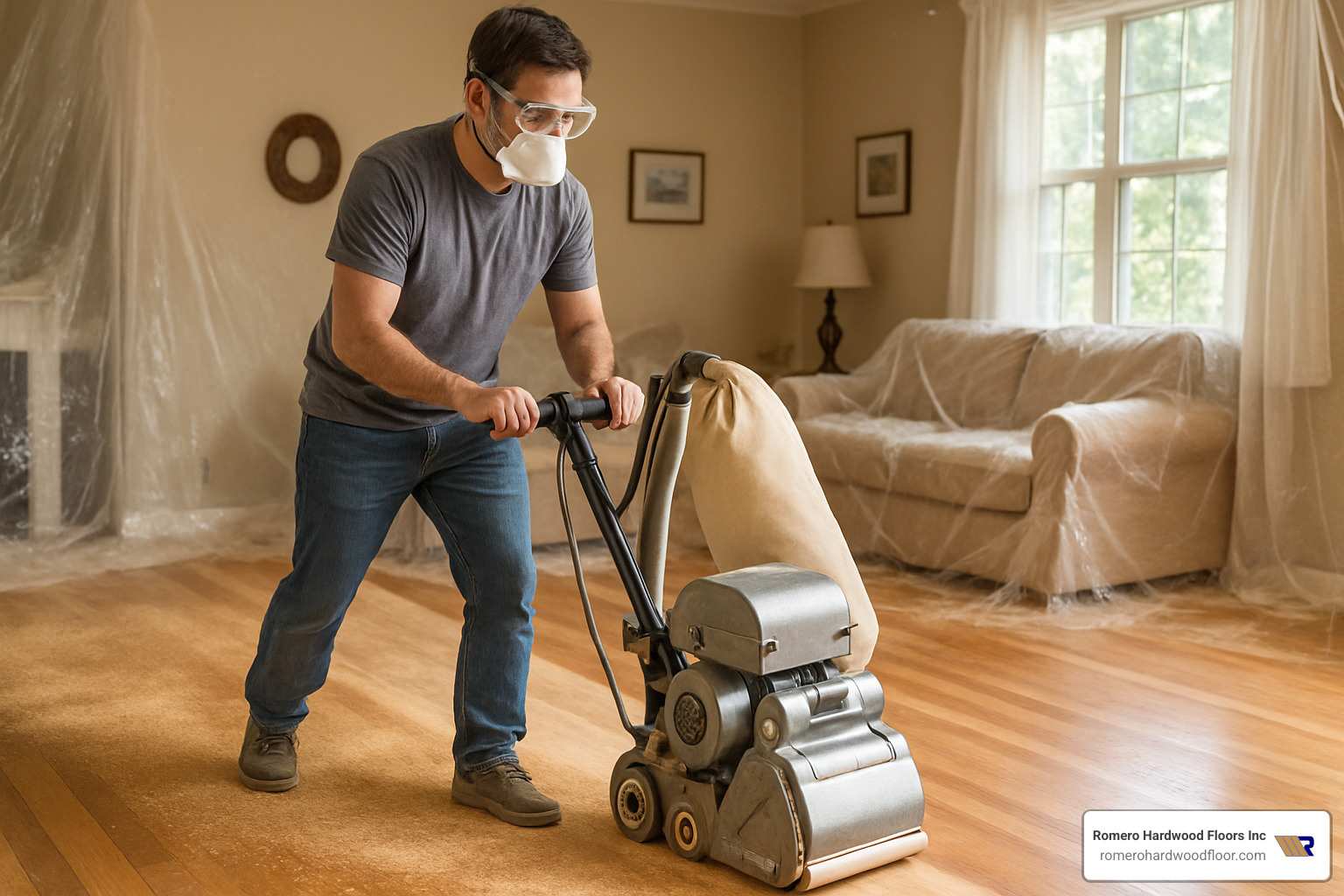
Then comes three coats of polyurethane with light sanding between each coat. The whole process takes 3-5 days including curing time. Yes, it means living with dust and fumes for a few days (we use plastic barriers and fans to minimize this). But when we’re done, you have a floor that’s perfectly smooth with seamless color from wall to wall.
The dust situation is real, though. Even with our best containment efforts, you’ll want to plan accordingly. Cover furniture, remove delicate items, and maybe plan a mini-vacation. Cost to Sand and Restain Hardwood Floors breaks down exactly what’s involved in this process.
Tear-Out & Disposal
Not all flooring removal is created equal. Carpet removal is relatively painless at $1-$2 per square foot—a few strategic cuts and it rolls up like a burrito. Tile removal is where things get serious, running $2-$5 per square foot because we’re talking about chipping, scraping adhesive, and hauling incredibly heavy debris.
Existing hardwood removal falls somewhere in the middle at $2-$4 per square foot. If it’s glued down, expect the higher end of that range. Nail-down floors come up easier, but we still need to pull every nail and prepare the subfloor.
Dumpster rental adds $300-$600 to your project, depending on size and how long you need it. But here’s where it gets tricky—some materials can’t just go in a regular dumpster. Asbestos tiles, lead paint, treated lumber—these require special disposal that costs significantly more.
I always recommend having the existing flooring tested if your home was built before 1980. Better to know upfront than find hazardous materials mid-project when everything gets more expensive and complicated.
Hidden Hardwood Flooring Cost Traps
Pattern complexity is the biggest budget buster I see. Standard plank installation runs that $3-$6 per square foot labor range we mentioned. But ask for herringbone, chevron, or any custom pattern, and you’re looking at $6-$12 per square foot for labor alone. Every cut has to be precise, every angle perfect. It’s beautiful work, but it takes time and skill.
Moisture barriers seem like a small thing at $0.50-$1.50 per square foot, but they’re essential over concrete slabs or in humid conditions. Skip this step, and you might end up with cupped, crowned, or buckled floors that require complete replacement. Trust me, I’ve seen it happen.
The general contractor markup catches many homeowners off guard. If your hardwood is part of a kitchen renovation or whole-house project, expect that 13-22% markup on top of everything else. GCs provide valuable coordination and project management, but it’s a cost that adds up quickly on larger projects.
After nearly two decades in this business, I’ve learned that transparency about these costs upfront prevents unpleasant surprises later. A good contractor will walk through every potential expense during the estimate process—because the last thing anyone wants is a beautiful half-finished floor and an empty bank account.
Save or Splurge? Refinishing, DIY & Financing Tips
Refinishing existing hardwood delivers an impressive 147% return on investment—the highest ROI of any flooring project. This makes it the smart financial choice when your current floors have good bones but tired surfaces. I’ve seen countless homeowners transform 30-year-old floors that looked ready for the dumpster into stunning showcases that rival brand-new installations.
DIY installation tempts many homeowners with potential savings of $3-$8 per square foot in labor costs. But here’s the reality check—you’ll need serious skills, dedicated time, and a hefty tool investment. Pneumatic nailers rent for $50-$100 daily, miter saws cost another $40-$60 per day, and a decent moisture meter runs $150-$300 to purchase. Most weekend warriors manage 100-150 square feet per day, so a 500-square-foot room becomes a month-long project.
Financing options make Hardwood Flooring Cost more manageable when you’re facing a $10,000+ project. Home equity lines of credit (HELOCs) typically offer the lowest rates for large renovations. Personal loans work for smaller jobs but carry higher interest rates. Some contractors offer 0% financing for qualified buyers—just read the fine print carefully.
Refinish vs Replace Decision
Surface wear like light scratches, scuffs, or sun fading responds beautifully to refinishing. Here’s my quarter test: if you can drive a quarter into the wood and it doesn’t leave a permanent dent, refinishing will likely work perfectly. The process costs $3-$8 per square foot—a fraction of Hardwood Flooring Cost for replacement.
Structural damage tells a different story. Deep gouges that penetrate through the wood, water damage causing boards to cup or crown, or floors that have been refinished too many times need replacement. Solid hardwood can typically handle 7-10 refinishing cycles over its lifetime, while engineered floors with thin veneers might only survive 1-2 sandings.
Age considerations add another wrinkle. Floors installed before 1978 may contain lead-based finishes requiring special handling during refinishing. Very thin engineered floors might lack sufficient veneer thickness for proper sanding. Cost to Replace Hardwood Floors helps you weigh all these factors when making the refinish-versus-replace decision.
DIY Hardwood Install Essentials
Tool requirements extend far beyond a hammer and nails. You’ll need pneumatic nailers, miter saws, moisture meters, and various hand tools that can easily cost $500+ to rent for a weekend project. Acclimation requires storing wood indoors for 3-7 days before installation—something many DIYers find too late.
Skill level matters enormously with hardwood installation. Measuring, cutting, and fitting require precision carpentry skills that take years to develop. Mistakes with expensive exotic woods hurt both your budget and timeline. The most successful DIY projects use prefinished engineered planks with click-lock installation—the most forgiving option for beginners.
Savings potential ranges from 30-50% of total project costs, but factor in tool rental, your time value, and potential mistake costs. I’ve seen DIY disasters that cost more to fix than professional installation would have cost originally. Hardwood Flooring Price Trends show when seasonal sales make professional installation surprisingly affordable.
Smart Ways to Cut Your Hardwood Flooring Cost
Bulk buying saves 10-20% on materials when covering multiple rooms simultaneously. Manufacturers offer better pricing on large orders, plus you’ll have perfectly matched planks throughout your home. I always recommend this approach for whole-house projects.
Open floor plans reduce labor costs significantly since installers work more efficiently in large, uninterrupted spaces. Complex layouts with lots of cuts, transitions, and obstacles increase installation time and material waste. A simple rectangular room costs less per square foot than a kitchen with islands and cabinets.
Moving furniture yourself saves $20-$150 per room in professional moving fees. Rent furniture dollies from your local hardware store and recruit friends with strong backs. Just protect your existing floors during the move—scratched hardwood defeats the purpose.
Multiple bids from qualified installers ensure competitive pricing without sacrificing quality. Get at least three quotes using identical specifications for accurate comparisons. The lowest bid isn’t always best—verify licensing, insurance, and references before signing anything.
Seasonal timing affects both material and labor costs more than most homeowners realize. Spring and fall see peak demand and higher prices as everyone wants new floors for entertaining season. Winter installations often come with 10-15% discounts as contractors maintain steady work during slower seasons.
Frequently Asked Questions about Hardwood Flooring Cost
When planning your hardwood project, these three questions come up in almost every consultation I have with homeowners. Understanding these basics helps you budget accurately and avoid surprises.
What percentage of my budget should cover labor?
Labor typically accounts for 50-70% of total Hardwood Flooring Cost, which surprises many first-time hardwood buyers. This percentage shifts based on your material choices and project complexity. When you choose premium materials like Brazilian walnut, labor might drop to 40-50% of your total budget since the wood itself costs so much. But with basic red oak installation, labor could reach 70% or more of your project cost.
Here’s a real-world example: For a typical $10,000 hardwood project, expect $5,000-$7,000 for labor and $3,000-$5,000 for materials. Complex installations like herringbone patterns or stair treads push the labor percentage even higher since they require specialized skills and take significantly more time.
Note: These are average costs based on internet data and not actual costs for Romero Hardwood Floors Inc.
How much extra material should I order for waste?
Order 10% extra material for standard installations, 15% for diagonal or complex patterns. This covers cutting waste, installation mistakes, and gives you perfectly matched planks for future repairs. I’ve seen too many homeowners try to save money by ordering exact quantities, only to face project delays when they run short.
Longer planks generate less waste than shorter ones since there are fewer end cuts. Experienced installers also waste less material than DIY installations. For a 500 square foot room, order 550 square feet of flooring. That extra 50 square feet costs $200-$600 depending on your wood species, but it prevents headaches and ensures perfect color matching down the road.
The beauty of having extra material? You’ll thank yourself years later when you need to repair a damaged plank and have perfectly matched wood waiting in your basement.
Do hardwood floors really increase home value?
Yes—hardwood floors deliver 118% return on investment for new installation and 147% for refinishing. These impressive numbers come from the National Association of Realtors’ comprehensive market analysis, and I see this value boost play out with my clients regularly.
Hardwood floors appeal to about 90% of homebuyers and often help homes sell faster in competitive markets. The value increase depends on your local area and what you’re replacing. Swapping out worn carpet for beautiful hardwood typically adds more value than replacing existing hardwood floors.
Quality installation and species choice affect resale impact too. A properly installed red oak floor adds solid value, while exotic species in good condition can really make your home stand out. The key is choosing materials and finishes that appeal to broad buyer preferences rather than highly personal tastes.
Conclusion
Making smart Hardwood Flooring Cost decisions transforms both your daily living experience and your home’s long-term value. Whether you’re drawn to the classic appeal of red oak at $6 per square foot or the exotic luxury of Brazilian walnut reaching $25 per square foot, hardwood flooring consistently ranks among the most rewarding home investments you can make.
Here at Romero Hardwood Floors Inc, we’ve watched countless homeowners fall in love with their new floors since we started serving Greater Boston in 2006. From cozy bedrooms in Beverly to grand living spaces in Winchester, we’ve seen how the right flooring choice can completely transform a home’s atmosphere. Our commitment to competitive pricing, expert craftsmanship, and guaranteed workmanship has built lasting relationships across communities from Revere to Woburn.
The numbers we’ve shared throughout this guide represent average internet data, not actual Romero Hardwood Floors pricing. Every home tells its own story, and factors like your subfloor condition, room layout, species preferences, and finish choices create a unique cost picture. That’s why we believe in personalized consultations rather than one-size-fits-all estimates.
What excites us most about Hardwood Flooring Cost discussions is helping homeowners understand the true value equation. Yes, the upfront investment feels significant, but when you spread that cost over 50-100 years of beauty and durability, plus factor in the 118% return on investment, hardwood becomes one of the smartest financial decisions you can make for your home.
Ready to see what beautiful hardwood could do for your space? Our Hardwood Floor Installation Cost resource provides detailed estimates custom to your specific project. Contact us today for a free consultation where we’ll discuss your vision, assess your space, and show you exactly how Hardwood Flooring Cost can work within your budget.
The investment in quality hardwood flooring creates value that extends far beyond dollars and cents. There’s something magical about walking barefoot across smooth, warm wood that carpet or vinyl simply can’t replicate. When you choose hardwood, you’re choosing floors that will welcome your family home for generations to come.
