
Understanding What Affects Your Hardwood Floor Installation Timeline
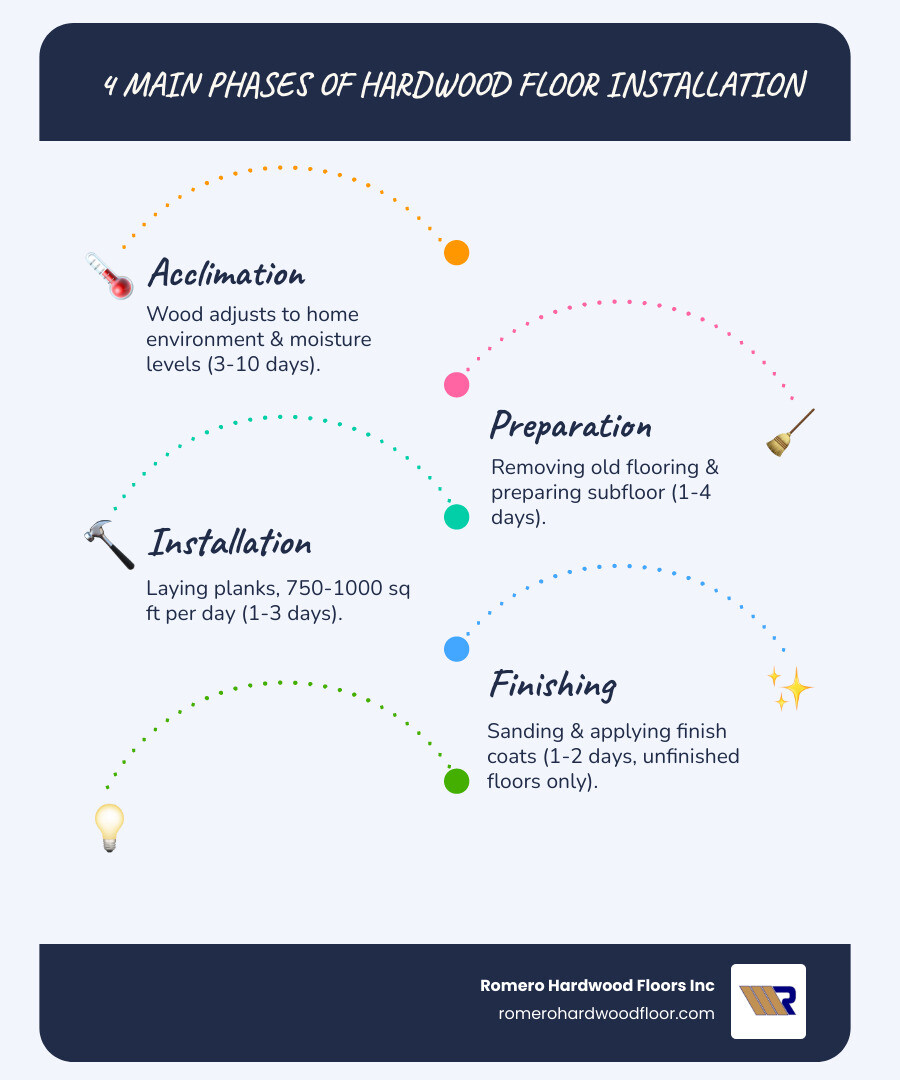
How long does it take to install hardwood floors? Most hardwood floor installations take between 8-15 days from delivery to completion, but the timeline varies significantly based on several factors:
- Acclimation: 3-10 days (mandatory for most hardwood)
- Site Preparation: 1-4 days (removing old flooring, subfloor repairs)
- Installation: 1-3 days (for typical residential projects)
- Sanding & Finishing: 1-2 days (unfinished floors only)
Prefinished floors typically result in shorter overall project times since they don’t require post-installation finishing. A professional crew of two installers can typically complete 750-1,000 square feet per day.
When homeowners and property managers in Revere reach out to us, one of the first questions they ask is about timing. And it’s a smart question—understanding how long does it take to install hardwood floors helps you plan around work schedules, coordinate other contractors, and set realistic expectations for when you can start enjoying your new floors.
The truth is, there’s no single answer. A small bedroom might be done in a few days, while a whole-house installation with custom patterns could take two weeks or more. The type of hardwood you choose, the condition of your subfloor, and whether you select prefinished or unfinished planks all play major roles in the timeline.
Here’s what really matters: A rushed installation almost always leads to problems down the road. Skipping proper acclimation can cause boards to warp or gap. Cutting corners on subfloor preparation creates squeaks and uneven surfaces. That’s why professional installers follow a systematic process with specific timeframes for each phase.
In this guide, we’ll break down exactly what happens during each stage of hardwood floor installation and how long each phase typically takes. You’ll learn which factors add time to your project, how to prepare your home for installation, and what to expect during the process. Whether you’re planning a single room or a full property renovation, you’ll walk away with a clear understanding of the timeline.
I’m Francisco Romero, owner of Romero Hardwood Floors Inc., and over the past 15+ years, I’ve overseen hundreds of installations throughout the Revere area. One lesson I’ve learned: homeowners who understand how long does it take to install hardwood floors and why each phase matters are always happier with their finished project.
Related content about how long does it take to install hardwood floors:
- cost of hardwood floor installation
- diy hardwood floor installation
- how to install hardwood flooring
The Hardwood Floor Installation Timeline: A Phase-by-Phase Breakdown
When we talk about how long does it take to install hardwood floors, we’re looking at a journey with several distinct stops. From the moment your beautiful new wood arrives at your home in Chelsea or Saugus, to the final walk-through, a typical hardwood floor installation can span anywhere from 8 to 15 days. This entire process is carefully planned to ensure your floors are not only stunning but also durable and long-lasting.
Our professional installation process is divided into four main phases: acclimation, site preparation, the actual installation, and finally, sanding and finishing (if applicable). Each phase is critical and contributes to the overall timeline, ensuring that every detail is handled with the precision your investment deserves. A skilled team of two installers can typically lay between 750-1,000 square feet of flooring per day, making us highly efficient in turning your flooring dreams into reality across Lynnfield, Malden, and beyond.
More info about our installation process
Phase 1: Acclimation – The Crucial Waiting Game (3-10 Days)
Before a single plank is laid, your hardwood flooring needs to get comfortable in its new home. This isn’t just about letting it sit; it’s a vital scientific process called acclimation. Wood is a natural, hygroscopic material, meaning it absorbs and releases moisture, expanding and contracting with changes in temperature and humidity. If we skip this step, or rush it, we risk issues like warping, cupping, buckling, or unsightly gapping between boards. Nobody wants that!

Acclimation allows the wood’s moisture content to stabilize and reach equilibrium with your home’s environment, typically a relative humidity of 30-50% and temperature between 60-80 degrees Fahrenheit, which are common conditions here in Revere, MA. Most manufacturers recommend a minimum of 3 days for acclimation, but 7 days is often better, and in some cases, it can take up to 10 days. We always measure the moisture content of the wood and the subfloor to ensure optimal conditions before proceeding. Engineered hardwood generally acclimates faster than solid hardwood due to its more stable construction, but both require this essential step.
How Long Does it Take to Acclimate Hardwood Flooring?
Phase 2: Site Preparation – Setting the Stage (1-4 Days)
Once your flooring has happily acclimated, it’s time to prepare the canvas for its grand debut. This phase typically takes 1-4 days, depending on the current state of your space.
First, we carefully remove any existing flooring, whether it’s old carpet, tile, or laminate. We also ask our clients in areas like Medford and Melrose to move furniture out of the rooms where work will be done. This clears the area for a thorough subfloor inspection. The subfloor, which is the foundation for your new hardwood, undergoes a meticulous check.
Any imperfections—dips, bumps, unevenness, or even signs of moisture or termite damage—are addressed. This might involve leveling compounds to create a perfectly flat surface, or more extensive repairs, which can add time and potentially cost to the project. For instance, subfloor repairs can sometimes add 1-2 days to the timeline. Finally, we ensure the subfloor is immaculately clean and dry, ready for installation.
Learn about installing on concrete
Phase 3: The Installation – Laying the Planks (1-3+ Days)
This is where the magic happens! The actual laying of the hardwood planks is typically the fastest part of the process, often taking 1-3 days for a standard residential room. Our skilled teams, often two installers strong, are highly efficient, covering between 750-1,000 square feet per day.
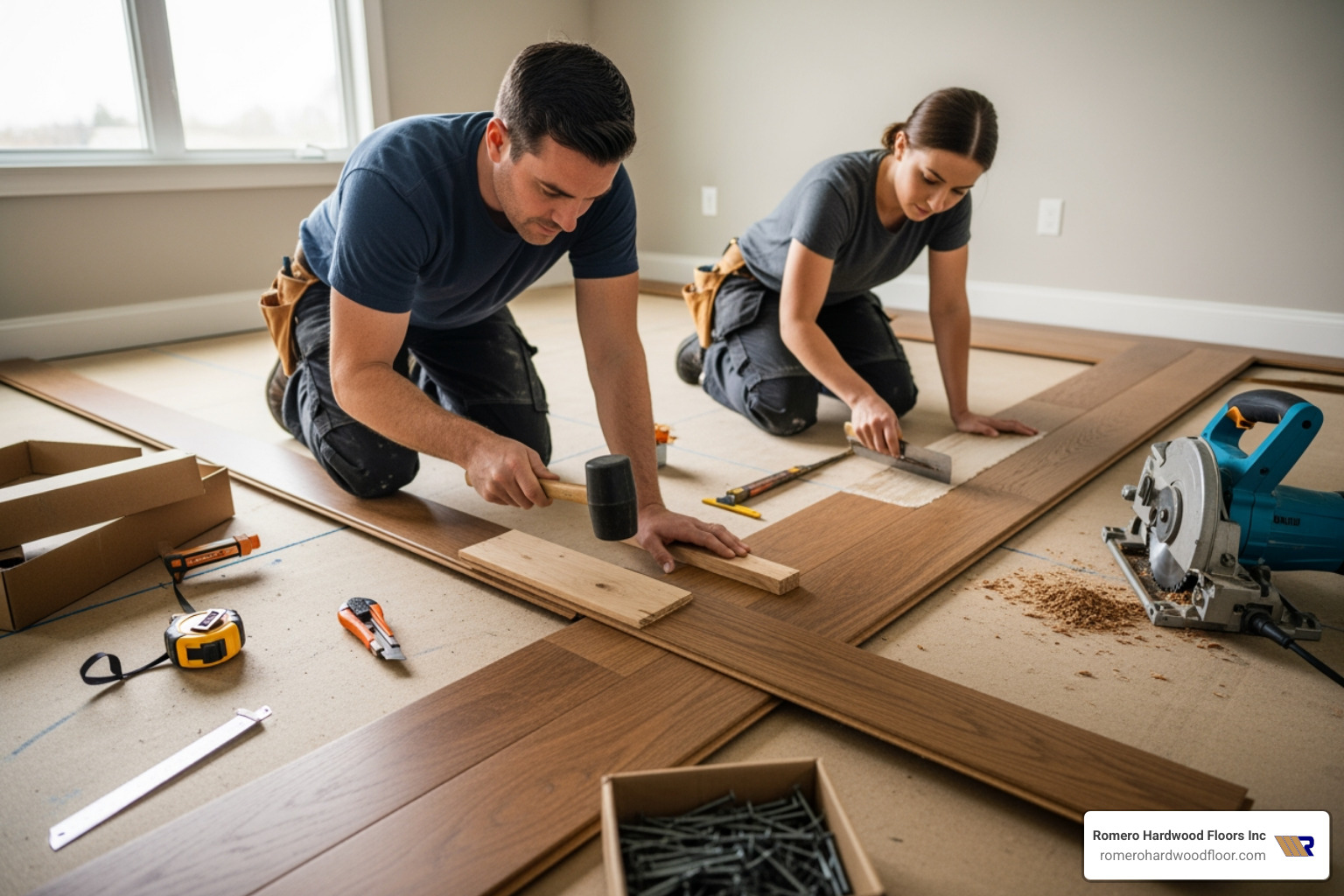
We use various installation methods depending on your chosen flooring type and subfloor. Nail-down is common for solid hardwood over wood subfloors. Glue-down offers a secure bond, especially for engineered wood, and floating installations (where planks click together without being attached to the subfloor) are also popular for engineered options. Custom cuts are made around doorways, corners, and other architectural features in your home, ensuring a seamless and beautiful finish. Navigating obstacles like fireplaces, built-in cabinets, or intricate room layouts naturally takes more time and precision.
Phase 4: Sanding & Finishing – The Final Touches (1-2 Days for Unfinished Floors)
This phase is exclusively for unfinished, or site-finished, hardwood floors. Prefinished floors, as the name suggests, arrive with their finish already applied from the factory, bypassing this step entirely.
For unfinished floors, this is where their true beauty is revealed. The process typically takes an additional 1-2 days. First, the newly laid wood is carefully sanded to remove any imperfections, smooth the surface, and prepare it for staining. Then, we apply your chosen stain, allowing it to penetrate and highlight the wood’s natural grain. Finally, multiple coats of a protective finish are applied. We often use durable finishes to protect your investment for years to come. Each coat requires adequate drying time, which is crucial for the finish’s longevity and appearance. Water-based finishes generally dry faster than oil-based ones, but both need proper ventilation and time to cure.
More on sanding and refinishing
So, How Long Does It Take to Install Hardwood Floors? Key Influencing Factors
While the general breakdown above gives you a good idea, the precise answer to how long does it take to install hardwood floors is as unique as your home in Manchester by the Sea or Winthrop. Several factors can either speed up or slow down the process. Understanding these variables helps us provide the most accurate estimate for your project.
Find a contractor for your project
Prefinished vs. Unfinished: How does it impact how long it takes to install hardwood floors?
The choice between prefinished and unfinished hardwood flooring significantly impacts your overall project timeline. It’s one of the first decisions we help our clients in Peabody and Stoneham make.
| Feature | Prefinished Hardwood | Unfinished Hardwood |
|---|---|---|
| Installation Speed | A team can install 300-350 sq ft per day. More careful handling is required to avoid damaging the factory finish. | A team can install 400-450 sq ft per day. Faster to lay as imperfections will be sanded later. |
| Overall Project Time | Shorter. No post-installation sanding or finishing required. Floors are ready for use sooner. | Longer. Requires additional 1-2 days for sanding, staining, and finish application, plus drying time. |
| Finish Durability | Factory-applied finishes are often more durable and uniform. | Site-applied finishes offer excellent protection but depend on environmental conditions during application. |
| Customization | Limited to available colors and finishes. | Allows for complete on-site customization of stain color and finish type. |
| Disruption | Less dust and fumes during installation. | More dust and odors from sanding and finishing. |
While prefinished hardwood might take slightly longer to lay per square foot due to the careful handling required, the absence of post-installation sanding and finishing phases means a significantly shorter overall project time. This can be a huge plus for homeowners who need to minimize disruption. Conversely, unfinished hardwood offers unparalleled customization, allowing us to perfectly match existing trim or create a unique look, but requires the additional time for finishing.
Project Size and Layout Complexity
It stands to reason that a larger area will take longer to install, but it’s not always a linear relationship. While a small bedroom in Nahant might be a quick job, a sprawling open-concept living space in Gloucester, or multiple rooms, will naturally extend the timeline. For instance, a 500 sq. ft. project might take 2-3 days, while a 1,000 sq. ft. project could be 3-5 days, and 2,000+ sq. ft. could take a week or more.
The complexity of your home’s layout also plays a huge role in how long does it take to install hardwood floors. Rooms with many angles, doorways, or architectural obstacles like fireplaces and built-in cabinets require more intricate cuts and careful fitting, which adds to the labor time. Staircases, for example, are highly detailed work and can take a full day to install for just that section of the project.
See our residential installation services.
How long does it take to install hardwood floors with custom patterns and trim?
If you’re dreaming of a truly unique floor, like a grand herringbone pattern in your dining room or a distinctive chevron design in your foyer, be prepared for an extended timeline.
Intricate patterns like herringbone, chevron, or parquet require meticulous planning, precise cuts, and significantly more labor than a standard straight lay. Such customizations can add anywhere from 30% to 50% more time to the installation process, and some complex designs can even take two or three times as long as a standard installation. It’s a labor of love, but the stunning result is well worth the extra time!
Beyond the main flooring, trim work also adds to the overall duration. Installing baseboards, quarter-round molding, and transition pieces between different flooring types requires careful measurement, cutting, and fitting to achieve a polished look. This can typically add an extra 1-2 days to the project.
The State of Your Subfloor
The condition of your subfloor is paramount. It’s the silent hero beneath your beautiful hardwood, and any issues here can significantly impact how long does it take to install hardwood floors. We always conduct a thorough inspection in areas like Danvers and Salem.
If we find moisture damage, termite damage, or significant unevenness (dips, bumps, or slopes), these issues must be addressed before installation can proceed. Repairing or leveling a subfloor can add 1-2 days to the project, and in severe cases requiring partial or full subfloor replacement, it could extend the timeline further and increase the overall project cost. A proper subfloor ensures a stable, squeak-free, and long-lasting floor, so we never cut corners here.
Check our installation costs guide.
Preparing for a Smooth Installation: Your Homeowner Checklist
A smooth hardwood floor installation is a team effort! While our expert installers handle the heavy lifting, a little preparation from your side can make a world of difference, minimizing disruption and ensuring the project stays on track. We appreciate our clients in Woburn and Reading who take these steps to help us work efficiently.
Before the Installers Arrive
To help us hit the ground running, here’s what you can do before our team arrives:
- Clear the Space: Remove all furniture, rugs, and decor from the rooms receiving new flooring. Don’t forget to empty closets and cabinets in the work area.
- Disconnect Electronics: Unplug and move all electronic equipment and associated wiring.
- Plan for Pets and Children: For their safety and to minimize disruption, arrange for pets and children to be away from the installation area or in a designated safe zone.
- Establish a Work Zone: Ensure a clear path for our team to bring in materials and remove debris. Cover any furniture or items in adjacent areas that you want to protect from dust.
- Communicate: If you have any specific concerns or requests, please discuss them with us beforehand. Open communication is key to a successful project!
During the Installation: What to Expect
While we strive to be as clean and unobtrusive as possible, installing hardwood floors is a construction project. Here’s what you can expect:
- Noise and Disruption: There will be noise from saws, nail guns, and other equipment. If your project involves sanding (for unfinished floors), expect significant noise.
- Dust: Even with dust containment systems, some dust is inevitable, especially during sanding. We recommend covering vents and doorways to minimize its spread.
- Ventilation and Odors: With finishes, particularly for unfinished floors, there will be odors. We ensure proper ventilation, but sensitive individuals might prefer to be away during this time.
- Limited Accessibility: Certain areas will be restricted, particularly during finish drying times. Please plan for limited access to the work zones.
- Final Walk-Through: Once the installation is complete, we’ll conduct a final walk-through with you. This is your opportunity to inspect the finished floors, ask questions, and address any concerns. We want you to be absolutely thrilled with your new hardwood!
Beyond the Install: Longevity and Other Considerations
Installing hardwood floors is a significant investment in your property, enhancing its beauty and value for years to come. Once the installation is complete, you’ll want to know how long your beautiful new floors will last and what else to consider.
Find the best installers near you.
How Long Do Hardwood Floors Last?
One of the most appealing aspects of hardwood flooring is its incredible longevity. With proper care and quality installation, hardwood floors can last for decades, even centuries! It’s not uncommon to find original hardwood floors in historic homes across Rockport and Winchester that are still beautiful and functional.
Several factors contribute to this impressive lifespan:
- Quality of Installation: A professional, meticulous installation is foundational to a long-lasting floor. Proper subfloor preparation, correct fastening methods, and adequate acclimation prevent premature issues.
- Wood Species: Certain hardwood species are naturally more durable. Oak and maple, popular choices in our service areas, are known for their resistance to wear and tear, making them excellent for high-traffic areas. Exotic hardwood species can also offer exceptional durability and unique aesthetics.
- Maintenance and Care: Regular cleaning, prompt spill cleanup, and avoiding harsh chemicals are crucial. For unfinished floors, periodic refinishing (typically every 10-15 years) can restore them to like-new condition, extending their life indefinitely.
- Environmental Factors & Usage: Maintaining consistent indoor humidity levels (30-50%) and temperature (60-80°F) year-round helps prevent excessive expansion and contraction. Limiting exposure to excessive moisture and protecting floors from heavy impacts or sharp objects will also contribute to their longevity.
Solid vs. Engineered Hardwood: How Does the Installation Process Differ?
While both solid and engineered hardwood offer beautiful, natural wood aesthetics, their construction leads to some key differences in installation and suitability for various environments in East Boston or Swampscott.
- Construction & Stability: Solid hardwood is a single piece of timber. Engineered hardwood consists of a real wood veneer over multiple layers of plywood or high-density fiberboard. This layered construction gives engineered wood superior dimensional stability, making it less prone to expanding and contracting with humidity changes.
- Acclimation Time: Due to its improved stability, engineered hardwood often adapts to ambient conditions faster than solid hardwood, potentially shortening the acclimation phase.
- Installation Methods:
- Solid Hardwood: Primarily installed using nail-down methods over a wood subfloor.
- Engineered Hardwood: More versatile. It can be glued down directly to concrete, nailed down, or installed as a floating floor using click-lock systems.
- Below-Grade Installation: Solid hardwood is generally not recommended for below-grade (basement) installations due to potential moisture issues. Engineered hardwood, with its greater stability, is often a suitable choice for on-grade or below-grade installations, provided proper moisture barriers are in place.
These differences mean that while the overall project timeline for engineered hardwood might be slightly shorter (especially if you’re gluing over concrete and skipping a subfloor build-up), both types require professional expertise for a flawless finish.
Engineered hardwood installation costs.
Frequently Asked Questions about Hardwood Floor Installation
We often get excellent questions from homeowners in Gloucester and Marblehead, and we’re always happy to provide clear answers. Here are some of the most common ones:
What are the consequences of not properly acclimating hardwood flooring?
Neglecting proper acclimation is one of the most common (and costly!) mistakes in hardwood floor installation. The consequences can range from minor annoyances to severe, permanent damage, potentially even voiding your manufacturer’s warranty. These include:
- Warping and Cupping: Boards can bend or curl, resulting in an uneven surface.
- Buckling: In extreme cases, the entire floor can lift and separate from the subfloor.
- Gapping Between Boards: As wood shrinks due to insufficient moisture, unsightly gaps can appear.
- Cracking: Stress from movement can cause boards to crack.
- Voiding Manufacturer Warranty: Most manufacturers require proper acclimation, and failure to do so can negate your warranty coverage.
It’s a step we never skip, ensuring your floors start their life on the right foot (pun intended!).
How long should I wait before walking on or moving furniture onto my new floors?
This depends entirely on whether you chose prefinished or unfinished hardwood:
- Prefinished Floors: Great news! You can typically walk on prefinished floors immediately after installation. For moving heavy furniture, we recommend waiting 24 hours to allow any adhesives or fasteners to fully set. Always use felt pads under furniture legs to prevent scratches.
- Unfinished Floors: For site-finished floors, patience is a virtue. You’ll need to wait 24-48 hours before allowing light foot traffic. For moving furniture, we advise waiting several days (often 3-5 days, depending on the finish type and environmental conditions) to allow the finish to fully cure and harden. Again, felt pads are your best friend!
Can I live in my house during the installation process?
Yes, you can certainly live in your home during the installation process, and many of our clients in Somerville and Stoneham do. However, it’s important to set realistic expectations about the experience.
- Noise: As mentioned, there will be noise from power tools.
- Dust: While we take measures to contain dust, some will inevitably escape, especially during sanding.
- Limited Access: Rooms under installation will be inaccessible for periods, and you’ll need to plan routes through your home carefully.
- Odors: If your floors are being site-finished, there will be odors from stains and sealants. We ensure proper ventilation, but some people are more sensitive to these fumes.
We recommend planning for temporary relocation from the immediate work areas, especially if you have young children, pets, or individuals with respiratory sensitivities. Thinking of it as a temporary adventure can help manage expectations!
Conclusion: Plan Your Project with Confidence
Understanding how long does it take to install hardwood floors is the first step toward a successful and stress-free renovation. From the crucial acclimation period to the final, protective finish, each phase plays a vital role in creating a floor that will bring beauty and value to your home for generations. While the average timeline typically falls between 8-15 days from delivery to completion, factors like the type of hardwood, the size and complexity of your space, and the condition of your subfloor can all influence the exact duration.
At Romero Hardwood Floors Inc., we pride ourselves on our competitive pricing, punctuality, and guaranteed workmanship. Based in Revere, MA, and serving surrounding communities like Beverly, Chelsea, Danvers, and more, we bring over 15 years of expertise to every project. We understand the unique needs of homes in our New England climate and are dedicated to enhancing your property value with expert flooring solutions.
When you choose us, you’re not just getting a new floor; you’re investing in quality, durability, and peace of mind. We’ll guide you through every step, ensuring you know exactly what to expect and when.
Ready to start your project? Learn more about our hardwood floor installation services.
