
Why a Wood Flooring Calculator is Essential for Your Project
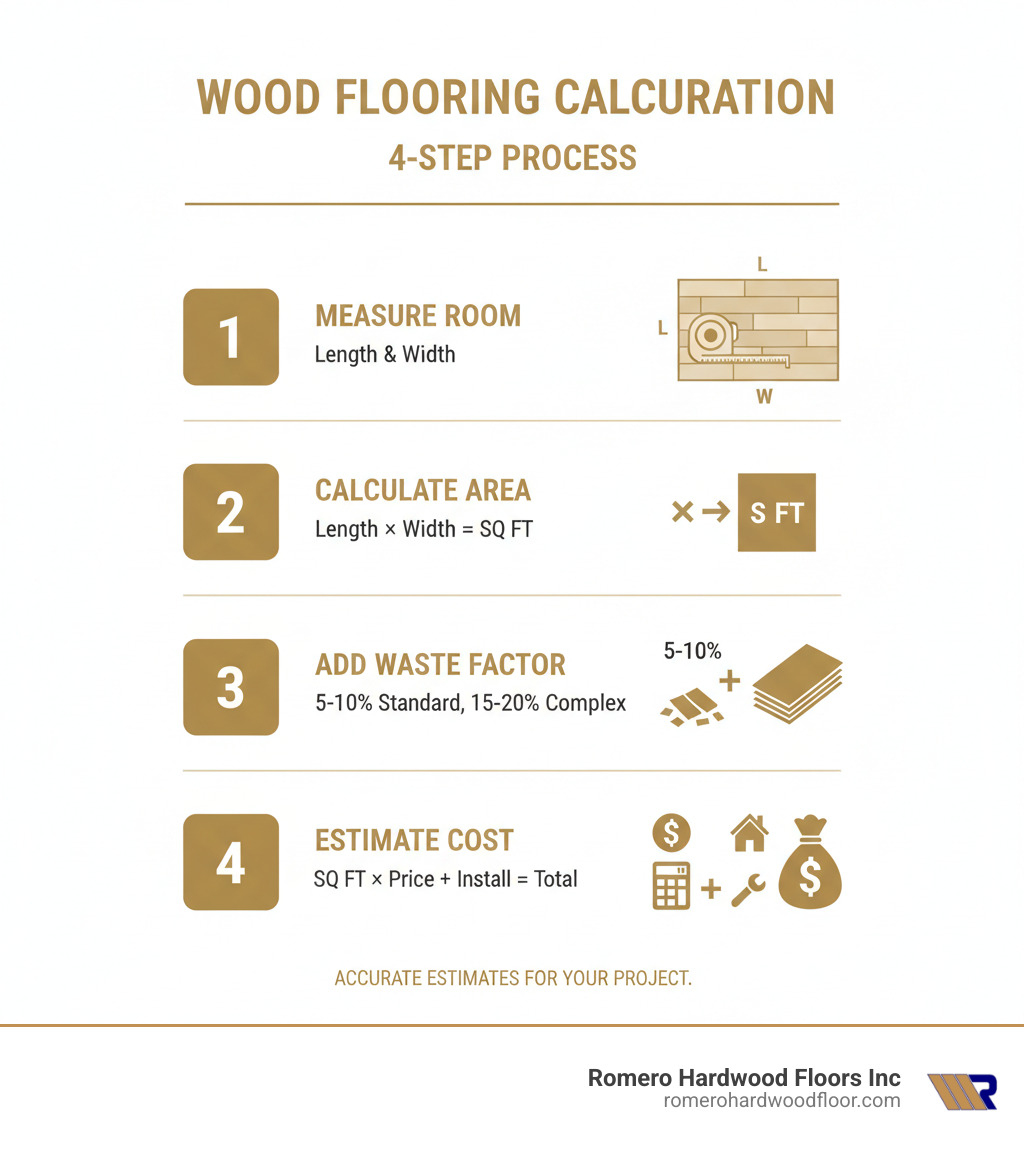
A wood flooring calculator is a crucial tool that determines exactly how much material you need by converting room dimensions into accurate square footage. The basic process is simple:
- Measure your room’s length and width in feet.
- Multiply length × width to get the base square footage.
- Add a waste factor of 5-10% for standard installations or 15-20% for complex patterns.
- Estimate material cost by multiplying the total square footage by the price per square foot.
Planning a hardwood flooring project is exciting, but budgeting can be a challenge. Ordering too little material causes delays and color-matching issues, while ordering too much wastes money. With the average cost to install hardwood in a 340-square-foot room ranging from $2,500 to $7,500, accurate calculations are vital for your budget and timeline.
A wood flooring calculator eliminates the guesswork. It turns your measurements into a precise shopping list, accounting for necessary cuts and waste. This prevents the frustration of running short mid-project and the expense of over-ordering.
I’m Francisco Romero, owner of Romero Hardwood Floors Inc. With over 15 years of experience serving homeowners in Revere, MA, a reliable wood flooring calculator is the first tool I recommend. It helps clients understand their project’s scope and budget before we even schedule a consultation.
How to Accurately Measure Your Space for Flooring
Accurate measurements are the foundation of a successful project and are essential before using a wood flooring calculator. An error here can delay your project and inflate costs. As the old saying goes: measure twice, cut once!
To start, you’ll need a tape measure, a notepad, and a calculator. For complex rooms, sketching the layout on graph paper can be helpful.
Simple Rectangular Rooms
For a standard rectangular room, the process is simple. Measure the length and width of the room from wall to wall. Multiply these two numbers to get your square footage. For example, a room that is 10 feet long and 12 feet wide is 120 square feet (10 × 12 = 120).
Measuring Complex Rooms
Most rooms aren’t perfect rectangles. For L-shaped rooms or spaces with alcoves and closets, the strategy is to divide the complex shape into smaller, manageable rectangles.
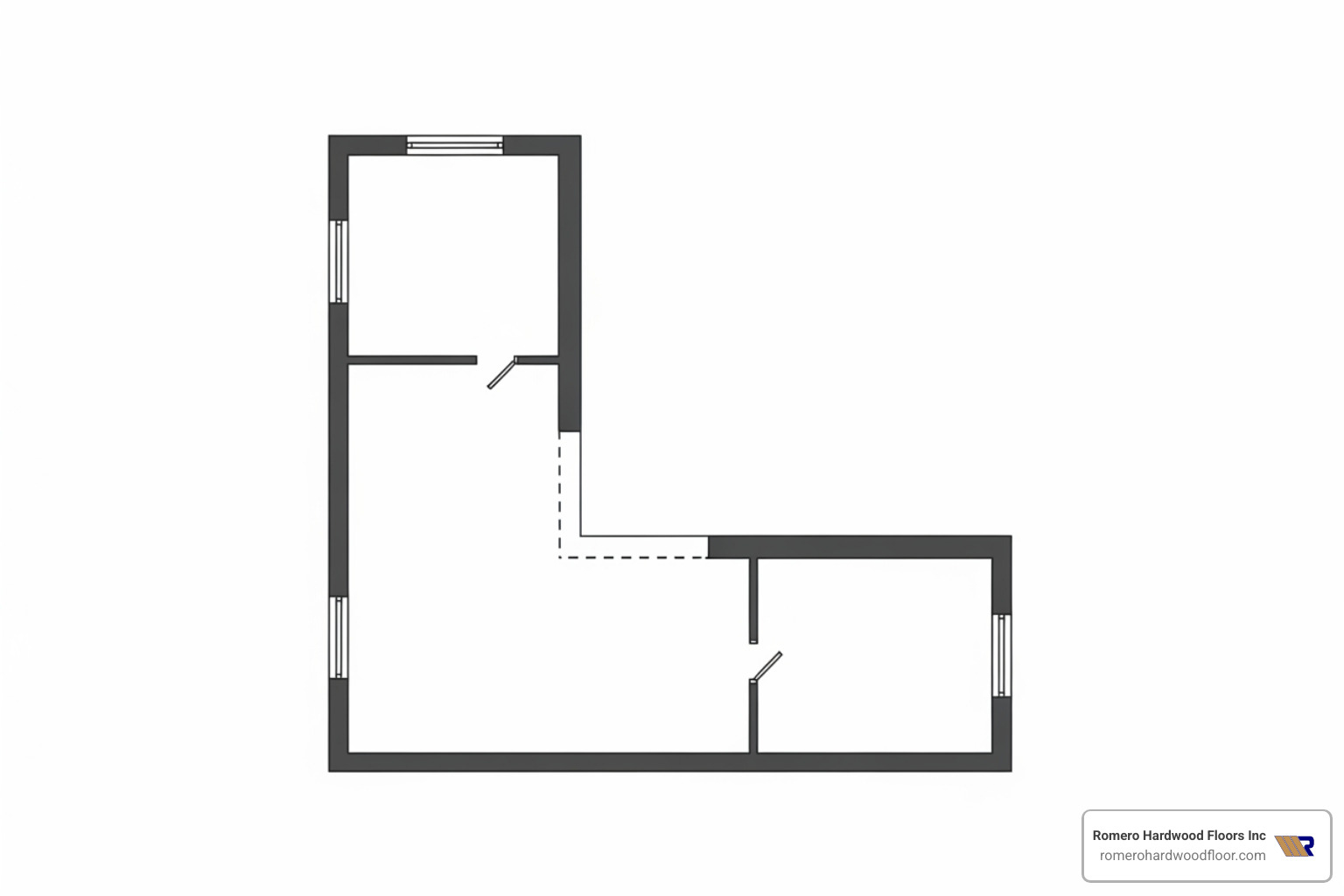
Sketch the room and divide it into separate rectangular sections. Measure the length and width of each section, calculate its individual square footage, and then add all the areas together for your total. Don’t forget to include closets and entryways that will receive new flooring, as these small areas add up.
Key Measurement Tips:
- Double-check everything. A small mistake can throw off your entire material order. Measure every dimension at least twice.
- Round up. When measuring, round any fractions of an inch up to the next whole inch. A wall that is 10 feet, 3.5 inches should be recorded as 10 feet, 4 inches. This provides a small buffer.
To see how these measurements are used in a professional project, learn more on our installation process.
Using a Wood Flooring Calculator: From Square Feet to Materials Needed
Once you have your room’s square footage, the next step is to determine how much flooring to actually buy. You can’t just order the exact amount; you must account for material that will be lost to cuts and fitting. This is known as the “waste factor,” and a wood flooring calculator is the perfect tool to figure it out.
Every flooring installation involves cuts to fit planks along walls, around doorways, and in corners. Sometimes, an installer might make a miscut or need to discard a plank with a natural defect. Ordering exactly 150 square feet for a 150-square-foot room will leave you short, causing delays, extra shipping costs, or worse, color-matching issues with a new batch of flooring.
What is the typical waste percentage for wood flooring?
The industry standard waste factor depends on your installation pattern:
- Standard Straight-Lay: Plan for 5% to 10% waste. This is for layouts where planks run parallel to the walls.
- Complex Patterns: For diagonal, herringbone, or chevron layouts, you’ll need 15% to 20% waste. These designs require numerous angled cuts, creating more unusable offcuts.
Rooms with many angles or architectural features also generate more waste. To calculate your total, multiply your square footage by 1.10 (for 10% waste) or 1.15 (for 15% waste). For example, for a 150 sq ft room with a standard layout, you would order 165 sq ft (150 x 1.10).
How a Wood Flooring Calculator Helps
A wood flooring calculator automates this entire process. You enter your room’s dimensions, and it calculates the square footage. Then, you select your waste percentage, and the tool instantly adds this buffer, giving you a final, reliable number of how much flooring to purchase. It turns a tedious, error-prone task into a simple, 30-second step, preventing both over-ordering and under-ordering.
A pro tip: always buy a little extra beyond your calculated waste. Having a box of leftover planks is a lifesaver for future repairs, ensuring you have a perfect match years down the line.
Ready to try it? Use our wood flooring calculator tool for a preliminary estimate. For a precise assessment custom to your project, you can find more info on getting a professional estimate.
Beyond Square Footage: Factors That Influence Your Flooring Needs and Costs
A wood flooring calculator provides a great material estimate, but your true project cost involves more than just square footage. Several key factors influence both your material needs and final budget.
Installation Patterns and Plank Width
The installation pattern directly impacts your waste factor and labor costs.
- Straight Lay: The most material-efficient pattern (5-10% waste), with planks running parallel to the walls.
- Diagonal Layout: Adds visual interest but increases waste to 10-15% due to angled cuts.
- Herringbone & Chevron: These intricate, high-end patterns are beautiful but require 15-20% waste and more intensive labor, increasing costs.
Plank width also affects the look and cost. Wider planks (5+ inches) create a modern, spacious feel but can be more expensive per square foot. Narrower planks (2-3 inches) offer a traditional look.
Wood Flooring Types
- Solid Hardwood: A single piece of wood, typically 3/4-inch thick. It can be sanded and refinished multiple times, offering incredible longevity. It’s usually nailed down to a plywood subfloor.
- Engineered Hardwood: Made of a real wood veneer over a stable core, it’s more resistant to moisture and temperature changes. This versatility allows installation in basements or over concrete. Learn more about our Engineered hardwood floors.
Material and Labor Cost Estimation
Material costs vary widely by wood species, grade, and type. A calculator can help you budget for this. Simply input the price per square foot to get a material cost estimate.
Important Note: The prices below are national averages from internet data and are not a quote from Romero Hardwood Floors Inc. Costs in the Revere, MA area will vary based on product, market conditions, and project specifics.
| Wood Flooring Type | Average Material Cost (per square foot) |
|---|---|
| Common Hardwoods (Oak, Maple, Ash) | $6 – $18 |
| Premium Hardwoods (Walnut, Hickory, Cherry) | $9 – $27 |
| Exotic Hardwoods (Brazilian Cherry, Tigerwood) | $13 – $30+ |
| Engineered Hardwood (material only) | $3 – $10 |
Labor costs for professional installation typically range from $4 to $8 per square foot. This can vary based on room complexity, installation method (nail-down, glue-down, floating), and any necessary subfloor preparation like leveling or repairs.
Additional Supplies
Don’t forget to budget for essential supplies like underlayment (for moisture protection and sound dampening), trim and molding (to cover expansion gaps), and adhesives or fasteners. These items are crucial for a professional, long-lasting finish.
For a complete breakdown, Learn about the cost to install a hardwood floor. Most calculators don’t include labor or supplies, so think of their output as your material cost, not the total project cost. For more detail, you can See our hardwood flooring cost breakdown. A professional estimate is the only way to get a truly comprehensive quote.
Getting the Most Accurate Estimate: Tips and Limitations
A wood flooring calculator is an invaluable tool for planning, but understanding its strengths and limitations is key to getting an accurate estimate.
Benefits of Using a Calculator
- Budget Accuracy: Get a solid numerical foundation for your project budget, avoiding guesswork.
- Time-Saving: Automate calculations in seconds, freeing you to focus on design choices.
- Prevents Shortages: Accurately factoring in waste helps prevent mid-project delays and material-matching issues.
To get the most from a calculator, ensure your inputs are correct. Double-check all measurements and always round up fractions of an inch to the next whole inch. Most importantly, select the appropriate waste factor for your chosen installation pattern (5-10% for standard, 15-20% for complex).
Calculator Limitations
While powerful, online calculators can’t see your home. They are unaware of:
- Subfloor Condition: They cannot assess if your subfloor needs leveling, repairs, or moisture remediation.
- Regional Price Differences: Calculators often use national averages, which may not reflect local material and labor costs in Revere, MA.
- Complex Scenarios: Unique room shapes, custom inlays, or architectural features require an expert eye.
- Additional Costs: Most calculators only estimate material costs. They don’t include labor, underlayment, trim, adhesives, or subfloor prep work.
This is why a professional on-site assessment is irreplaceable. A wood flooring calculator is perfect for initial planning, but a final, purchase-ready quote requires an experienced professional to evaluate your space.
Our team at Romero Hardwood Floors Inc. has provided comprehensive estimates for homeowners across the greater Revere area since 2006. We serve communities from Beverly to Woburn, assessing your subfloor, discussing design options, and providing a detailed quote that covers all aspects of the job. Ready for a professional assessment? Find a professional hard wood floor contractor and let’s create a plan for your dream floors.
Frequently Asked Questions about Wood Flooring Calculators
How much extra wood flooring should I buy for waste?
This depends on the installation pattern. For a standard, straight-lay installation, a 5-10% waste factor is recommended. This covers cuts and minor imperfections. For more complex patterns like herringbone, chevron, or diagonal layouts, you should increase the waste factor to 15-20% due to the numerous angled cuts required. It’s always wise to keep a few extra planks for any future repairs.
Can a flooring calculator handle complex room shapes?
Yes. The key to measuring a complex room (like an L-shape or one with alcoves) is to break it down into smaller, individual rectangles. Measure the length and width of each rectangle, calculate its square footage, and then add all the areas together to get your total. Input this total square footage into the calculator.
How accurate are online wood flooring calculators?
Online wood flooring calculators are perfectly accurate at doing the math, but their final output is only as accurate as the measurements you provide. A small measurement error will lead to an incorrect material estimate. These tools are excellent for initial budgeting and getting a ballpark figure for material needs. However, they cannot account for subfloor conditions, regional price differences, or labor costs. For a final, all-inclusive quote, a professional on-site measurement is always recommended.
Use our own cost calculator for a preliminary estimate to get started, and contact us when you’re ready for a comprehensive assessment.
Your Next Step to Perfect Hardwood Floors
You now have the knowledge to plan your flooring project with confidence. By accurately measuring your space, using a wood flooring calculator, and understanding the importance of the waste factor, you’re well on your way. Remember to budget not just for materials, but for labor, subfloor prep, and supplies.
A calculator is an excellent first step for a preliminary estimate, but it can’t see the unique conditions of your home, like an uneven subfloor or a complex layout. That’s where professional expertise becomes essential.
For a precise, all-inclusive assessment and guaranteed workmanship in the Revere, MA area, trust the experts at Romero Hardwood Floors Inc. Since 2006, we have served communities throughout the region, including Beverly, Danvers, Marblehead, Melrose, Salem, and Winchester. We pride ourselves on competitive pricing, punctuality, and creating beautiful, long-lasting floors.
Ready to move from calculation to installation? Request an Estimate today to get started, and let our team bring your hardwood flooring vision to life.
Like us on Facebook!
