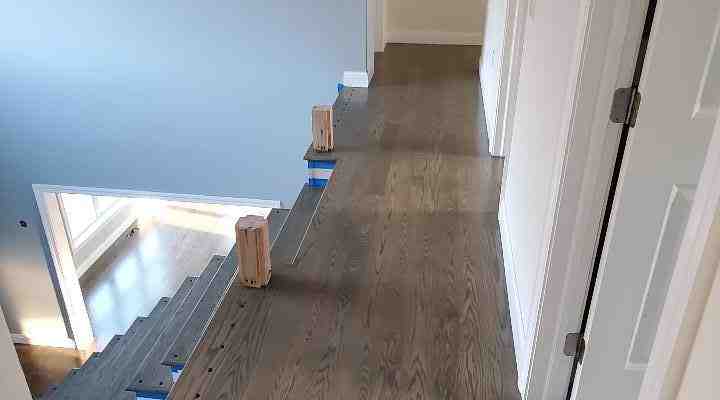
Why Hardwood Floor Installation on Concrete Requires Careful Planning
Hardwood floor installation concrete projects demand precision, patience, and the right techniques to achieve lasting results. Unlike traditional wood subfloors, concrete slabs present unique challenges—from moisture management to adhesive selection—that can make or break your flooring investment.
Quick Answer: Installing Hardwood Floors on Concrete
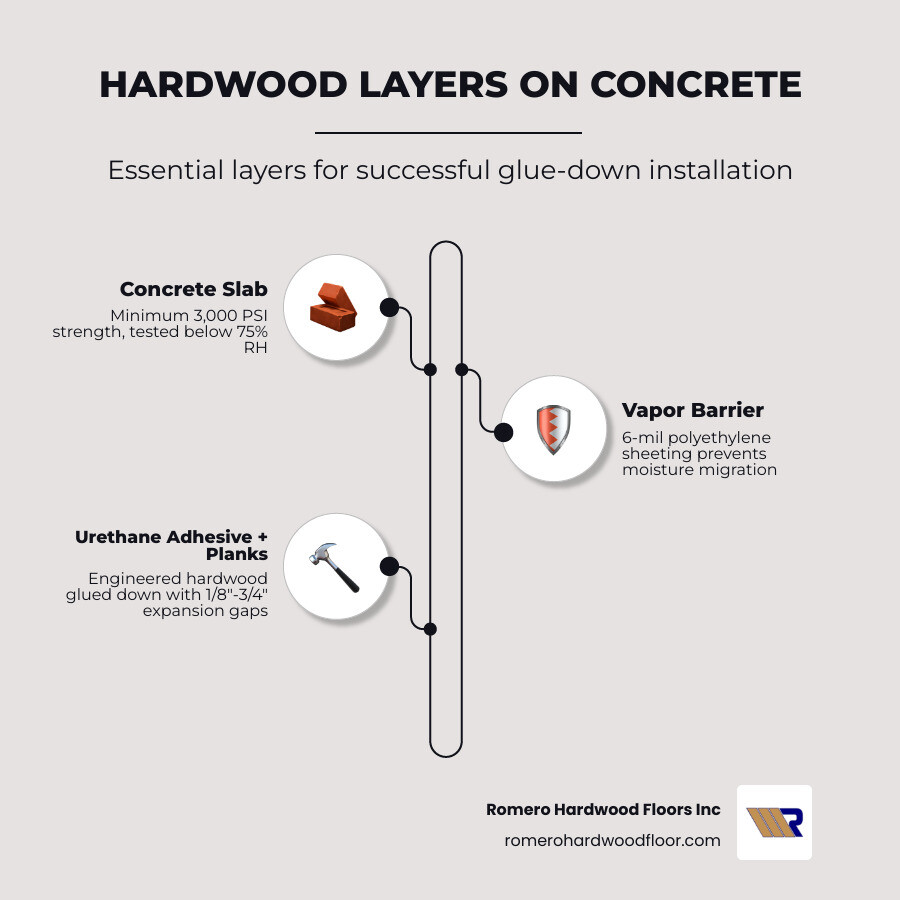
- Best option: Engineered hardwood with glue-down method (most stable)
- Solid hardwood: Possible on-grade or above-grade only, never below-grade
- Critical first step: Moisture testing (concrete must be below 75% RH or 3 lbs/1000 sq ft/24 hrs)
- Required prep: Vapor barrier, flat surface (1/8″ in 6 feet), minimum 3,000 PSI concrete strength
- Acclimation time: 48 hours minimum in installation environment
- Expansion gaps: 1/8″ to 3/4″ around all perimeters
The research is clear: moisture is the number one enemy of hardwood floors over concrete. Concrete naturally absorbs and releases moisture from the ground below, which can cause cupping, warping, and adhesive failure if not properly addressed. That’s why professional-grade moisture testing isn’t optional—it’s essential before any installation begins.
You’ll also need to decide between engineered and solid hardwood. Engineered wood’s multi-layer construction resists humidity changes better than solid planks, making it the preferred choice for basements and ground-level installations. Solid hardwood can work beautifully on upper floors or on-grade slabs, but only when moisture levels are strictly controlled.
The installation method matters too. Glue-down installations create a permanent bond and work well in commercial spaces, while floating floors over a moisture barrier offer easier DIY options for some engineered products. Each approach has specific requirements for adhesives, vapor barriers, and subfloor preparation.
I’m Francisco Romero, owner of Romero Hardwood Floors Inc., and over the past 15+ years I’ve completed countless hardwood floor installation concrete projects across Revere and surrounding Massachusetts communities. My team and I have seen how proper preparation and technique make the difference between floors that last decades and those that fail within months.
Learn more about hardwood floor installation concrete:
- best way to install engineered hardwood flooring on concrete slab
- gluing solid hardwood floors to concrete
- hardwood flooring over radiant heated concrete
Understanding Hardwood Floor Installation on Concrete
When we talk about hardwood-floor-installation-concrete, we are essentially discussing the marriage of two very different materials. Concrete is porous, cold, and holds moisture; wood is organic, reactive, and expands or contracts with the weather. To make them live together in harmony, we have to use specific methods.
The two most common professional methods are the direct-glue method and floating floors. In a glue-down setup, we use high-quality wood adhesives to bond the planks directly to the slab. This provides a solid, “real” feel underfoot that many homeowners in places like Marblehead and Winthrop prefer. Alternatively, floating-wood-floor-over-concrete involves clicking planks together over a padded underlayment, allowing the floor to move as a single unit.
Historically, some installers used “sleepers”—2×4 lumber nailed to the concrete to provide a nailing surface. However, we generally advise against this today. Sleepers take up too much vertical space, can warp if moisture gets trapped, and are often more expensive than modern glue-down or floating solutions.
Key Differences: Solid vs. Engineered Wood
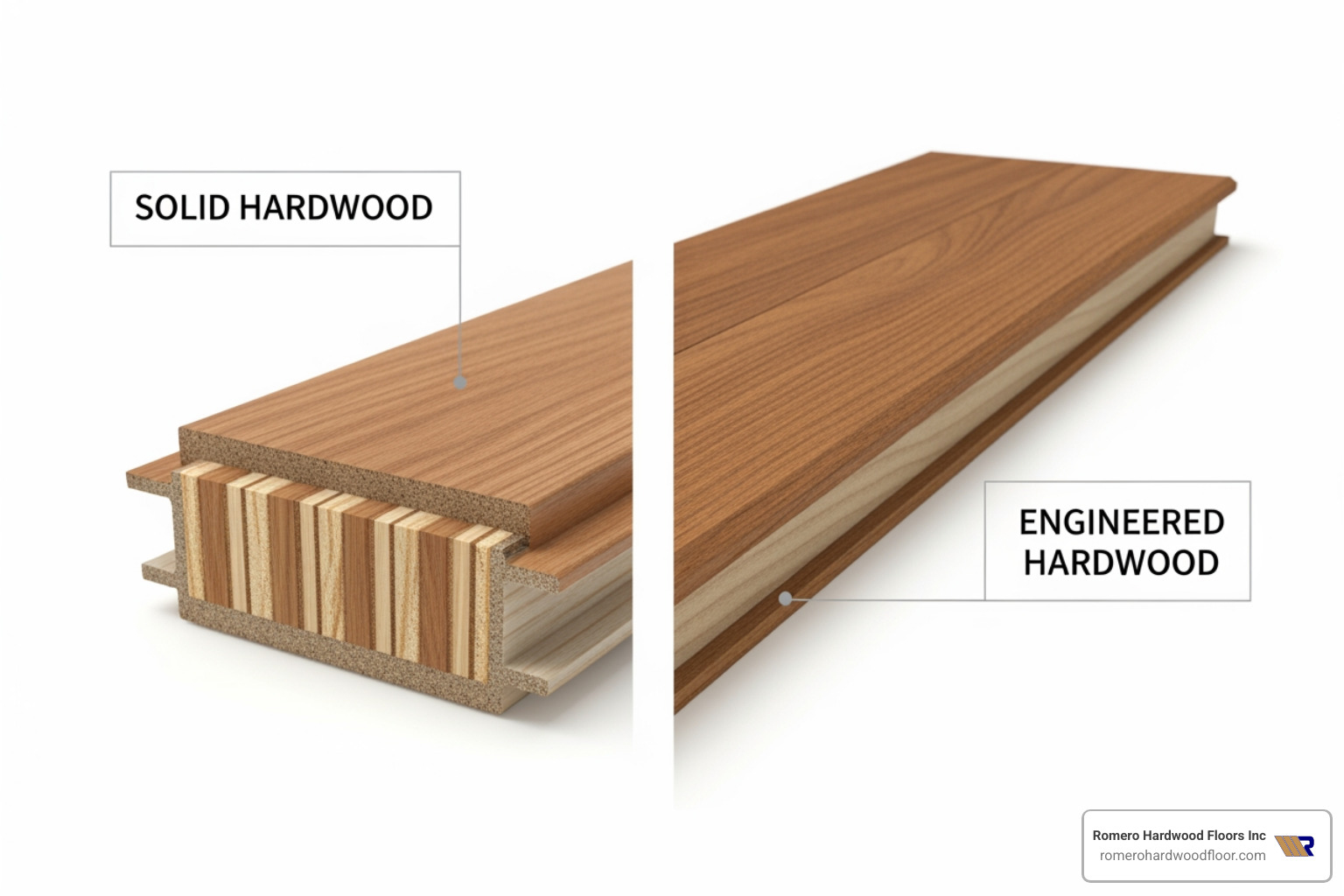
Choosing the right material is half the battle. Engineered-hardwood-over-concrete is the industry standard for a reason. Because it is made of cross-layered wood veneers, it has incredible dimensional stability. It won’t expand or contract nearly as much as solid wood when the humidity spikes during a Massachusetts summer.
Solid hardwood, on the other hand, is a single piece of wood. While it can be sanded more times over its life, it is much more “temperamental.” If you are set on solid wood, you must ensure the concrete is perfectly dry and stay on top of your home’s humidity levels. You can learn more about the specifics in this guide on How To: Install Engineered Hardwood Flooring on Concrete.
| Feature | Solid Hardwood | Engineered Hardwood |
|---|---|---|
| Stability | Lower (reacts to moisture) | High (cross-grain layers) |
| Install Method | Glue-down (tricky) or Sleeper | Glue-down, Floating, or Click |
| Below-Grade | Not recommended | Highly recommended |
| Refinishing | Multiple times | 1-3 times (depending on wear layer) |
| Cost | Often higher for labor | Varies, but often faster install |
Grade Levels and Concrete Slabs
Where the concrete sits in relation to the ground (the “grade”) dictates what you can install.
- Above-grade: Any floor above ground level. These are the safest for solid wood.
- On-grade: Ground level. Solid-hardwood-on-concrete-slab is possible here with a heavy-duty vapor barrier.
- Below-grade: Basements. Because basements are prone to hydrostatic pressure (water pushing through the slab), we almost exclusively recommend engineered wood or luxury vinyl here. Hardwood-floor-on-a-slab in a basement requires the most rigorous moisture mitigation.
Essential Subfloor Preparation and Moisture Testing
Before we even open a box of flooring, the concrete must be vetted. At Romero Hardwood Floors Inc., we follow National Wood Flooring Association (NWFA) standards, which state that concrete must be at least 3,000 PSI in strength and completely free of contaminants like oil, wax, or old adhesive.
If you are dealing with a new pour, remember this: concrete must cure for a minimum of 30 days before we even begin testing, and most slabs are still too wet for flooring until they are 60 days old. You can find more details on installing-hardwood-floors-on-concrete-slab requirements here.
Critical Moisture Testing Methods
We don’t guess; we test. There are three primary ways to test your slab for excess moisture:
- Calcium Chloride Test (ASTM F-1869): This measures how much moisture is escaping the surface. The limit is usually 3 lbs per 1,000 sq ft over 24 hours. If it’s between 3 and 7 lbs, we must use a vapor retarder.
- Relative Humidity (RH) Probe (ASTM F-2170): This involves drilling small holes into the slab to test the moisture deep inside. The reading should not exceed 75%.
- Calcium Carbide (CM) Method: A more technical chemical test. Readings over 2.5% require mitigation.
If the levels are too high, we look into using a moisture mitigation system like a specialized epoxy primer that seals the slab.
Achieving Subfloor Flatness
A floor that isn’t flat will squeak, “bounce,” or eventually break at the joints. Our tolerance for how-to-install-hardwood-flooring-on-concrete-slab is strict: the slab must be flat within 1/8” over a 6-foot radius or 3/16” over 10 feet.
To fix an uneven slab, we use a concrete grinder to take down high spots (following OSHA silica dust rules, of course!) and fill low spots with a cementitious self-leveling compound. This ensures the hardwood-floor-installation-concrete has a perfect foundation.
The Step-by-Step Process for Hardwood Floor Installation Concrete
Once the slab is dry, clean, and flat, the real fun begins. Whether you are in Saugus or Somerville, the process remains the same to ensure a lifetime of beauty. You can see a detailed breakdown on how-to-install-hardwood-floors-on-concrete.
For floating floors, we start by laying down a 6-mil polyethylene vapor barrier, overlapping the seams by at least 6 inches and taping them. For gluing-solid-hardwood-floors-to-concrete, we apply the adhesive directly to the prepared slab.
Acclimation and Layout Planning for Hardwood Floor Installation Concrete
Wood needs to “get used” to your home. We recommend acclimating the planks for at least 48 to 72 hours in the room where they will be installed. The HVAC should be running at normal living conditions (typically 35–65% relative humidity and 60–80°F).
When planning the layout, we snap chalk lines to ensure the floor stays straight. One of the most common mistakes is forgetting expansion gaps. We leave 1/8” to 3/4” (depending on the wood type) around the entire perimeter to allow the wood to breathe. You can find more layout tips in this guide on the best-way-to-install-engineered-hardwood-flooring-on-concrete-slab.
Adhesive Selection and Application
When installing-engineered-hardwood-on-concrete, the glue is the only thing holding your investment in place. We only use high-quality urethane or acrylic adhesives.
Products like Bostik Pro-Cure or East Bay Clipper are excellent choices because they remain flexible after curing. We use a specific notched trowel to ensure 100% adhesive transfer. After laying a section, we often use a 100-pound roller to press the wood into the glue, ensuring there are no hollow spots.
Advanced Considerations: Radiant Heat and Costs
Many modern homes in areas like Winchester and Stoneham feature radiant heating. Can you put hardwood over it? Yes, but with caveats.
Hardwood Floor Installation Concrete with Radiant Heating
Engineered wood is the king of heated-hardwood-floors-on-concrete. Because it’s so stable, it handles the temperature fluctuations well. If you choose solid wood, it must be a species known for stability (like White Oak) and should ideally be installed using a sleeper system or specialized heat-rated adhesives.
Always check your specific manufacturer’s manual, as exceeding a surface temperature of 85°F can dry out the wood and cause cracking. You can read more about hardwood-flooring-over-radiant-heated-concrete here.
Estimated Costs and Budgeting
Budgeting is the “not-as-fun” part, but as we say, some of us DO love our spreadsheets. When looking at costs, these are average estimates based on internet data and not actual quotes for Romero Hardwood Floors Inc.
- Materials: $3 to $15+ per square foot.
- Labor & Prep: $2 to $10 per square foot (depending on how much leveling and moisture mitigation is needed).
- Total Range: $5 to $25+ per square foot.
Always factor in a 10% waste margin for cuts and mistakes. If you buy “bargain-bin” wood, that waste can jump to 25% because of short boards and defects!
Frequently Asked Questions about Hardwood on Concrete
Can you install solid hardwood directly on concrete?
Yes, but only on-grade or above-grade, and only if the moisture levels are very low. It requires a high-quality moisture-barrier adhesive. We generally recommend engineered wood for a more “worry-free” experience on concrete.
What is the best vapor barrier for concrete slabs?
For floating floors, a 6-mil polyethylene film is the standard. For glue-down floors, the “vapor barrier” is usually built into the high-end urethane adhesive or applied as a liquid epoxy primer before gluing.
How long should concrete cure before installing wood floors?
At a bare minimum, 30 days for testing, but 60 days is much safer. Even then, the moisture tests (RH or Calcium Chloride) are the final authority, not the calendar.
Conclusion
At Romero Hardwood Floors Inc., we believe that every home in the Greater Boston area—from the historic streets of Salem to the modern builds in Revere—deserves beautiful, durable floors. Hardwood floor installation concrete may be complex, but with our expert craftsmanship and punctuality, we make the process seamless.
Whether you are looking for residential warmth or a durable commercial solution, we guarantee our workmanship. If you’re ready to transform your space, we’re here to help.