
Bamboo Flooring Installation: 7 Powerful Steps for Success 2025
Everything You Need to Know About Bamboo Flooring Installation
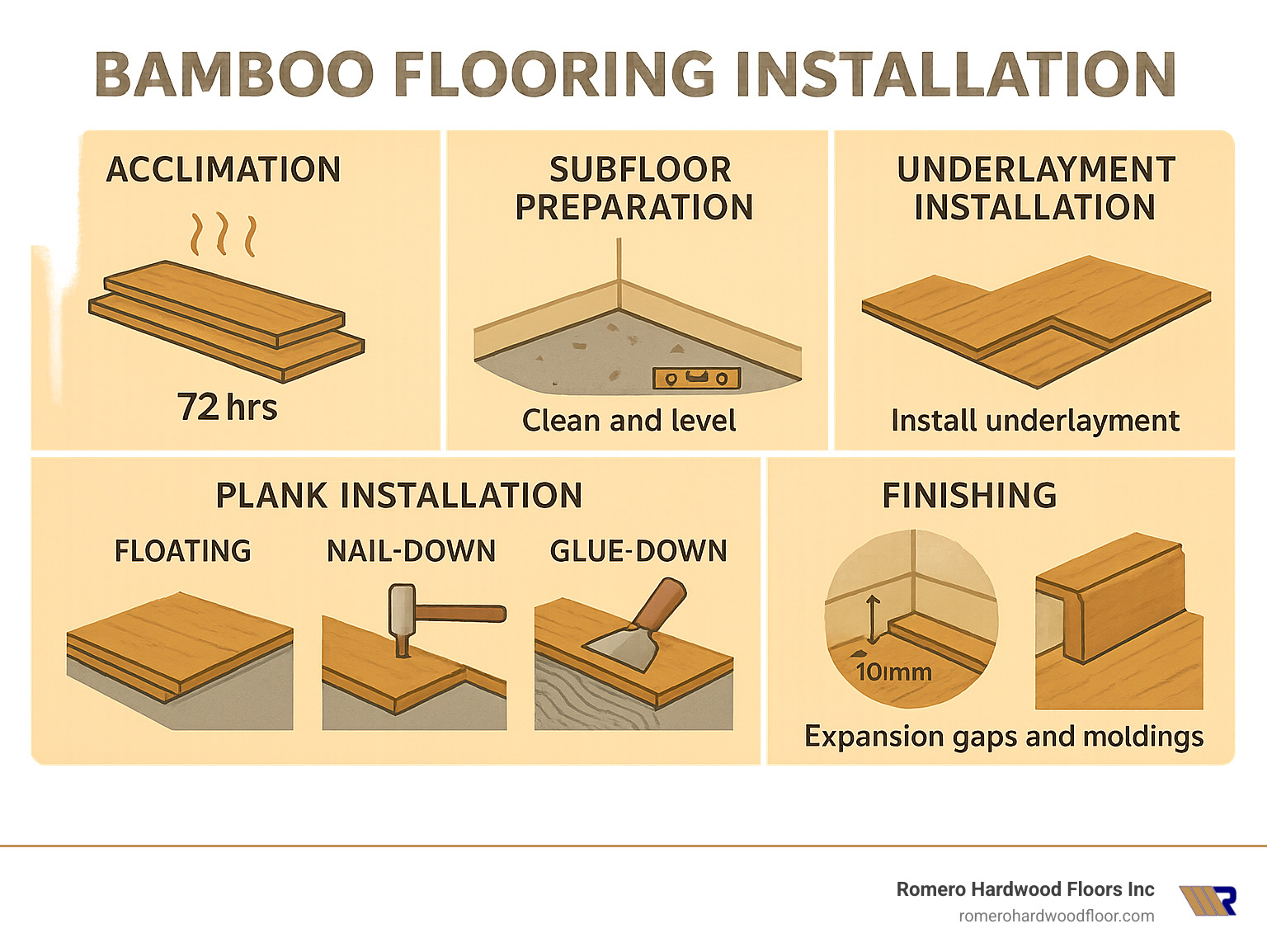
Bamboo flooring installation is a straightforward process that follows these basic steps:
- Acclimate the bamboo for at least 72 hours in the installation room
- Prepare the subfloor – ensure it’s clean, dry, and level (within 3/16″ over 10 ft)
- Choose your installation method:
- Floating (click-lock) – fastest for DIY
- Nail-down – most economical, requires special nailer
- Glue-down – best for concrete subfloors
- Leave a 10mm expansion gap around the perimeter
- Install underlayment appropriate for your subfloor type
- Install planks following manufacturer guidelines
- Finish with moldings and transitions
Bamboo flooring installation combines the beauty of traditional hardwood with superior durability and eco-friendly benefits. With a Janka hardness rating of up to 5000 for strand-woven varieties, bamboo offers exceptional resistance to dents and scratches while being harvested from a rapidly renewable resource that matures in just 5 years.
I’m Francisco Romero, owner of Romero Hardwood Floors Inc., with over 15 years of experience specializing in premium bamboo flooring installation and other sustainable flooring solutions for homes and businesses throughout Revere, MA.
Quick Bamboo flooring installation terms:
– Eco-Friendly Hardwood Flooring
– sustainable wood flooring
– eco friendly hardwood floor cleaner
Understanding Bamboo Flooring Options
Bamboo flooring has gained tremendous popularity as homeowners seek sustainable alternatives to traditional hardwood. Before diving into the bamboo flooring installation process, it’s important to understand the different types available.
Types of Bamboo Flooring
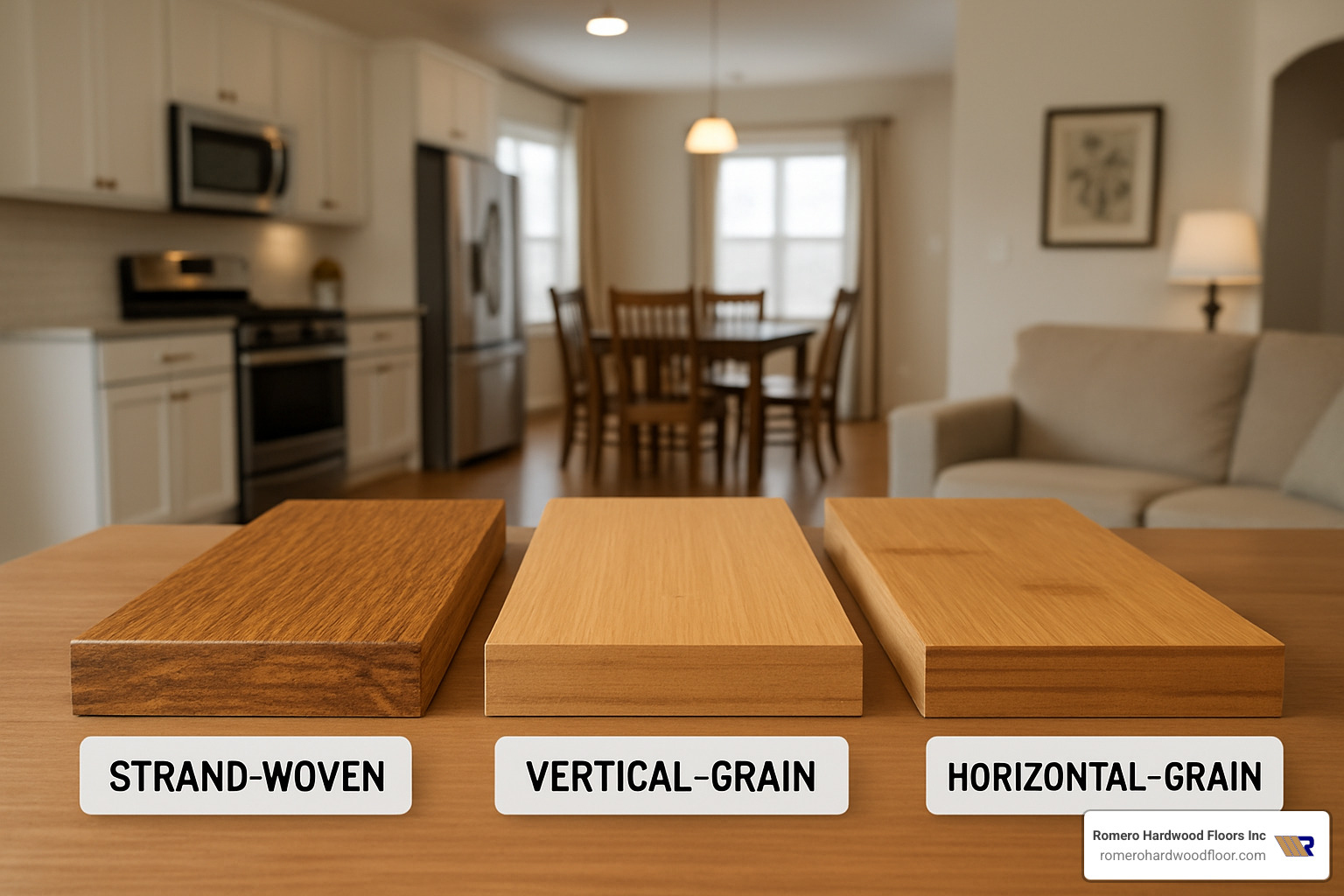
The strongest option is strand-woven bamboo, which rates around 5000 on the Janka hardness scale—twice as hard as oak! These are created by compressing bamboo fibers with resin under high pressure.
Vertical-grain bamboo offers a more linear look with moderate hardness, while horizontal-grain bamboo features wider, more visible grain patterns as bamboo strips are laid flat before being pressed together.
In homes with humidity fluctuations or radiant heating, engineered bamboo is recommended. It features a bamboo veneer over a plywood or high-density fiberboard core, offering excellent stability.
Solid bamboo with traditional all-bamboo construction comes in tongue-and-groove profiles perfect for nail-down or glue-down installation methods.
| Feature | Bamboo Flooring | Oak Flooring |
|---|---|---|
| Janka Hardness | 1,380-5,000 | 1,290-1,360 |
| Renewable | 5-7 years | 40-60 years |
| Cost | $2-$8 per sq ft | $3-$10 per sq ft |
| Moisture Resistance | Good to Excellent | Moderate |
| Refinishable | 1-2 times (solid) | 3-5 times |
| Installation Methods | Floating, Nail, Glue | Nail, Glue |
| Eco-Friendly Rating | High | Moderate |
Why Choose Bamboo Over Hardwood?
The environmental benefits are remarkable. Bamboo reaches maturity in just 5 years, compared to 40-60 years for most hardwood trees, giving it a significantly lower carbon footprint.
Bamboo generally costs between $2-$8 per square foot for materials, with premium options reaching up to $24 per square foot. (Note: These are average market prices and not specific to Romero Hardwood Floors Inc.)
Durability is another major selling point. Strand-woven bamboo is twice as hard as oak, making it exceptionally resistant to dents and scratches. Many homeowners also love bamboo’s clean, contemporary look that complements various interior design styles and can improve home resale value.
The Right Bamboo for Your Project
For high-traffic areas like entryways or kitchens, strand-woven bamboo is recommended. Its exceptional hardness stands up to pets, kids, and heavy furniture.
In moisture-prone areas like bathrooms or basements, engineered bamboo provides better dimensional stability when humidity fluctuates.
If you have radiant heating systems, choose engineered bamboo specifically rated for radiant heat. Thinner profiles (under 1/2″) conduct heat more efficiently.
For DIY enthusiasts, click-lock floating systems are ideal. They snap together without glue or nails, making installation more approachable for beginners.
For more information on sustainable flooring options, visit our guide on Most Eco-Friendly Wood Flooring.
Pre-Installation Essentials for Bamboo Flooring Installation
The secret to a stunning, long-lasting bamboo floor starts with proper preparation. These preliminary steps are the foundation of a floor you’ll love for years to come.
Acclimation: The Critical First Step
Let your bamboo rest in the installation room for at least 72 hours. In New England’s climate, a full week is often recommended. Maintain room temperature between 60-70°F and humidity between 40-60%.
Cross-stack the unopened boxes to allow air circulation. This helps the bamboo adjust gradually to your home’s unique conditions. When bamboo isn’t properly acclimated, it can warp, buckle or develop gaps after installation.
Subfloor Requirements
Your subfloor needs to be in excellent condition before any bamboo flooring installation begins:
Flatness is non-negotiable—check for a maximum variance of 3⁄16″ over a 10-foot radius. Any high spots need sanding, and low spots need filling.
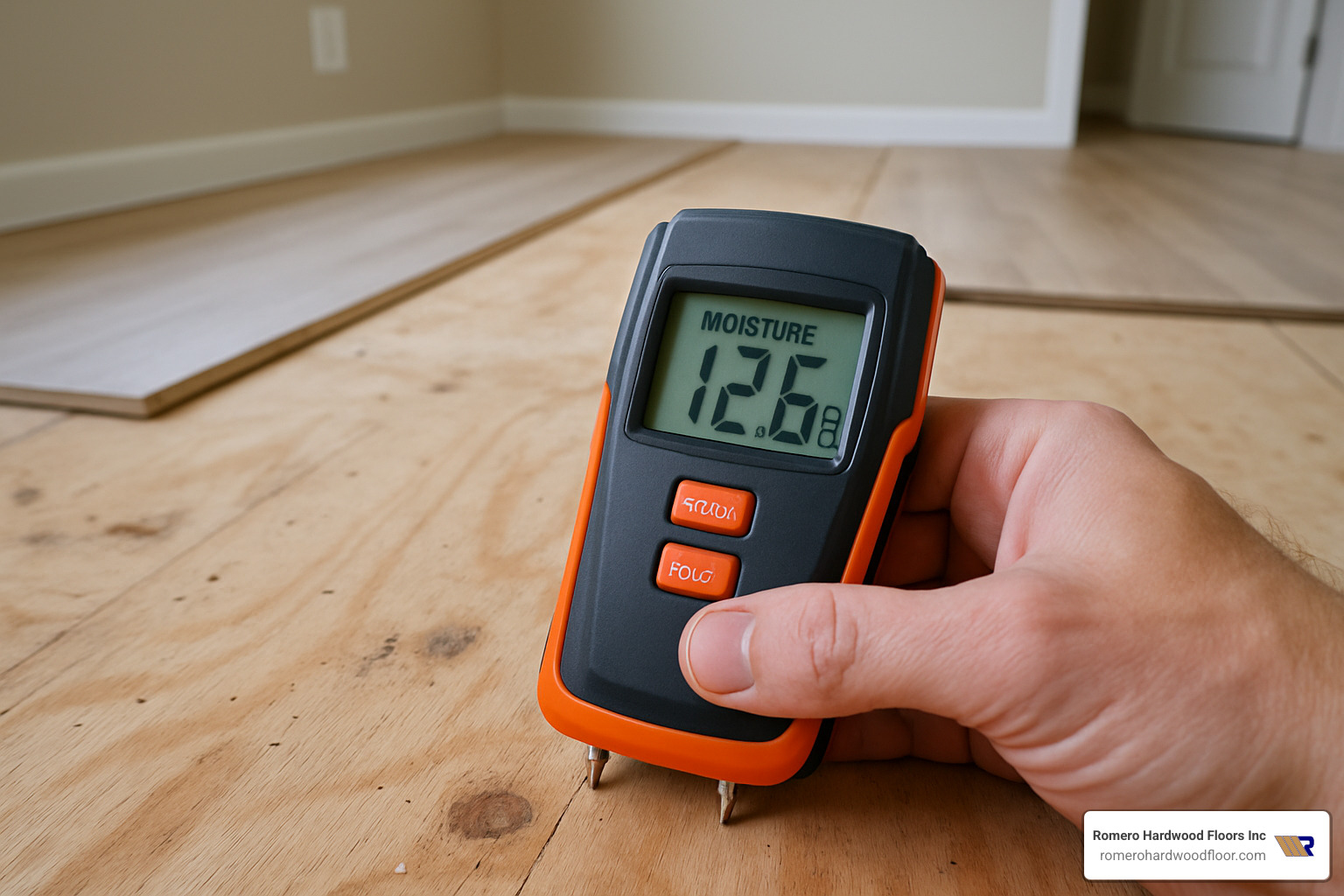
Dryness is crucial. Wood subfloors should have moisture content below 12%, while concrete must test below 6%. Always use a quality moisture meter to test both your subfloor and bamboo flooring.
The subfloor must also be clean and structurally sound (no squeaks or loose areas).
For scientific insights on proper moisture testing, this research video offers excellent guidance.
Preparing Different Subfloors
For concrete slabs, ensure they’re fully cured (at least 60 days old). Fill any cracks with patching compound and apply self-leveler if needed. Always install a vapor barrier for floating installations, or use moisture-resistant adhesive for glue-downs.
With plywood or OSB, check that sheets are securely fastened to joists. Add extra screws to eliminate squeaks. Sand down high spots, fill low areas, and verify you have at least 5/8″ thickness for joists 16″ on center.
For installations over floor joists, your bamboo planks need to be at least 18 mm thick with tongue-and-groove profiles. Joists must be level and structurally sound, with maximum spacing of 16″ on center.
For more comprehensive guidance, our Hardwood Floor Installation Guide covers these topics in greater detail.
Order the Right Amount
Always order 7-10% more flooring than your measured square footage to account for cutting waste, potential damage during installation, and future repairs. For diagonal installations, increase to 15% extra.
Tools & Materials Checklist
For any installation method, you’ll need measuring tools (tape measure, chalk line, carpenter’s square), cutting tools (utility knife, jamb saw, miter or circular saw with fine-tooth blade), and installation aids (pry bar, pull bar, tapping block, spacers, and a dead-blow hammer).
For floating installation, add a 3-in-1 underlayment that handles moisture barrier, cushioning, and sound dampening.
For nail-down installation, invest in an 18-gauge pneumatic flooring nailer, an air compressor (90-120 PSI), 15 lb roofing felt underlayment, and appropriate flooring nails or cleats.
For glue-down installation, you’ll need urethane-based wood flooring adhesive, the appropriate trowel, adhesive remover wipes, a 150 lb roller, and painter’s tape to secure planks during drying.
Bamboo Flooring Installation Methods Explained
Now that you’ve prepared your space and gathered your materials, let’s explore the three main ways to install your bamboo floors – each with its own advantages depending on your situation.
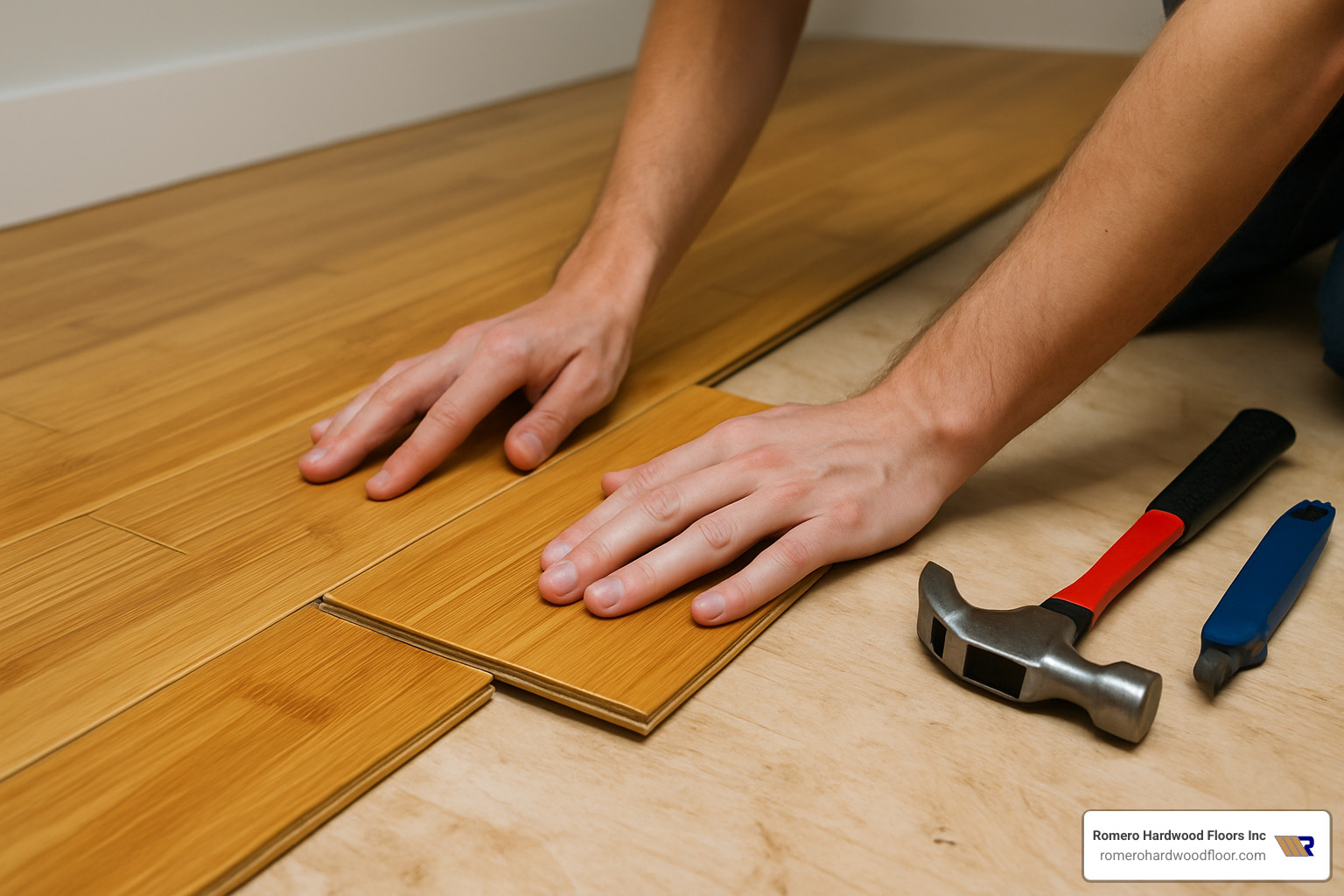
Before we jump into the specifics, there are a few universal steps that apply to all installation methods:
- Plan your layout carefully. Your bamboo planks should run parallel to the longest wall or perpendicular to floor joists.
- Stagger the end joints between adjacent rows by at least 6-8 inches.
- Mix planks from 4-6 different boxes as you work for a natural look with consistent color variation.
- Remove existing baseboards and undercut door casings to allow your new flooring to slide underneath.
Floating (Click-Lock) Bamboo Flooring Installation
The floating installation method is ideal for DIY enthusiasts with engineered bamboo featuring click-lock profiles.
Start by rolling out your 3-in-1 underlayment with the moisture barrier facing down. Tape the seams properly to create a continuous barrier.
Maintain a 10mm expansion gap along all walls using plastic spacers. This gap allows your bamboo to naturally expand and contract with seasonal changes.
Place your first plank with the groove facing the wall. For each subsequent plank, insert the end tongue into the groove of the previous plank at a slight angle, then lay it flat. Continue this pattern to complete your first row.
When starting the second row, use the cut piece from the first row (if it’s at least 8 inches long) to create a natural staggered pattern while reducing waste.
Floating floors shouldn’t extend more than 45 feet in any direction without an expansion break, and they require a very flat subfloor (maximum 3/16″ variance per 10 feet).
Nail-Down Bamboo Flooring Installation
The nail-down method creates an exceptionally stable floor and is ideal for installing solid bamboo over wood subfloors.
Begin by covering your wood subfloor with 15 lb roofing felt or your manufacturer’s recommended underlayment. Overlap seams by 4-6 inches.
Face-nail the first row along your chalk line – these nails will be hidden by baseboards later. For the second and third rows, pre-drill and blind nail at a 45° angle through the tongue.
Once you have enough clearance (usually by the fourth row), switch to an 18-gauge pneumatic flooring nailer with L-cleats. Position it against the tongue at a 45° angle, give it a tap, and the nail secures your plank.
Place nails every 6-8 inches along each plank, and within 2-3 inches of the ends. Every plank should have at least two nails for adequate anchoring.
As you approach the far wall, you’ll eventually run out of space for the pneumatic nailer. At this point, switch back to pre-drilling and blind nailing by hand.
Glue-Down Bamboo Flooring Installation
The glue-down method is ideal for concrete subfloors and provides exceptional stability. It’s also perfect when installing bamboo over radiant heat systems.
Select a urethane-based wood flooring adhesive appropriate for your subfloor. For concrete, a vapor-lock adhesive serves as a moisture barrier.
Work in manageable sections, spreading adhesive in a 2-3 foot section using the manufacturer-recommended trowel. Only spread as much as you can cover in 30-45 minutes.
Place your first row along the chalk line, pressing firmly into the adhesive. Secure every few rows with painter’s tape to prevent shifting while the adhesive sets.
Use a 150 lb roller every 50-100 square feet to ensure proper adhesive transfer and eliminate air pockets. Immediately remove any adhesive that gets on the surface using the manufacturer’s recommended cleaning wipes.
For more detailed information about engineered options, check out our Engineered Hardwood Floors page.
Finishing Touches, Protection & Maintenance
Once you’ve completed your bamboo flooring installation, it’s time for those final details that transform your project from “almost done” to “absolutely perfect.”
Completing the Installation
Remove all spacers and reinstall your baseboards or add new ones to cover the expansion gaps. Remember to attach these to the wall—not the floor—so your bamboo can naturally expand and contract.
Quarter-round moldings provide that extra touch of polish while ensuring complete coverage of expansion gaps. For doorways and transitions to different flooring materials, install transition strips to protect vulnerable bamboo edges.
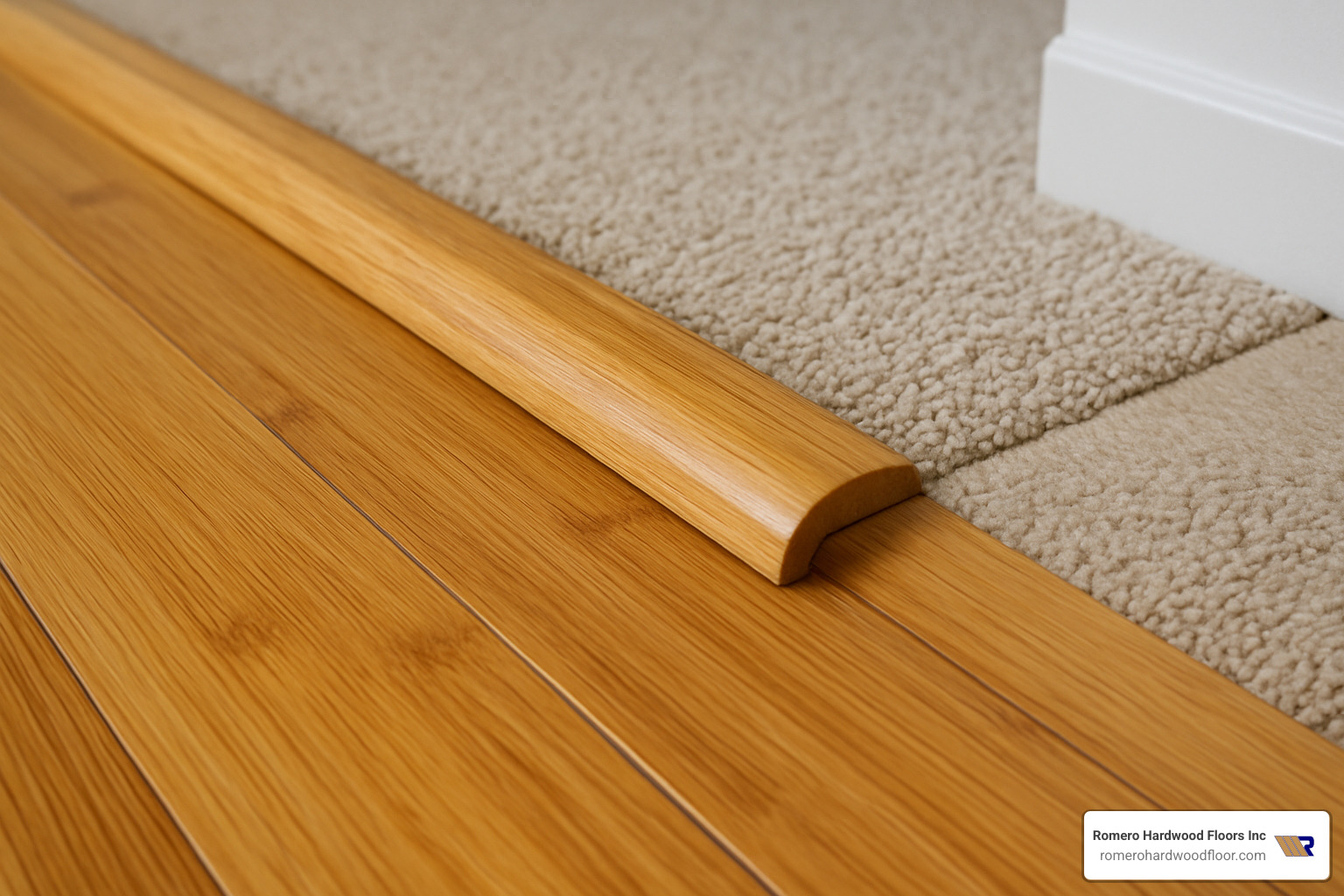
Don’t forget door stops to prevent doors from scratching your floor. Finally, give everything a thorough cleaning with a manufacturer-approved product.
Protecting Your New Floor During Other Renovations
If your bamboo flooring installation is part of a larger renovation, take special precautions. Ideally, schedule your bamboo installation toward the end of your renovation timeline.
When that’s not possible, use breathable floor protection products that shield your bamboo without trapping moisture. Never tape directly to the bamboo surface—adhesives can damage the finish.
Storing Leftover Planks
Store extra planks in a climate-controlled indoor location. Stack them flat with proper support to prevent warping, and label the box with all important details: manufacturer, product name, color, and purchase date.
For more guidance on proper installation techniques, check out our Wooden Floor Installation page.
Caring for Your New Bamboo Floor
Weekly sweeping or vacuuming with a soft brush attachment removes grit and dirt that can scratch your floor. Wipe up spills immediately to prevent staining and water damage. Use felt pads under furniture legs to prevent scratches.
For deeper cleaning, use a barely damp mop with a pH-neutral cleaner specifically formulated for bamboo or hardwood floors. Maintain humidity between 40-60% for optimal floor performance.
Avoid steam mops, vinegar, ammonia, harsh chemicals, wax-based cleaners, and excessive water.
For more detailed guidance on maintaining sustainable flooring, visit our Sustainable Wood Flooring page.
When to Call in a Pro
While many homeowners successfully tackle DIY bamboo flooring installation, some situations call for professional expertise. Complex patterns like herringbone or parquet, rooms with irregular shapes, or substantial subfloor repair needs might warrant professional help.
Many manufacturers require professional installation to maintain warranty protection. Professionals can often complete in days what might take a DIYer weeks, and they have the proper tools and know-how to handle unexpected challenges.
Professional bamboo flooring installation typically costs between $3-$5 per square foot for basic installation, though complex patterns or extensive subfloor preparation can increase costs to $7-$15 per square foot. (Note: These are average market prices based on internet data and not specific to Romero Hardwood Floors Inc.)
Frequently Asked Questions about Bamboo Flooring Installation
What expansion gap is best and why?
Always maintain a minimum 10mm (about 3/8 inch) expansion gap around the entire perimeter of your bamboo floor. This gap is essential because bamboo naturally expands and contracts with seasonal humidity changes. Without this crucial space, your floor has nowhere to go when it expands, potentially leading to buckling or warping.
Once you reinstall baseboards and quarter-round moldings, the gap will be completely hidden. In areas with significant seasonal humidity changes, a 12-15mm gap may be recommended, especially in larger rooms exceeding 30 feet in any direction.
Can bamboo flooring be installed over radiant heat systems?
Yes, bamboo can be installed over radiant heat systems, but with specific guidelines:
- Engineered bamboo is your best option due to its dimensional stability
- Look for products specifically labeled as “radiant heat compatible”
- Use a glue-down installation method for superior heat transfer
- Install a 2mm closed-cell underlayment as recommended
- Keep surface temperature below 85°F (29°C)
- Run your heating system at normal operating temperature for 5-7 days before installation
Bamboo conducts heat more efficiently than thicker traditional hardwoods, helping to reduce energy costs while maintaining comfort. Always follow manufacturer guidelines precisely to maintain warranty coverage.
How do I reuse or store leftover bamboo planks?
Store extra bamboo planks in a climate-controlled indoor space with 40-60% relative humidity. Stack them flat on a level surface with proper support to prevent warping. Cover them loosely with a breathable material to protect from dust while allowing air circulation.
Label everything clearly with the product information, purchase date, and which room it matches. These extra pieces can be used for future repairs or DIY projects like picture frames, small shelves, or furniture accents.
Conclusion
Bamboo flooring installation represents more than just a home improvement project—it’s an investment in beauty, durability, and environmental responsibility. The success of your bamboo floor depends on proper acclimation, thorough subfloor preparation, quality tools and materials, and essential expansion gaps that allow your natural bamboo floor to breathe with seasonal changes.
While many homeowners successfully install bamboo flooring themselves (especially with user-friendly click-lock systems), professional installation offers peace of mind for complex layouts, challenging subfloor conditions, or simply wanting expert craftsmanship.
Here at Romero Hardwood Floors Inc., we’ve been changing homes throughout Revere and surrounding Massachusetts communities since 2006. Our team has developed specialized expertise in bamboo flooring installation, bringing sustainable beauty to countless properties. We take pride in combining competitive pricing with guaranteed workmanship that improves both the value and enjoyment of your home.
Whether you’re a dedicated DIYer ready to tackle this project yourself or you’d prefer to leave it to experienced hands, the bamboo flooring journey is one worth taking. The natural warmth, exceptional durability, and eco-friendly benefits make bamboo an increasingly popular choice for today’s conscious homeowner.
For more information about our eco-friendly flooring options and professional installation services, visit our Eco-Friendly Hardwood Flooring page or contact us for a consultation. Let’s bring sustainable beauty to your home, one plank at a time.
