
Why the Hardwood Flooring Installation Process Matters for Your Home
The hardwood flooring installation process transforms your space from ordinary to extraordinary, but only when done right. Whether you’re a homeowner in Revere, MA, planning a living room upgrade or a property manager overseeing a commercial renovation, understanding each step ensures you get floors that last decades, not just years.
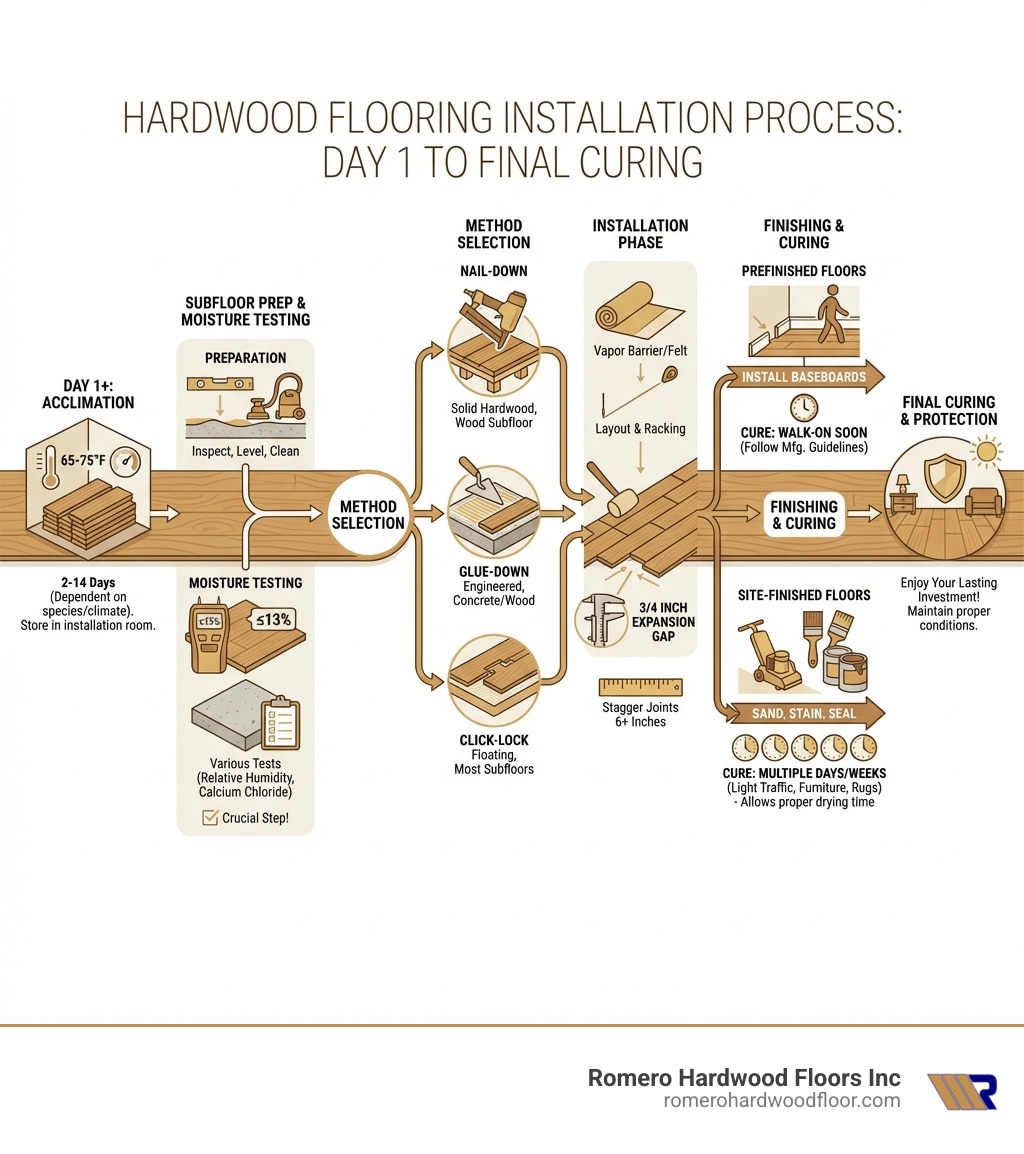
Key Steps in the Hardwood Flooring Installation Process:
- Acclimation – Store flooring in the installation room for 2-14 days at 65-75°F
- Subfloor Preparation – Inspect, level, clean, and test moisture (under 13% for wood subfloors)
- Choose Installation Method – Nail-down (solid hardwood over wood subfloors), glue-down (engineered over concrete), or click-lock (floating floors)
- Install Underlayment – Apply vapor barrier or roofing felt as needed
- Lay Flooring – Rack boards, maintain 3/4-inch expansion gaps, stagger joints by 6+ inches
- Finish – Sand, stain, and seal (for unfinished floors) or install baseboards (for prefinished)
- Cure and Protect – Allow proper drying time before use
The process isn’t just about nailing boards to a floor. It’s about moisture management, proper acclimation, and precise execution at every stage. Skip the acclimation period? Your beautiful new floors might gap or buckle within months. Rush the subfloor prep? You’ll hear squeaks every time someone walks across the room.
Professional installation prevents these costly mistakes. According to the National Association of Realtors, new hardwood flooring delivers a 118% return on investment—but only when installed correctly. Poor installation can actually decrease your home’s value and appeal.
The right flooring also depends on your specific situation. Solid hardwood works beautifully above grade but fails in basements. Engineered hardwood handles humidity better but has limited refinishing potential. Click-lock systems install faster but aren’t suitable for all subfloor types.
I’m Francisco Romero, owner of Romero Hardwood Floors Inc., and over the past 15+ years, I’ve seen every possible scenario in the hardwood flooring installation process—from historic Revere homes with uneven subfloors to modern commercial spaces requiring precision timing. This guide shares the professional insights that ensure your investment delivers lasting beauty and value.
Hardwood flooring installation process definitions:
- Hardwood floor underlayment types
- Hardwood floor installation mistakes
- Hardwood floor installation timeline
Essential Preparation and the Hardwood Flooring Installation Process
Before we even think about opening a box of wood, we have to talk about the foundation. At Romero Hardwood Floors Inc., we always say that a floor is only as good as what’s underneath it. Skipping the prep work is like building a luxury home on quicksand.
The first step in any successful hardwood floor installation is a rigorous inspection of the job site. We check the exterior drainage of the building—building codes generally require a 6-inch fall within the first 10 feet of the foundation to keep moisture away. Inside, we ensure all “wet trades” (like drywalling and painting) are finished and completely dry.
Why does this matter? Because wood is a sponge. If the air is full of moisture from fresh paint, your new floor will soak it up, expand, and then shrink later, leaving you with unsightly gaps. According to National Association of Realtors ROI data, hardwood floors are one of the best investments you can make, but that value is tied to the quality of the install.
Subfloor Readiness and Moisture Testing
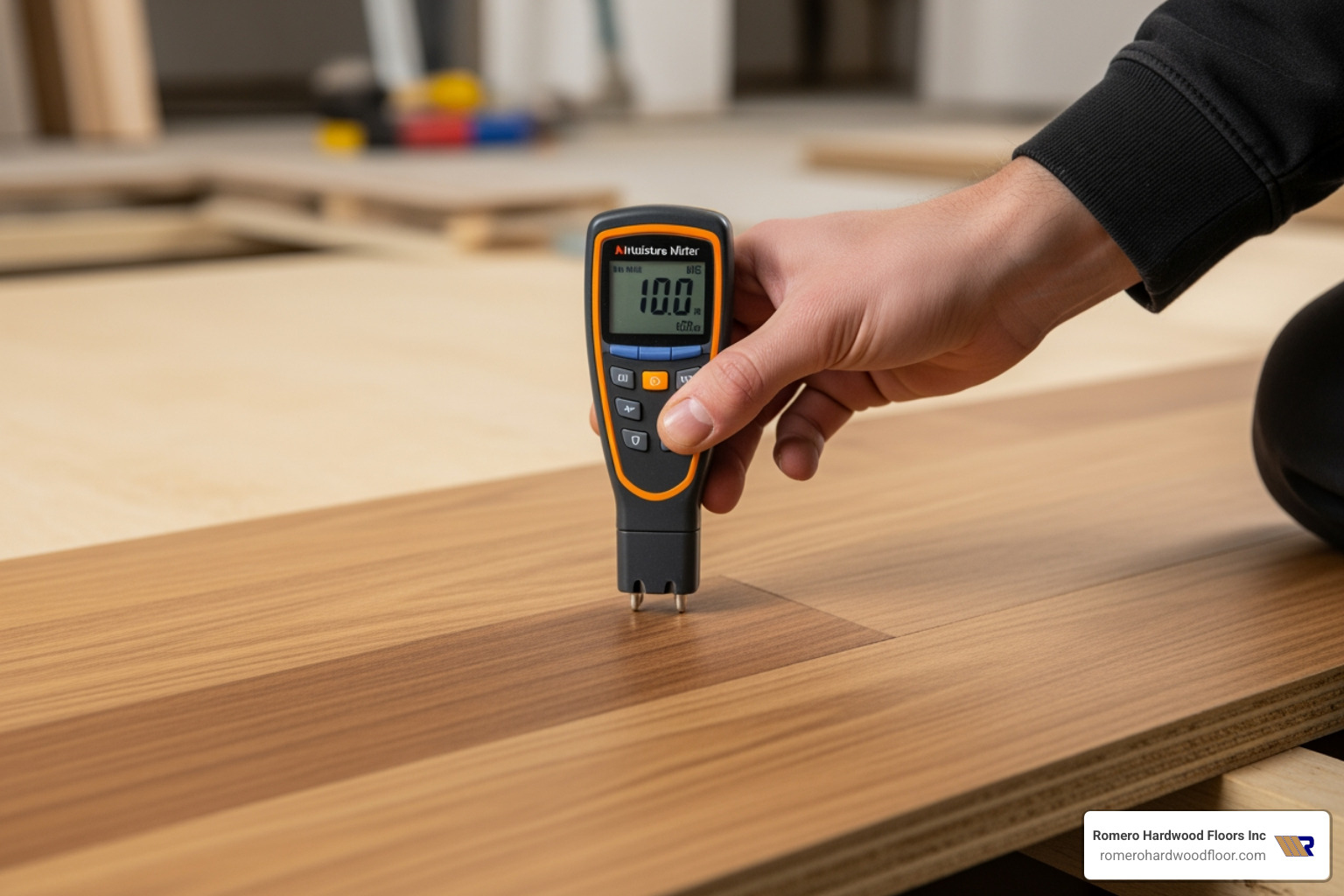
Whether you are in a seaside home in Gloucester or a condo in Somerville, moisture is the enemy. We use professional-grade moisture meters to test both the subfloor and the hardwood itself.
For wood subfloors, the moisture content must be under 13%, and the difference between the subfloor and the hardwood planks should typically be no more than 2% to 4%. If we’re dealing with concrete slabs—common in many Massachusetts commercial properties—we wait at least 60 days for newly poured concrete to cure before testing.
| Requirement | Wood Subfloor | Concrete Subfloor |
|---|---|---|
| Moisture Limit | < 13% Content | < 3 lbs/1000 sq ft (Calcium Chloride) |
| Flatness | 1/8″ in 10′ or 3/16″ in 6′ | 1/8″ in 10′ (for floating floors) |
| Thickness | Min 3/4″ CDX Plywood preferred | Must be fully cured (60+ days) |
| Cleanliness | Sanded flat, free of debris | Scraped, free of wax/sealers |
Acclimation: The Key to Long-Term Stability
Acclimation is the “patience phase” of the hardwood flooring installation process. We don’t just move the wood from our truck to your floor. The wood needs to live in your home’s environment to reach an equilibrium with the local humidity and temperature.
- Timeline: Solid wood usually needs 2–14 days, while engineered wood might only need 48–72 hours.
- Conditions: The room temperature should be maintained between 65–75°F with humidity levels between 30% and 55%.
- Location: Store the wood in the actual room where it will be installed. Never store it in a garage or a damp basement!
If you skip this, the wood might expand or contract significantly after it’s nailed down, leading to “cupping” (where edges are higher than the center) or “crowning” (where the center bulges).
Choosing Your Method: Nail-Down, Glue-Down, and Click-Lock
Choosing how to attach the floor is just as important as choosing the wood itself. Your subfloor type usually dictates the method. For instance, you can’t nail into concrete, and we generally don’t recommend a floating floor for high-end solid oak.
Solid vs. Engineered Hardwood Considerations
In the Greater Boston area, we see a mix of both. Solid hardwood is wood all the way through. It’s the gold standard for longevity because it can be sanded and refinished many times over 50+ years. However, it’s susceptible to moisture, so we only install it on or above grade.
Engineered hardwood, on the other hand, features a real wood wear layer over a stable composite core. This makes it much more resistant to warping in humid environments or below-grade spaces like finished basements. If you are looking for hardwood flooring contractors to handle a basement project, engineered is likely the way to go.
Specifics of the Hardwood Flooring Installation Process for Different Methods
- Nail-Down: This is the traditional method for solid wood. We use a flooring nailer to “blind nail” through the tongue of the board at a 45-degree angle. This hides the fastener and allows the next board’s groove to slide right over it.
- Glue-Down: Common for engineered wood over concrete. We use high-quality adhesives and specific trowels to ensure 100% coverage. Following the manufacturer’s specific installation instructions or similar guidelines is crucial here to avoid voiding warranties.
- Click-Lock (Floating): The planks “click” together without being attached to the subfloor. It’s fast and allows for an underlayment that provides excellent sound dampening—perfect for multi-unit buildings in Chelsea or East Boston.
Step-by-Step Guide to Laying and Finishing Your Floor
Once the subfloor is prepped and the wood is acclimated, the real magic begins. We start by laying down an underlayment. For nail-down installs, we often use 15lb roofing felt or red rosin paper as a moisture retarder and to prevent squeaks.
Layout, Racking, and Maintaining Expansion Gaps
We don’t just pull boards out of one box and start nailing. We “rack” the floor by opening multiple boxes and spreading the boards out. This ensures we mix the natural variations in color and grain so you don’t end up with a dark “patch” in one corner of the room.
- Joint Staggering: We ensure end joints are staggered by at least 6 inches between adjacent rows to maintain structural integrity and aesthetic flow.
- Expansion Gaps: We leave a 3/4-inch gap (or at least the thickness of the wood) around the entire perimeter. Wood moves! If it hits the wall, it will buckle. Don’t worry, the baseboards and shoe molding will cover this gap later.
- Joist Direction: For maximum strength, we install the planks perpendicular to the floor joists.
Finishing Touches: Sanding, Staining, and Transitions
If you chose unfinished wood, the next phase is floor staining and finishing. This is where the floor’s personality truly comes out.
We start with heavy-duty drum sanders, moving through a progression of sandpaper grits (from coarse to fine) to create a perfectly smooth surface. Then comes the buffer to blend any remaining marks. After the dust is carefully cleared, we apply the stain. Whether you want a modern “Weathered Oak” or a classic “Gunstock,” we ensure the application is even.
Finally, we apply multiple coats of polyurethane. Water-borne finishes are popular because they dry fast (you can walk in socks after 6 hours), while oil-modified poly offers a classic amber glow but takes longer to cure. For more details on this delicate stage, check out our page on floor sanding and refinishing.
Safety, Maintenance, and Professional Considerations
Safety is a huge part of the hardwood flooring installation process. Wood dust is flammable and can be harmful if inhaled. We use advanced dust collection systems and always wear appropriate PPE (Personal Protective Equipment), including N95 masks, ear protection for the saws, and knee pads.
Regarding costs, it’s important to understand the market. Based on internet data, the average cost for hardwood installation can range from $6 to $15 per square foot for labor and materials, though high-end custom work or exotic species can easily exceed $30 to $45 per square foot. Please note these are industry averages and not the specific rates for Romero Hardwood Floors; we provide custom estimates based on your unique project needs.
Avoiding Common Mistakes in the Hardwood Flooring Installation Process
We’ve been called in to fix many DIY projects that went south. Here are the most common blunders:
- The “H-Joint”: This happens when joints in every other row line up perfectly. It looks unnatural and is structurally weaker.
- Tight Joints: Not leaving an expansion gap is the #1 cause of “cupping” in the summer.
- Poor Leveling: If the subfloor has a dip, your “floating” floor will feel like a trampoline.
- Improper Stapling: Using the wrong PSI on the compressor can cause the staples to break the wood’s “tongue,” leading to squeaks later.
Post-Installation Care and Underfloor Heating
Once your floors are in, you want them to stay beautiful.
- Furniture: Use felt pads on everything! Replace plastic wheels on office chairs with rubber ones.
- Cleaning: Use a microfiber mop and a dedicated hardwood cleaner. Never use a steam mop—the heat and moisture can destroy the wood’s finish and cause the planks to swell.
- Radiant Heat: If you have underfloor heating, the surface temperature should never exceed 85°F. We recommend gradually increasing the heat over a week to avoid “shocking” the wood.
Frequently Asked Questions about Hardwood Installation
How long does the installation process take?
Most residential projects in the Revere area take about 1–3 days for the actual installation. If you choose site-finished wood, add another 3–5 days for sanding, staining, and drying.
Can I install solid hardwood over concrete?
Generally, no. Solid wood is too unstable for direct attachment to concrete. However, we can often install a plywood subfloor over the concrete first, or we may recommend a high-quality engineered hardwood that looks identical once installed.
When should I hire a professional vs. DIY?
If you’re handy and the room is a simple rectangle, you might tackle a click-lock floor. However, if you have out-of-square walls, complex transitions, or are installing solid hardwood that requires sanding and finishing, hiring a professional is a smart move. One mistake in the hardwood flooring installation process can cost more to fix than the original professional labor would have cost!
Conclusion
At Romero Hardwood Floors Inc., we take pride in serving our neighbors from Beverly to Winchester and everywhere in between. Since 2006, our mission has been to provide Revere and the Greater Boston area with guaranteed workmanship and competitive pricing.
The hardwood flooring installation process is a journey from raw material to a stunning home feature that boosts your property value. Whether you are looking for a classic nail-down oak or a modern engineered maple, we have the expertise to make sure the job is done right the first time.
Ready to transform your home? Request an estimate today and let’s start the process of bringing lasting beauty to your floors.
