Why Understanding Light Sanding Matters for Your Hardwood Floors
Light sanding hardwood floors is a preventative maintenance process that refreshes your floor’s protective finish without removing the wood itself. Here’s what you need to know:
Key Differences:
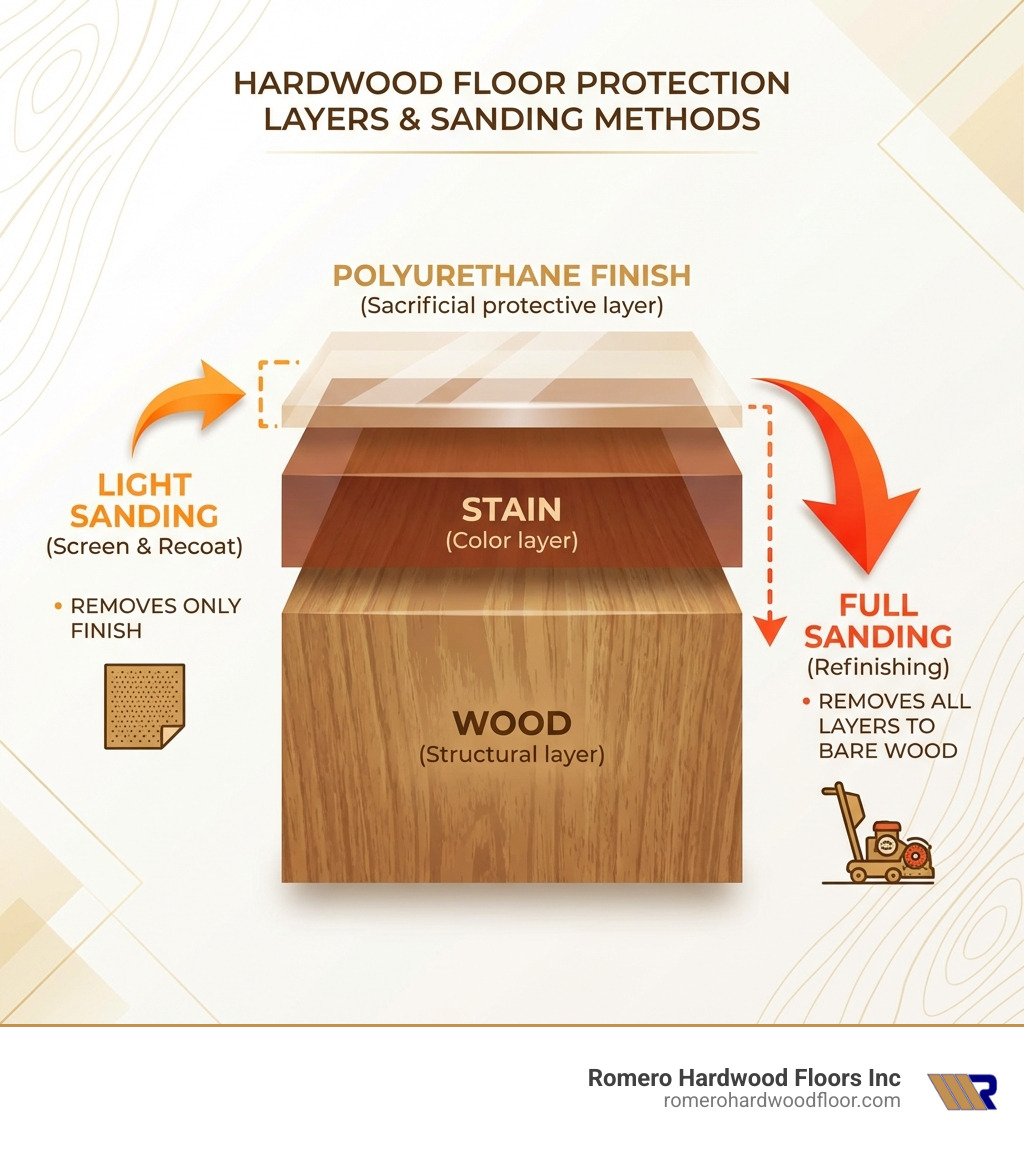
- Light Sanding (Screen & Recoat): Removes only the top polyurethane layer using fine grit (120-150) sandpaper, then applies a fresh coat of finish
- Full Refinishing: Strips all finish and stain down to bare wood using coarse sandpaper, then re-stains and refinishes completely
- Time: Light sanding takes about 1 day; full refinishing takes 3-7 days
- Cost: Light sanding is roughly 20% the cost of full refinishing
When to Choose Light Sanding:
- Surface scratches that haven’t penetrated the wood
- Dull or worn finish with no deep gouges
- Traffic areas showing wear but no stain damage
- Preventative maintenance every 3-4 years
If you’ve been searching for ways to restore your floor’s shine without the expense and disruption of a complete refinish, light sanding might be exactly what you need. Think of polyurethane as a sacrificial layer – it’s designed to take the beating so your wood doesn’t have to. When that protective coat starts looking dull or scratched, you can simply refresh it rather than sanding down to bare wood.
Many homeowners confuse light sanding with full refinishing, or they wait too long to maintain their floors and end up needing the more expensive option. The difference comes down to how deep the damage goes and how much of your floor’s protective finish remains intact.
I’m Francisco Romero, owner of Romero Hardwood Floors Inc., and I’ve been performing light sanding hardwood floors and full refinishing projects throughout the Revere, MA area since 2006. Over those 15+ years, I’ve helped hundreds of property owners understand when a simple screen and recoat will do the job versus when a complete refinish is necessary.
Essential light sanding hardwood floors terms:
Understanding light sanding hardwood floors vs. Full Refinishing
To truly grasp the magic of light sanding hardwood floors, we need to talk about the anatomy of your floor. Think of your hardwood floor like your skin. If you get a light scratch, you just need a little ointment and a bandage. If you have a deep wound, you might need surgery.
In the flooring world, the “ointment” is a screen and recoat (often used interchangeably with light sanding). This process focuses entirely on the sacrificial layer of your floor: the polyurethane. Polyurethane is a synthetic coating that forms a protective film resistant to moisture, chemicals, and the daily “tap-dance” performed by your pets and children. Over time, this layer gets thinner and more scratched.
When we perform Hardwood Floor Sanding, we are essentially scuffing up that top layer so a new coat of finish can stick to it. We aren’t touching the wood grain itself. Conversely, full sanding is an intensive process where we use heavy machinery like a drum sander to strip everything away—finish, stain, and a thin layer of the wood—to reveal a fresh surface.
As highlighted in Buffing vs. Sanding Hardwood Floors, buffing (another term for the mechanical part of light sanding) mainly addresses damage within the sealant layers. If you wait too long and the finish wears through to the bare wood, the wood will begin to gray and absorb moisture. At that point, a simple light sand won’t save you; you’ll be looking at a full restoration.
When to Choose a Screen and Recoat
Knowing when to opt for light sanding hardwood floors can save you thousands of dollars. We often tell our clients in Peabody and Salem that the best time to recoat is before you think you need to. It’s like applying sunscreen—you do it to prevent the burn, not to treat it.
You should choose a screen and recoat if:
- The finish is dull: Your floors have lost their “sparkle” and look lackluster even after a deep clean.
- Surface scratches are present: You see fine white lines (scratches in the poly) but no deep gouges that reach the brown wood underneath.
- High-traffic areas are thinning: The areas in front of the kitchen sink or the main hallway are starting to look “dry.”
If you have deep gouges, pet urine stains, or “graying” boards where the wood is exposed, you likely need a Hardwood Floor Repair or a full refinish.
Comparison Table: Light Sanding vs. Full Refinishing
| Feature | Light Sanding (Screen & Recoat) | Full Refinishing |
|---|---|---|
| Primary Goal | Refresh protection & shine | Remove damage & change color |
| Layers Removed | Top layer of polyurethane only | All finish, stain, and top wood layer |
| Grit Used | 120 – 150 grit (Fine) | 36 – 100 grit (Coarse to Fine) |
| Dust Level | Minimal (Buffing dust) | Massive (Requires containment) |
| Downtime | 24 hours | 3 – 7 days |
| Wood Loss | None | 1/32″ to 1/16″ of wood |
The DIY Process for Surface Restoration
If you’re a “hardcore DIYer” like the folks from the One Room Challenge, you might be tempted to tackle light sanding hardwood floors yourself. While it is much less intensive than a full sand, it still requires precision.
For a successful surface restoration, your tool list is your roadmap. You aren’t looking for a drum sander here; that’s overkill and dangerous for a maintenance job. Instead, you’ll want a floor buffer or a high-quality random orbital sander. Some pros even use a Festool Rotex RO 150 for smaller rooms, though it can be a significant investment ($550-$600).
Essential Tools for Light Sanding:
- Floor Buffer/Polisher: Available for rent at most home improvement stores in Medford or Saugus.
- Sanding Screens: 120-grit and 150-grit are the industry standards.
- Maroon Buffing Pad: Used for “denibbing” or a final smooth scuff.
- Vacuum with HEPA Filter: To catch the fine dust.
- Microfiber Tacking Mops: For the “white glove” clean.
- Applicator: A Pad applicator is best for a smooth, bubble-free finish.
How to Prepare for light sanding hardwood floors
Preparation is where most DIY projects fail. Because you are applying a new coat of Polyurethane over an old one, adhesion is everything.
First, empty the room completely. Even though we aren’t doing a “dust onslaught” like a full sand, there will still be fine particles. Use painters plastic to seal off doorways.
The most critical prep step is cleaning. You must remove every trace of wax, oil soap, or furniture polish. If you’ve ever used products like Murphy’s Oil Soap or Orange Glo, a new coat of finish will likely “bead up” like water on a waxed car. This is called “fisheyeing,” and it’s a nightmare. We recommend a deep clean with a mixture of water and a professional wood floor cleaner or a TSP (trisodium phosphate) substitute to strip away contaminants.
Step-by-Step: The Process of light sanding hardwood floors
- The “Screening”: Attach a 120-grit screen to your buffer. Move methodically across the floor. Your goal isn’t to remove the finish, but to turn the floor “dull” and “white.” This creates a mechanical bond for the new finish.
- Edge Work: Use a hand sander or a drywall pole sander with a 150-grit screen to get into corners where the buffer can’t reach.
- The First Clean: Vacuum the floor thoroughly. Don’t just do the floor; vacuum the baseboards and window sills where dust might have settled.
- Tacking: Use a damp (not soaking!) microfiber cloth or a tack cloth to pick up the microscopic dust. If you leave dust, your floor will feel like sandpaper when it dries.
- Applying the Finish: Using your pad applicator, “cut in” the edges first. Then, pour a small amount of polyurethane and spread it with the grain. Work in small sections, always “pulling” the finish toward you to avoid leaving footprints. For more detail, check out our Hardwood Floor Buffing Ultimate Guide.
- Dry Time: Most water-based finishes are dry to the touch in 2 hours, but wait at least 24 hours before walking on them with socks, and a week before moving furniture back.
Avoiding Common Pitfalls and Safety Hazards
In our years serving Marblehead and Swampscott, we’ve seen plenty of “shortcuts” go wrong. The biggest hazard isn’t the sander—it’s contamination.
If your floor has been waxed, the new finish will not stick. You can test this by putting a few drops of water on the floor; if it beads up, there’s a coating there. If it stays beaded after a minute, it’s wax. If it turns white, it’s a shellac or older finish. You must clean these floors with a specialized wax remover before you even think about light sanding hardwood floors.
Safety First:
- Respiratory Protection: Even “light” dust is bad for your lungs. Always wear a respirator mask.
- Fire Safety: Oil-based finish soaked rags can spontaneously combust. Always dry them flat outdoors or submerge them in water in a metal container.
- Ventilation: Ensure you have a cross-breeze, but don’t have fans blowing directly onto the wet finish, as this will trap dust in your beautiful new coat.
Refer to our Hardwood Floor Care Guide for long-term maintenance tips to avoid these issues in the future.
Cost Analysis and Long-Term Benefits
Let’s talk numbers. Based on average internet data, a full sand and refinish can cost anywhere from $3 to $8 per square foot for professional labor. However, in high-end markets or for complex jobs, we’ve seen quotes reach as high as $24 per square foot when including repairs and custom stains.
Note: These are average costs based on internet data and not actual costs for Romero Hardwood Floors.
In contrast, a screen and recoat is significantly more affordable. It usually costs about 20% to 30% of a full refinish. Because it takes about a day of work rather than a week, the labor savings are massive.
The long-term benefit is even greater. Every time you do a full sand, you lose about 1/32″ of your wood. Most solid hardwood can only take 4 to 6 full sandings before you hit the tongue and groove. By performing light sanding hardwood floors every 3 to 5 years, you can extend the life of your floors by decades, potentially never needing a full sand again. For a deeper dive into pricing, see How Much to Refinish Wood Floors.
Frequently Asked Questions about Floor Maintenance
Can light sanding fix deep gouges or water stains?
Unfortunately, no. Light sanding only affects the surface finish. If a scratch has gone through the finish and into the wood, or if water has caused a dark stain in the fibers, you need to go deeper. For these issues, you’ll need Hardwood Floor Repair and Refinishing, which involves sanding the wood down past the damage or replacing the affected boards.
How often should I perform a screen and recoat?
A good rule of thumb for homes in busy areas like Somerville or Everett is every 3 to 4 years. However, if you have large dogs or a “no-shoes-off” policy, you might want to look at your kitchen and hallways every 2 years. If the floor still has a good sheen and water beads up on it, you can probably wait.
Can I light sand prefinished or engineered hardwood?
Yes, but with caution. Prefinished floors often have a very hard “aluminum oxide” finish that is difficult to scuff. You may need a specialized bonding agent or a more aggressive screening process. For engineered floors, you must be careful not to sand through the thin “wear layer” of real wood. Check out our guide on Can You Refinish Prefinished Hardwood Floors for more specifics.
Conclusion
At Romero Hardwood Floors Inc., we believe that your floors are the foundation of your home’s beauty. Whether you are in Beverly, Medford, or right here in Revere, regular maintenance is the key to protecting that investment. Light sanding hardwood floors isn’t just a “quick fix”—it’s a smart, professional strategy to keep your home looking its best while avoiding the high costs of total restoration.
By choosing a screen and recoat, you are choosing to be proactive. You are saving time, saving money, and most importantly, saving the wood that gives your home its character.
If your floors have lost their luster and you’re ready for a professional touch, we’re here to help. We offer guaranteed workmanship and competitive pricing across the entire North Shore and Greater Boston area. Don’t wait until the wood is damaged—protect your floors today.
Ready to bring back the shine? Find Hardwood Floor Refinishing Near Me and let our team at Romero Hardwood Floors Inc. give your home the finish it deserves.